A summary of "Alien Memory" by Kir Bulychev
 Automatic translate
This science fiction novella was created in 1981. It explores the process of human cloning as a complete transfer of the donor’s memory, life experience, and deep psychological trauma to a new, artificially grown being.
Preparing for the Great Experiment
Sergei Andreevich Rzhevsky, director of the Biological Institute, is on the brink of a monumental scientific discovery. The scientist has been involved in genetic engineering and cloning for many years. Animal experiments are successfully conducted in the institute’s laboratories. Researchers have proven that a new individual inherits, along with physiological traits, the entire memory of the genetic donor. A striking example of this success is the case of a small chimpanzee named Lev. The infant escapes from its cage, deftly opens a complex lock, and unerringly finds its way to the director’s office. The animal fully utilizes the experience of its biological father, a large male named John.
Rzhevsky assembles a scientific committee. He requests government funding to conduct a similar experiment on humans. The director argues that conventionally growing an adult clone leads to "Mowgli syndrome." The empty brain of an adult cannot be trained from scratch, and memory transfer solves this problem. The elderly academician Chelovekov ardently supports the project. Having received approval from his superiors, Rzhevsky decides to use his own cell as a donor. The experimenter is confident that he will be able to observe the development of an exact copy of himself as objectively as possible.
The birth of a clone and the first difficulties
A secret project begins in an isolated internal laboratory. Technicians and doctors monitor the embryo’s development in a special biosolution. On November 21st, a fully formed young man is removed from the incubator. The twenty-year-old is named Ivan. Physically, he is a dead ringer for Rzhevsky as a student. Lab technician Nina Gulinskaya is recruited to care for the new patient. Gulinskaya is the daughter of the director’s old acquaintances, Elsa and Viktor. Nina eagerly takes the job, but her mother is categorically opposed. Gulinskaya fears for her daughter’s life and openly hates the director.
Ivan’s adaptation is painful. The young man’s brain can’t cope with the colossal amount of information. His twenty-year-old body is forced to process the mature experience of a fifty-year-old professor. Ivan is plunged into torturous nightmares. He clearly remembers the evacuation from Kursk in 1941, the fear of the droning locomotive, and the weight of his father’s grief. Ivan painfully realizes his artificial nature. The young man resents his creator for the childhood he stole. The clone feels like a puppet without a personal past.
The conflict between father and son is escalating. Rzhevsky plans to make Ivan his successor in science, while Ivan resists authoritarian control.
Ivan’s independent actions
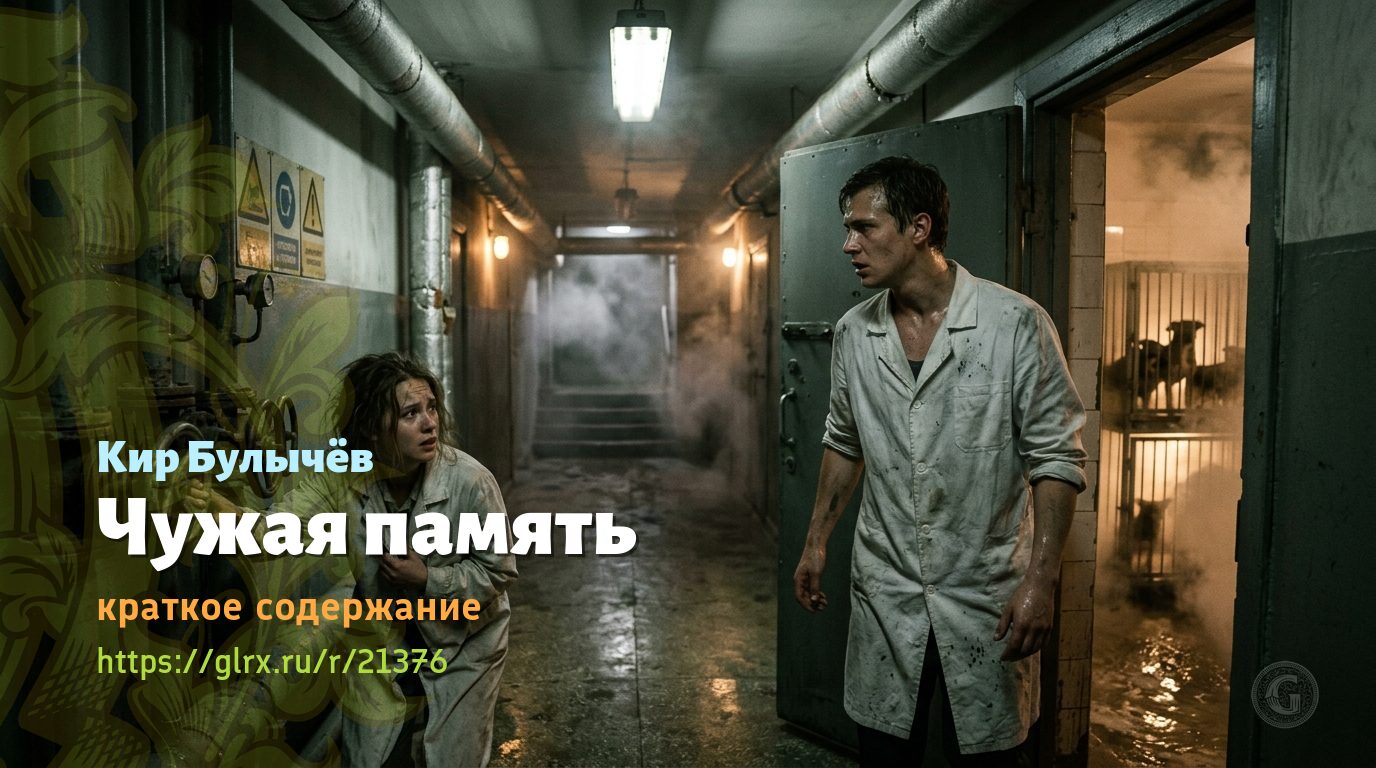
The young man strives with all his might to separate himself from Rzhevsky’s personality. Chance provides him with such an opportunity. One night, a hot water pipe bursts in the institute’s basement. The basement containing the experimental dogs fills with boiling water and steam. Ivan awakens, sensing the animals’ anxiety. Using the director’s memory of the room’s layout, the young man descends into the vivarium. He severely burns his legs and arms, but he persists in opening the red-hot cages and saves the dogs from a painful death.
This selfless act becomes Ivan’s first personal decision. The burns leave deep scars on his skin. These marks now physically distinguish the clone from his father. Gradually, Ivan begins to venture beyond the laboratory. He runs into Elsa in the institute cafeteria. She refuses to believe his origins are real and believes Ivan is an actor in disguise. To prove the authenticity of his memory, Ivan recalls small details of their shared riverboat ride. Frightened by the accuracy of his memories, Elsa flees.
While strolling around the city, Ivan visits the Historical Museum. There he meets Pavel Dubov, an old friend of Rzhevsky’s. In his youth, Rzhevsky was interested in archeology and went on expeditions to Novgorod. Dubov recognizes Ivan as a friend, but mistakes him for the director’s ordinary son. The meeting awakens Ivan’s deep interest in antiquities.
The heavy legacy of memory
Rzhevsky’s deep-seated guilt becomes the young man’s main problem. Thirty years ago, young Sergei was in a relationship with Lisa, a woman with a young daughter, Katya. One day, Sergei broke it off, citing the relationship as ruining his career. Lisa took her daughter, moved to Vologda, and died shortly afterward. Rzhevsky blamed himself for her death his entire life. Ivan inherited this psychological trauma along with the donor’s cells. The pain of someone else’s conscience prevents the young man from living a normal life.
Ivan decides to conduct his own investigation. He and Nina visit her parents. During a drinking party, a drunken Viktor becomes aggressive. An envious old man claims that Rzhevsky cold-bloodedly sacrificed love for ambition. Ivan doesn’t believe Viktor and searches for Lisa’s ex-brother. The man advises him to contact the deceased woman’s daughter directly. Ivan secretly flies to Vologda and finds Katya.
Katya warmly welcomes her guest. The woman says, "I recognized you right away." She explains that Lisa was never angry with Sergei. The real reason for their breakup was outside interference. Katya shows Ivan some old papers. Among the letters is a message from Viktor. The sordid truth about the old friends’ intrigues is revealed. Viktor secretly desired Lisa. A man came to her in Sergei’s name and claimed that Rzhevsky had begun a new affair with Elsa. Viktor convinced her to leave. It was this lie that destroyed their relationship.
The final division
Upon learning the truth, Ivan experiences a severe nervous breakdown. The conflict between two personalities within a single brain leads to a physiological crisis. Ivan loses consciousness in Katya’s apartment. Katya calls an ambulance and then calls Moscow. Rzhevsky and his attending physician, Volodin, rush to Vologda. In the hospital ward, Rzhevsky meets Katya and receives old letters. The director of the institute reads Viktor’s confession. Rzhevsky realizes the absurdity of his long-standing feelings of guilt.
Ivan’s body successfully copes with the crisis. The young man overcomes biological incompatibility with the implanted consciousness. Ivan recovers and returns to Moscow. Viktor sneaks into Ivan’s room. The pathetic schemer begs him not to tell Nina anything. Ivan contemptuously dismisses Viktor and keeps the secret. Rzhevsky invites his son to collaborate on biological problems. Ivan firmly refuses.
The young man finally separates from his father. In the hospital ward, Professor Volodin declares, "Fresh air and the dust of excavations are the best medicine." The young man decides to go on an archaeological expedition with Pavel Dubov. Ivan chooses the path in life that Rzhevsky had once rejected. The experiment culminates in the birth of a new, sovereign individual, empowered to make his own choices.
- Kir Bulychev’s "The Predictor of the Past," a summary
- "The Abduction of the Sorcerer" by Kir Bulychev, summary
- A summary of "Prisoners of the Asteroid" by Kir Bulychev
- Kir Bulychev’s "Pass," a summary
- "The Extra Twin" by Kir Bulychev, summary
- Writer Vladimir Sharov became the winner of the Russian Booker
You cannot comment Why?