"The Abduction of the Sorcerer" by Kir Bulychev, summary
 Automatic translate
This science fiction novella was written in 1979. It is a harmonious blend of science fiction about time travel and a meticulous historical reconstruction of medieval Russian life, where messengers from the future attempt to rescue unknown geniuses of the past from the clutches of certain death. The work has been successfully adapted for the screen twice. Audiences saw a television play directed by Gleb Selyanin in 1981, followed by a full-length feature film of the same name by Viktor Kobzev, released in 1989.
Arrival in Zamoshye and mysterious guests
Anna arrives in a small Belarusian village where she visited her aunt twenty years ago. She finds the house she’s looking for empty. She struggles to open the heavy lock, airs out the musty entryway, and diligently scrubs the floors. The simple physical labor brings a pleasant satisfaction. A long-forgotten sense of inner peace and harmony returns. That afternoon, she has a long conversation with her grandfather, Gennady.
An old man grazes his horse, Cleopatra, near a dilapidated seventeenth-century church. He has become passionate about local history after a recent visit from the Leningrad restorer Vasiliev. The old man shows Anna his homemade museum. Among the exhibits are ancient pottery shards, a horseshoe, and a massive copper handle shaped like a lion’s head. Gennady is certain that historical treasures are hidden on the hill.
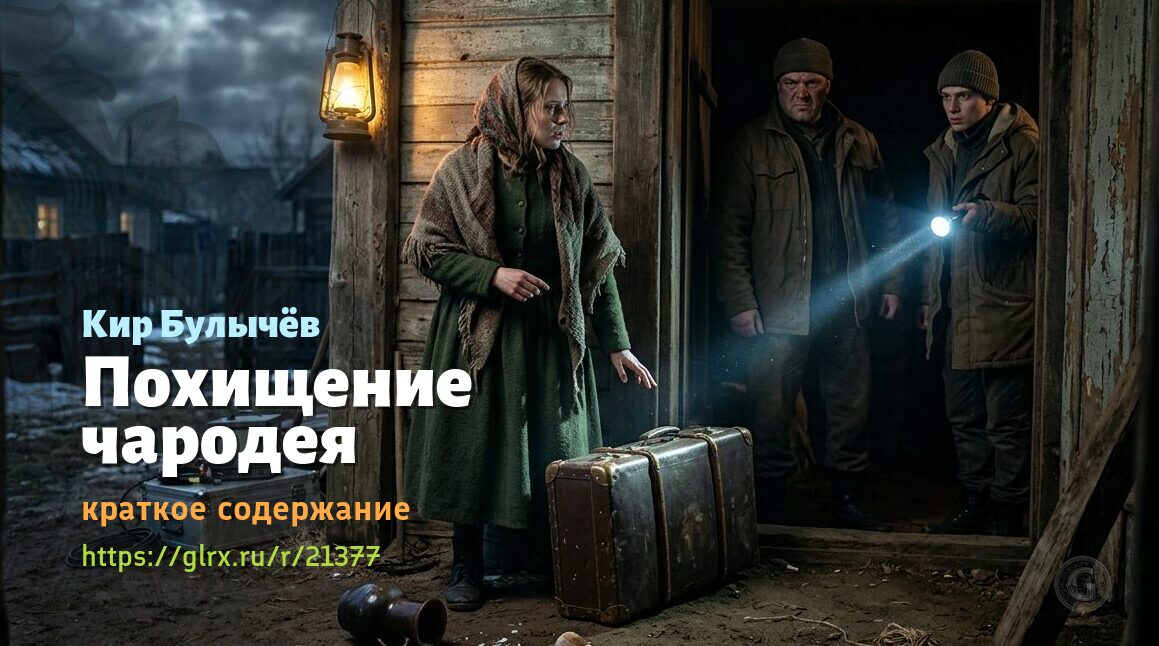
That evening, the village idyll is shattered. In the dark entryway, Anna painfully hits her foot on a massive suitcase and drops a jug of milk. Flashlights flicker on, illuminating two strangers. The men, introducing themselves as Keane and Jules, claim to be legally renting the apartment from her aunt. The manners of young Jules and the commanding tone of Keane, with his massive, high cheekbones, send Anna into a fit of rage.
Hostility gives way to shock when the guests reveal the true purpose of their visit. The aliens have arrived from the twenty-seventh century. They need the house as a relay base for onward travel to 1215. A direct jump is only possible between parallel turns of the time spiral, separated by many hundreds of years. A stop in the twentieth century is an unavoidable technical necessity.
Observing the era of the Crusades
Keane explains the mission’s humanistic philosophy. The human brain has developed uniformly over many thousands of years. At different times, individuals are born who are capable of surpassing their time. The historian reads accounts of child geniuses who perished in complete obscurity. A Burmese philosopher, a young violinist from Kyiv, and a young mathematician from Khiva all fell victim to human cruelty and ignorance.
The expedition picks up a unique individual at the precise moment of his death, completely without disrupting the general course of history. The sought-after genius lives in the thirteenth century. On a hill near the village, the fortress of Zamosh’e once stood. The wooden town will soon fall to the onslaught of German knights. Along with the defenders, the unknown inventor of gunpowder and creator of the printing press are destined to perish.
When Grandfather Gennady comes to visit Anna, Jules skillfully uses a laptop. He creates a three-dimensional hologram of an old SUV on the street. The old man believes the optical illusion and leaves. Meanwhile, Jules assembles a chrono-link installation. A black sphere hovers above the metal box, broadcasting events from the distant, harsh Middle Ages.
Inside the holographic sphere, the researchers explore the year 1215. A wooden town is surrounded by a heavily armed detachment of sword-bearing knights. The enemy has pitched white tents across a small river, is constructing a wooden siege tower, and is bringing up a powerful catapult. Anna witnesses a fierce skirmish at the fortress gates. Shepherds are trying to herd their cows under the protection of the wooden walls, but the German soldiers overtake one of them.
Paradoxes and mysteries of medieval alchemy
The Russian Prince Vyachko makes a desperate sortie. The stern boyar Roman stands beside the fearless, red-haired prince. Kin believes him to be the scholar he seeks. Nearby, Anna notices the Polish Princess Magdalena, who has been captured. The girl bears a striking resemblance to Anna herself. Also bustling around is the deformed, lame dwarf Akiplesha, who serves as the prince’s obedient jester.
That night, brave defenders burn down the knights’ tall siege tower. Landmeister Friedrich von Kokenhausen discusses this daring act with Bishop Albert of Riga. They are well aware of the fugitive alchemist Roman, who is hiding behind the city walls. The bishop covets the secret of creating pure gold. Equipment from the future reads words from lip movements.
In Roman’s dark underground hideout, chemical work is incessantly underway. Glass flasks and large copper vessels are arranged along the smoky walls. The boyar is assisted by his devoted acolyte Gluzd, the vengeful Lithuanian warrior Mazei, and the ubiquitous jester. Roman, in reality, turns out to be a cynical man who dreams of absolute power over European monarchs.
The alchemist is indifferent to the tragic fate of ordinary townspeople. He is ready to cold-bloodedly betray the defenders of Zamosh to save his manuscripts and laboratory equipment. The boyar arranges a secret nighttime meeting with the enemy knight. Meanwhile, Kin’s expedition is in serious danger of being ruined. The historian travels back in time disguised as an ordinary Lithuanian mercenary.
A desperate leap through the millennium
Kin infiltrates the sorcerer’s courtyard on the eve of the imminent assault on the fortress. The clever jester immediately recognizes the newcomer as a suspicious stranger by his overly bold behavior. The dwarf deftly drapes a strong lasso over Kin’s shoulders, stuns him, and throws him into a damp basement. The captive is securely bound with thick hemp ropes. The situation spirals out of control for the alarmed chronophysicist.
The bound historian is unable to act. Anna clearly understands that she must save the helpless scholar. She persuades Jules to exploit her resemblance to the young Polish princess. The prudent dwarf has already given the real Magdalena a powerful sleeping potion. Anna dons a heavy antique dress, takes a small bowl, and prepares for the perilous journey.
Jules attaches a homing sensor to her right ear and activates the transfer field. The girl falls into cold, millennia-old darkness. Materializing in an empty tower, Anna hurries through the grimy streets of the doomed city. Ancient Zamosh’e is gripped by an animalistic fear, the terrified townspeople brace themselves for a painful death. In a dark alley, the girl runs into Roman.
The true face of a medieval genius
The alchemist is deceived by her appearance and asks to take refuge from danger in the chemistry lab. Anna descends the wooden stairs to the basement. In a commanding, princely tone, the girl orders the prisoner’s release, calling Kin her personal, loyal servant. The boy obediently removes the tight bonds from his wrists. Kin goes upstairs to accompany the treacherous boyar.
Anna remains in a dark dungeon with a deformed jester. A piercing, frank conversation erupts between them. Akiplesha demonstrates an unattainable depth of powerful analytical thinking. He quotes ancient philosophers, speaks foreign languages fluently, and understands the essence of complex chemical reactions. The dwarf sympathizes with the simple peasants.
A stunning realization hits Anna. The true creator and unrecognized genius is not the greedy, cruel Roman, but his physically disabled slave. Akiplesha is forced to hide his analytical mind behind the guise of a pathetic, rootless buffoon. The dwarf declares that he will not allow his cynical master to hand over his deadly knowledge to the German Order.
At the breaking of a cool dawn, the swordsmen break down the wooden gates. Landmaster Friedrich descends into the basement to complete a secret deal. The jester leaps from a two-meter drop and lunges at the betrayed master, a sharp dagger in hand. During the fight, Akiplesha mortally wounds Roman. The knight’s heavy sword rises above the unfortunate dwarf’s head.
Keane activates the protective field, intercepting the true medieval genius an elusive split second before certain death. Both human figures vanish into thin air. Panic-stricken, Anna presses the life-saving sensor hard. A dizzying fall through dense layers of time returns her to the wooden house.
An exhausted Jules confirms the absolute success of the risky mission. The chronophysicists pack up their energy-intensive equipment and vanish into the morning air, leaving the twentieth century behind forever. On a bright sunny day, Anna awakens in a quiet room. She still wears the dress of the vanished Polish princess. A neighbor brings her the brass handle from an ancient door.
- Дэниел Маклиз, ирландский художник-историк: биография, картины
- Василий Суриков, русский художник исторического жанра
- Похищение сабинянок, Николя Пуссен
- Похищение дочерей Левкиппа, Рубенс
- Похищение сабинянок: скульптура Джамболоньи
- Искусство рассказывать истории: Похищение сабинянок
- Похищенные полотна Гогена и Боннара 40 лет провисели на кухне у простого рабочего
- Экспозиция картин и гравюр
- Развитие европейской портретной живописи
You cannot comment Why?