A summary of Maxim Gorky’s "Confession"
 Automatic translate
 The story was written in 1908 on the island of Capri. The text captures Maxim Gorky’s fascination with the philosophical movement of god-building. The idea boils down to a rejection of traditional church dogma in favor of the deification of the human collective, where the working people themselves are declared the sole creator of miracles and the sovereign masters of the earth.
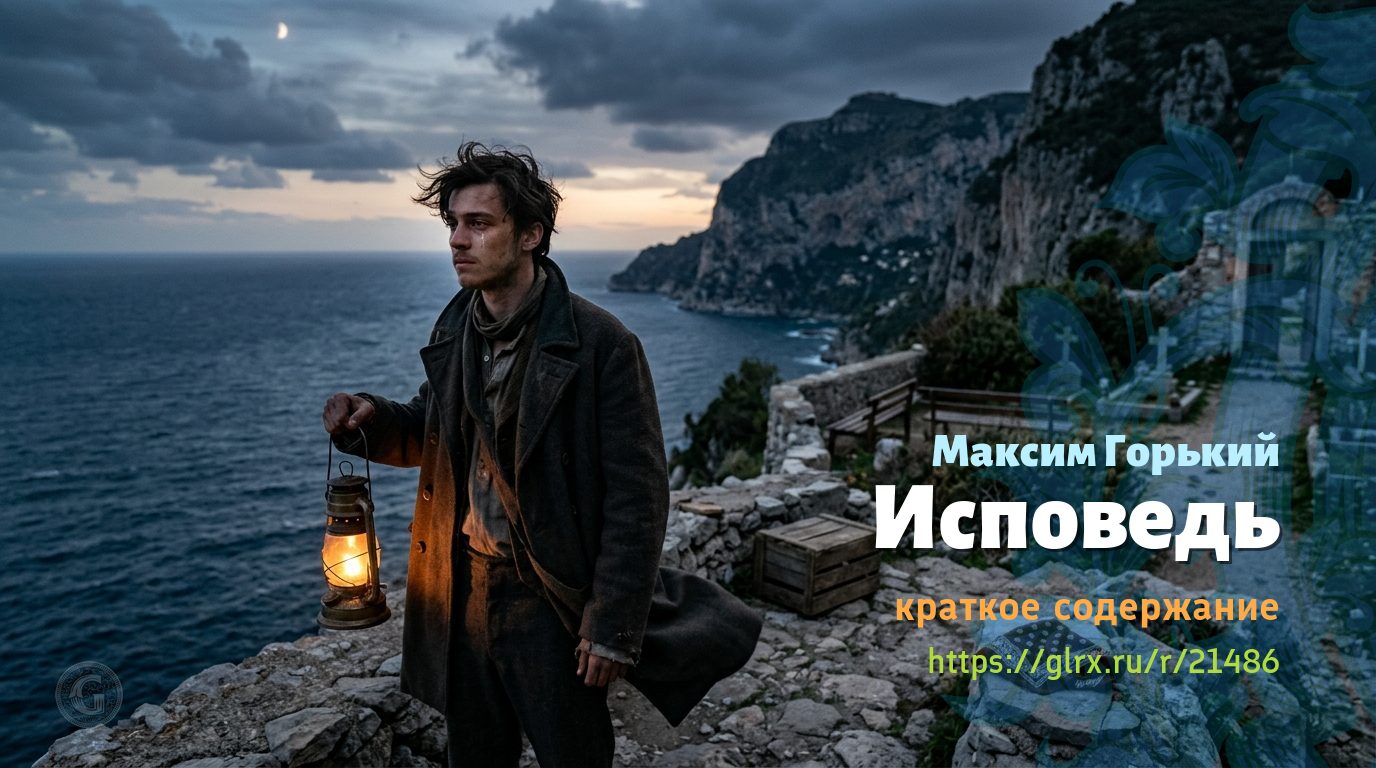
Matvey’s childhood and growing up
The protagonist, Matvey, is an illegitimate foundling. Gardener Danila Vyalov found the infant in a park in the village of Sokolye. Until he was four, the boy lived with the gardener’s family, surviving on occasional handouts. Then the boy was taken in by the local deacon, Larion. This man had a soft heart, a sincere love for songbirds and beautiful church hymns. Larion taught Matvey to see the divine beauty in life, denied the existence of the devil, and often drank with the thief Savyolka Migun.
One day, a drunken Larion drowns in Lyubushin’s pool. The lonely Matvey is rescued by Yegor Titov, the clerk of the household. Titov takes the boy into his home and teaches him how to do business. Matvey witnesses the clerk robbing the peasants and defrauding his master, Losev. The young man finds solace in church services, helping the watchman, Vlasiy. Vlasiy suffers from senile insanity, calling himself the god of cattle. Matvey immerses himself in reading the lives of the saints, finding in them a pure, unearthly joy.
Family tragedy and rebellion
Matvey falls in love with Titov’s daughter, the quiet Olga. She agrees to marry him. The cunning Titov refuses to provide a dowry and forces the young man to participate in office fraud. For Olga’s sake, Matvey begins cheating the peasants. The ill-gotten gains are used to build their own house. The embittered peasants burn down the wooden hut on the eve of their housewarming.
Matvey rebuilds the house, and his wedding with Olga is a success. The couple has a son, Alexander. Matvey draws a lucky lot, sparing him from conscription. Olga becomes pregnant for the second time, with a heavy premonition of her death. During a painful labor, she dies, delivering a stillborn baby. Soon, little Sasha accidentally ingests poisonous arsenic and dies. Crushed by grief, Matvey accuses God of cruelty, leaves his property to his father-in-law, and goes into hiding.
Monastic disappointments
The hero visits a clairvoyant archpriest, hoping to resolve his tormenting doubts. The conversation ends in scandal: the priest threatens the heretic with the police. On the street, Matvey meets a prostitute, Tatyana. She shows him deep human sympathy, gives him a place to stay, and advises him to turn to the wise nun Fevronia. Matvey goes to a convent, but the old hermit’s teachings seem primitive to him.
In search of truth, the young man enrolls as a novice at the Savvateevskaya Hermitage. He is assigned to the bakery as an assistant to the ferocious monk Mikhail. The boss hates women, seeing Satan’s machinations in everything. Matvey becomes despondent from the grueling labor and Mikhail’s dark fanaticism. He finds comfort in conversations with the novice Grisha. Grisha fled from his greedy merchant father after his sister Liza shot herself, refusing to marry for money. Another companion, the vagabond Seraphim, tells poetic stories about the sea and the Caucasus mountains.
Soon, Matvey is thrown into a damp punishment cell for his insolent words and then transferred to Father Anthony’s cell. Anthony is a handsome nobleman, a former army officer. He drinks expensive wines, reads French novels, and secretly has affairs with a woman named Zoya. The monk declares that God is only a fiction, a dream of the human soul. Outraged by the filth and cynical hypocrisy of the monastery, Matvey demands the return of his passport. The foolish elder Asaph viciously insults him as he leaves, and the abbot convinces him that the prostitute in his cell was a demonic possession.
Wanderings among the common people
Having left the hermitage, Matvey merges with the crowds of pilgrims. The hero listens to countless stories of people tormented by poverty and grave illnesses. At Beloozero, he sees a wealthy pilgrim ostentatiously washing the feet of pilgrims to atone for his sins. A stern young Ukrainian woman confesses to Matvey that she beat her children out of desperate hunger when their family unsuccessfully attempted to resettle on the distant Amur River.
In a convent, Matvey accidentally becomes close to a choir member, Christina. The girl is being held captive by greedy guardians. She begs Matvey to give her a child so that, for her obvious sin, she will be finally expelled from the convent and freed. Matvey helps her achieve her goal, but refuses further encounters, torn by moral doubts.
On the road from Perm to Verkhoturye, Matvey meets the wanderer Yehudiel, formerly the priest Jonah. This cheerful old man astonishes the young man with the idea that the true creator of all gods is the working people themselves. Jonah asserts that the living god will rise again when the disparate wills of men coalesce. The old man sends Matvey to the Isetsky plant to join his loyal associates.
Factory workers and the new force
In a filthy workers’ settlement, Matvey finds mechanic Pyotr Yagikh and his nephew, schoolteacher Mikhail. These people reject the church, but are filled with a deep inner faith in the invincible power of the collective mind. Mikhail proves that the selfish human ego breeds blind fear and weakness. Matvey gets a job as a laborer at a factory, hauling wheelbarrows of scorching-hot slag through the hellish furnaces.
The hero begins openly preaching his rebellious views to a crowd of grimy artisans. Workers Gavrila Kostin and old Kryukov support his bold speeches. Suddenly, a horseman gallops into the factory with news of police searches following a denunciation by a local priest. Fearing imprisonment, Matvey agrees to escape. In the forest, he is accompanied by underground activists Ivan Bykov and a white-haired teenager named Kostya. Kostya, the boy, condemns the hero’s cowardice, causing Matvey to feel a searing sense of shame.
Wandering further, Matvey shares his new ideas with the peasants. The police attempt to arrest him at a fair, but the crowd shelters him. The worker Fedyuk secretly leads him out of a ravine, telling him about the exiled revolutionaries. In Omsk and Zlatoust, Matvey talks with settlers, feeling a growing affinity with the working people.
The miracle of unity
After many months of Siberian wandering, Matvey finds himself near the Seven Lakes Hermitage. He watches a procession carrying the miraculous icon of the Mother of God. Thousands of pilgrims form a tightly packed line, shrouded in a suffocating cloud of dust. At the ancient gates of the monastery, a paralyzed girl lies in a cart; her parents tearfully plead with the crowd for healing through prayer.
A vast crowd is instantly engulfed in a single, ecstatic impulse. They demand a miracle with all their might, directing their entire mental will toward the frail patient. Matvey throws himself into the thick of the crowd, completely dissolving into a shared, passionate prayer. Under the pressure of the thousand-voiced choir and the shared, fervent faith, the paralyzed girl raises her trembling arms, rises to her feet, and takes independent steps.
That night, Matvey sits by the dark lake, comprehending the shock that has just occurred. He clearly understands that the miracle was performed by the people themselves, united. The people appear before him as the true creators of the earth and the immortal builders of God. Matvey resolves to return to the Urals to Mikhaila and Pyotr. He is ready to dedicate his life to the liberation of human souls and the unification of the disparate people into a single, invincible force.
- Михаил Ларионов, русский художник, основоположник лучизма
- Выставочная группа русских художников “Ослиный хвост”: основана Ларионовым и Гончаровой
- Лучизм
- Болгарская альтернативная православная церковь
- Экспозиция картин и гравюр
- Развитие европейской портретной живописи
- Развитие портретной живописи в эпоху Возрождения
- Хранение картин
- Живопись эпохи Ренессанса
You cannot comment Why?