A summary of "The Cabby" by Maxim Gorky
 Automatic translate
Maxim Gorky’s short story "The Cabby" was written in 1895. This work is a direct polemic against themes from Fyodor Dostoevsky’s classic novel about the limits of what is permissible, casting the story of a brutal murder for the sake of enrichment in the form of a dark Christmas dream. The protagonist commits a terrible crime, but instead of the expected tormenting pangs of conscience, he encounters absolute spiritual emptiness. The writer drew on real crime reports of the time, reinterpreting newspaper accounts through the prism of cold cynicism.
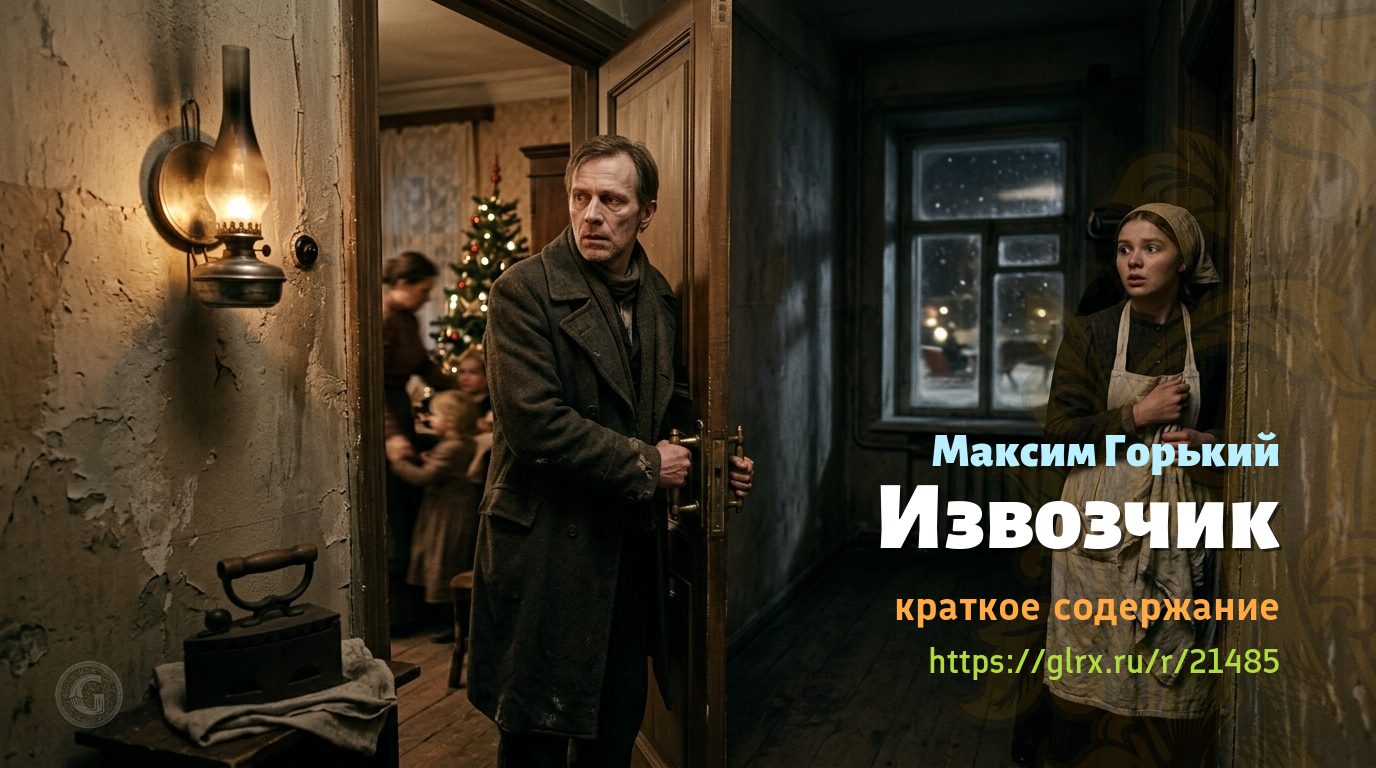
Pre-holiday bustle and strange conversation
Pavel Nikolaevich, a man with a modest salary, wakes up on Christmas Eve completely exhausted. The pre-holiday rush, the constant petty expenses that drain his meager budget, and the general incompetence of those around him drive him to the point of severe nervous exhaustion. He feels acutely irritated with his wife, who attaches too much importance to Christmas. He is also irritated by his noisy children and tired servants. The family demands his immediate involvement in holiday preparations. His wife sends him to the market for a Christmas tree, to the store, and to the greenhouse for flowers.
Having completed his errands, Pavel Nikolaevich returns home at five o’clock in the evening. Tired and having had a poor dinner, he locks himself in his bedroom, lies down on his wife’s bed, and stares blankly at the ceiling. The room is dimly lit by a lit oil lamp. The soft sounds of passing sleighs drift in from the street.
From the next room, his wife’s sharp shout at their young son, Kolya, echoes. Pavel Nikolaevich silently remarks that adults lack proper upbringing themselves, so it’s pointless to talk about properly educating children. He philosophizes about the hardships of a poverty-stricken existence. He concludes that people work only for food, and their wages don’t even cover their basic physiological needs.
The hero recalls a recent trip from the market and a strange conversation with a drunken, broken-down cab driver. This man with inflamed, red eyelids told the passenger a story about his former mistress, the wealthy merchant Kapitolina Petrovna Zametova. The coachman explained that the old woman lived in a large, old house, completely alone, surrounded by only three servants. The merchant had no relatives, but had accumulated vast sums of money, which lay idle.
A fatal decision and a double crime
During the drive, a drunken companion bluntly suggested that Pavel Nikolaevich kill Zametova. The man coldly argued that it takes very little to kill a person, and the old woman’s savings would go to whoever was brave enough to eliminate her. He advised striking the victim in a sensitive spot, arguing that it would be much easier for a smart gentleman to do so.
Recalling this cynical monologue, Pavel Nikolaevich at first mentally dismisses the annoying adviser, but then begins to seriously consider his proposal. He convinces himself of his right to a better life. A huge sum promises freedom, independence, and liberation from poverty. Pangs of conscience are dismissed as a ridiculous fantasy. Pavel Nikolaevich decides to use a heavy iron wrapped in a towel as a weapon, planning to discreetly remove it from the hallway.
Overcome by an unprecedented surge of calm energy, the hero rises from his bed. He approaches the two-story house of merchant Zametova, whose plaster is peeling, and yanks the doorbell hard.
A loud voice answered from behind the door. The man introduced himself as a messenger from Biryukov, the owner of a well-known delicatessen.
The door is opened by the young maid, Annushka. Upon learning that the cook, Marina, has gone to the bathhouse, the man pretends to leave, but the girl trustingly invites him in. When Annushka bends over to help him remove his galoshes, he strikes her hard across the back of the head with a metal iron. The girl falls dead, wrapped in the folds of her pink calico. A button breaks from her bodice and rolls across the floor with a clatter. The killer coldly remarks on the simple ease of taking a life.
A fight with the owner and the theft of savings
From above, the dry voice of the old woman Zametova is heard, inquiring about the guest. Pavel Nikolaevich rushes up the steps, leaving the iron below. A bony woman with a long neck stands on the top landing. Noticing something amiss, she steps back. The hero lunges at the mistress of the house, grabbing her by the throat and feeling for the vertebrae beneath her skin.
Zametova desperately resists, wheezing, kneeing her attacker and clawing at his chest. Her face quickly turns blue, her tongue lolling from her mouth. The old woman manages to grab the killer by the collar, causing a cufflink to fly out of his shirt. Fearing to leave evidence, the attacker squeezes his victim’s neck with redoubled force. They fall to the floor together, where the trembling of the old man’s body finally ceases.
Convinced of the merchant’s wife’s death, the man sits down next to the corpse. He feels only physical fatigue and irritation, but finds no pity or animal fear in his soul. Suddenly, the same drunken cab driver appears on the staircase railing. He swings his legs and calmly inquires about the master’s progress.
Pavel Nikolaevich is outraged by his cold-bloodedness, but the peasant responds by decrying the futility of pity for the dead. The murderer is astonished by his own absolute indifference. He committed a terrible crime, yet feels no remorse. The man demands an explanation for the disappearance of the inner law. The guest accuses everyone of deceit. He advises the master not to be tormented by doubts but to take the money, after which he instantly disappears.
Pavel Nikolaevich heads to the deceased old woman’s bedroom. Under the bed, he finds an antique wardrobe with a key stuck in the lock. Inside are huge sums of money. The killer stuffs his reticule and pockets with heavy stacks of banknotes, then calmly leaves the house, stepping over the bodies of the murdered women.
Long years without mental anguish
Exactly eight years pass. Pavel Nikolaevich’s life is prosperous. The late Zametova’s money has been put to good use: he’s managed it wisely, becoming a wealthy and influential figure in the city. His eldest son, Kolya, is turning nineteen, one daughter is getting ready to marry, and his wife has become a respectable philanthropist. He himself is a leading candidate for the position of mayor.
However, his character deteriorates significantly. From a sincere man, he transforms into a gloomy, withdrawn thinker. No remorse haunts him. The townspeople discussed the mysterious crime at length, and Pavel Nikolaevich calmly supported these conversations, waiting for fear to awaken. His heart remained completely silent. It is overwhelmed only by the question of the reasons for this lack of moral torment. Life seems to the hero a strange delirium devoid of true feelings.
One day, the ragged cabby reappears in the rich man’s office. Time hasn’t altered his rumpled face or his ragged azyam. He sits down in a chair and asks if the master has found his lost law. Pavel Nikolaevich sadly admits his failure. The cabby explains the disappearance of morality by the lack of practical application. The man was merely speculating in search of personal gain.
The pursuit of public honor and living up to others’ expectations have completely drained his soul. The guest declares Pavel Nikolaevich’s spiritual death, acting out of mechanical habit. When the host asks about his next steps, the strange interlocutor suggests publicly proclaiming his emptiness. Perhaps those around him will hear this confession and peer into their own empty hearts. The man vanishes into thin air, and Pavel Nikolaevich continues to live by inertia.
Confession of the mayor and a sudden awakening
Election day arrives. Pavel Nikolaevich is officially elected mayor. A crowd of distinguished acquaintances gathers at his home, where laudatory speeches and congratulations are offered. The host listens to his guests with deep inner contempt, considering everyone present pathetic and blind. Suddenly, he is overcome by a wild desire to astonish and crush these smug bourgeois citizens. He takes a glass of wine, stands, and interrupts the feast.
Instead of words of gratitude, the man loudly declares to the assembled crowd their complete ignorance. He publicly confesses to the long-ago murder of the merchant Zametova and her young maid. The speaker declares that his entire fortune was made from stolen savings. The guests are shocked. They feel insulted by the tone of the new mayor, whose eyes glow with contempt. A commotion ensues, and someone demands to call the police. Pavel Nikolaevich calls on the people to protect their souls from destructive indifference.
The audience looks at the speaker with anger. At that moment, the cab driver’s face appears before him again, expressing genuine delight. He approves of public repentance, calling suffering a saving cross for the purification of the soul. The peasant reminds them of the forgiven robber and commands them to bear their cross courageously. Suddenly, the surrounding world begins to fade, dissolving in a flickering red light. Sounds disappear, the earth trembles.
Pavel Nikolaevich opens his eyes and sees his wife, Yulia, standing before him. She’s standing in her nightgown, holding a lamp, and irritably shaking her husband’s shoulder. She scolds her husband for sleeping in his clothes and complains of extreme fatigue. With great relief, the hero realizes the illusory nature of everything he’s experienced. It was just a long dream.
He tries to tell Yulia about the fantastic cab driver, but the exhausted woman refuses to listen to his confusing nighttime stories and demands peace. Pavel Nikolaevich obediently falls silent. The man crawls onto his bed. He quickly falls asleep to the dull brassy sound of holiday bells. The steady knock of a guard can be heard from the street.
You cannot comment Why?