A summary of "A Handsome Man" by Alexander Ostrovsky
 Automatic translate
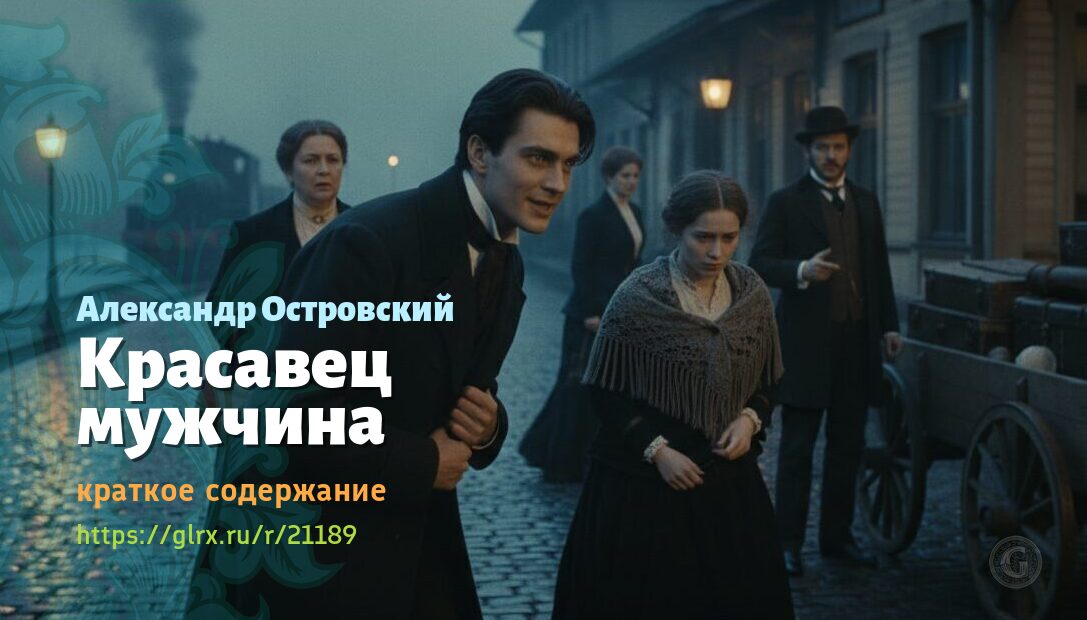
This book is a classic comedy of manners, written in 1882. The work reveals the conflict between sincere feelings and cynical calculation, where human destinies become bargaining chips in the pursuit of money and a life of idleness. The author masterfully depicts how blind love collides with cold selfishness, shattering the traditional moral foundations of society.
In 1883, the author was awarded the prestigious Griboyedov Prize for this work. The play was a hit with audiences and was repeatedly performed on theatrical stages. In 1978, director Margarita Mikaelyan adapted the comedy into a successful two-part television film of the same name.
Life on credit
The action unfolds in a provincial town, at the local train station and in the homes of the main characters. Apollon Evgenich Okoemov, an attractive young man, is accustomed to living lavishly. Having married the meek and wealthy Zoya Vasilyevna, he has completely squandered her fortune in just a few years. His wife is madly in love with him and forgives any misdeeds. Okoemov constantly hangs out at clubs, plays cards, and has affairs.
Apollinaria Antonovna, Zoya’s aunt, laments her niece’s fate. She sees Okoyomov’s true colors but is unable to convince the love-blinded girl. At this time, Naum Fedotych Lotokhin, a wealthy nobleman and distant relative of Zoya, arrives in town. He intends to look into the family’s affairs and help his niece. Lotokhin immediately notices the Okoyomovs’ plight and begins his own investigation.
Okoemov’s insidious plan
Apollon Evgenich realizes his wife’s money is gone and his debts continue to mount. He devises a cynical plan to salvage his situation. A young widow, Susanna Sergeyevna Lundysheva, lives in the city and possesses a vast fortune. Okoemov decides to divorce Zoya and marry the wealthy widow. To do so, he needs to obtain a formal reason for the divorce.
Okoemov begins to court Susanna using his charm. The young widow, susceptible to flattery and masculine beauty, reciprocates his feelings. Fyodor Petrovich Oleshunin, a modest landowner, is also in love with Susanna. He is sincerely devoted to her, but the widow rejects his feelings, preferring the company of the brilliant Okoemov. Oleshunin suffers, watching his beloved fall into the clutches of a calculating womanizer.
Sacrifice for love
To obtain a divorce, Apollon demands an unthinkable sacrifice from his wife. He asks Zoya to take the blame and publicly confess to an affair that never happened. Okoemov convinces her this is the only way out of their dire situation. He lies, promising to secretly leave with her after the sham divorce and start a new life.
Zoya Vasilyevna, raised with strict rules, experiences profound emotional distress. However, her boundless love for her husband and her habit of obeying him in everything prevail. After agonizing deliberation, she consents to this shameful step. Zoya signs the papers admitting her guilt to infidelity. Aunt Apollinaria Antonovna is horrified by her niece’s actions, but is powerless to change them.
The intervention of Lotokhin and Sosipatra
Naum Fedotych Lotokhin learns of the impending divorce. He doesn’t believe the meek Zoya is cheating and suspects Okoemov of deception. Sosipatra Semyonovna, an independent and wealthy woman and the sister of Nikandr Semyonovich Lupachev, joins the investigation. Sosipatra leads a free life, disdains conventions, but possesses a keen mind and a kind heart. She has been watching Okoemov for a long time and knows the value of his words.
Together with Lotokhin, they decide to expose the handsome man. Sosipatra hosts a reception at her home, inviting all the actors in the drama. She skillfully manipulates her interlocutors, eliciting their secrets. Lupachev, an elderly gentleman with a dubious reputation, has long had his eye on Zoya. Okoemov, aware of this, hatches a new plot.
Betrayal and Epiphany
Apollon Evgenich, wanting to finally get rid of his wife and collect his severance pay, makes her a monstrous offer. He asks Zoya to become the kept woman of the wealthy Lupachev. This offer is the last straw for the young woman. The scales fall from her eyes, and she finally understands the true, base nature of the man she idolized.
Zoya Vasilyevna resolutely refuses and breaks off all ties with her husband. At this point, Lotokhin and Sosipatra openly expose Okoyomov’s plans to Susanna Lundysheva. They provide the widow with irrefutable evidence of her chosen one’s greed and baseness. Susanna, shocked by the truth, rejects Okoyomov and turns her attention to the devoted Oleshunin.
The collapse of illusions
Left without his wealthy fiancée, penniless, and with a ruined reputation, Okoemov realizes his gamble is lost. All his plans have collapsed, and creditors are demanding immediate payment. Former friends like Georges and Pierre are turning their backs on him. Lupachev also refuses his financial support, realizing Zoya will never give in to his advances.
In the final scene, Apollon Evgenich, driven to despair, comes to Zoya. He falls to his knees, begs for forgiveness, and asks to be allowed to return. Okoemov vows to reform and lead an honest life. Zoya Vasilyevna, with tears in her eyes, refuses him. She says, "Become a decent person, and then maybe I’ll love you again." With these words, the play ends, leaving the hero alone with his ruined future.
- Exhibition "Your face is my face"
- Exhibition "Everyday magic or under a microscope of sight"
- "Everyday magic or under a microscope of sight"
- Arkhangelsk viewers saw performances that won the Golden Mask
- Screenplay "True Friends" by Alexander Galich, summary
- "Who Lives Well in Rus’" by Nikolai Nekrasov, summary
You cannot comment Why?