Ivan Turgenev’s "Faust," a summary
 Automatic translate
This book is an epistolary novella written in 1856. The plot of Goethe’s tragedy is intricately intertwined with the daily life of a Russian noble estate, and the reading of a long-forgotten poem suddenly becomes the cause of a fatal spiritual breakdown. The author uses the form of one-person letters to convey the protagonist’s profound emotional torment.
Return to the old estate
The story is told from the perspective of Pavel Alexandrovich B. He writes to his close friend Semyon Nikolaevich. In early June 1850, the hero arrives in his old village of M…oe. Pavel hasn’t been back home for nine long years. Looking into his great-grandmother’s darkened mirror, he notices with deep sadness the changes in his own appearance as he ages. He will soon be forty, his youth gone forever.
The old house has fallen into disrepair and sunken into the ground. The familiar servants have grown decrepit. The housekeeper, Vasilyevna, is hunched over, and old Terentiy mumbles through his sunken mouth. But the garden has flourished beautifully. Pavel spends his time in complete solitude. He sincerely enjoys nature, listens to birdsong, and takes long walks along the shady linden alleys. In the dusty library, he finds yellowed old editions. Among them, he comes across a copy of Johann Wolfgang von Goethe’s Faust. Reading it brings back a storm of memories of his student years in Berlin.
An unexpected neighborhood
During a long walk, Pavel meets an acquaintance. It’s Priimkov, his former university friend. Priimkov retired as a lieutenant, bought an estate nearby, and set about farming. During their conversation, a surprising detail comes to light: Priimkov’s wife, Vera Nikolaevna Yeltsova, is an old acquaintance of Pavel’s.
The hero recalls the events of the past. Nine years ago, he was visiting a wealthy relative in the T* province. There, he met sixteen-year-old Vera and her mother. Madame Yeltsova was a superstitious woman. She raised her daughter according to her own strict system. The girl was strictly forbidden to read fictional stories, any novels, or poetry. Her mother was terrified of the dark elements of life.
Madame Yeltsova’s fears were well founded. Her biological father, Ladanov, had kidnapped an Italian peasant girl from Albano. Yeltsova’s mother was stabbed to death by her abandoned Italian fiancé the day after giving birth. Yeltsova’s husband died accidentally while hunting. The widow forever locked away her feelings. Pavel then fell in love with the young Vera. He asked her mother for her hand in marriage. The old woman coldly refused, considering Pavel a broken man, unsuitable for her pure daughter. Pavel resigned himself and left for Berlin.
New meeting and reading of the poem
Pavel pays a visit to the Priimkovs. He is struck by Vera Nikolaevna’s appearance. At twenty-eight, having given birth to three children, she looks like a seventeen-year-old girl. Her clear eyes radiate the same absolute calm she once had. She is completely unafraid of a huge spider, calmly throwing it out into the street with her bare hands. The house is cozy, and their five-year-old daughter, Natasha, is growing up. A somber portrait of the late Madame Yeltsova hangs above the sofa.
It turns out Vera still hasn’t read a single line of poetry. She sacredly honors her mother’s long-standing prohibition. Pavel is genuinely outraged by such indifference to fine literature. He decides to enlighten the young woman. For his first book, he chooses "Faust," which he brought with him.
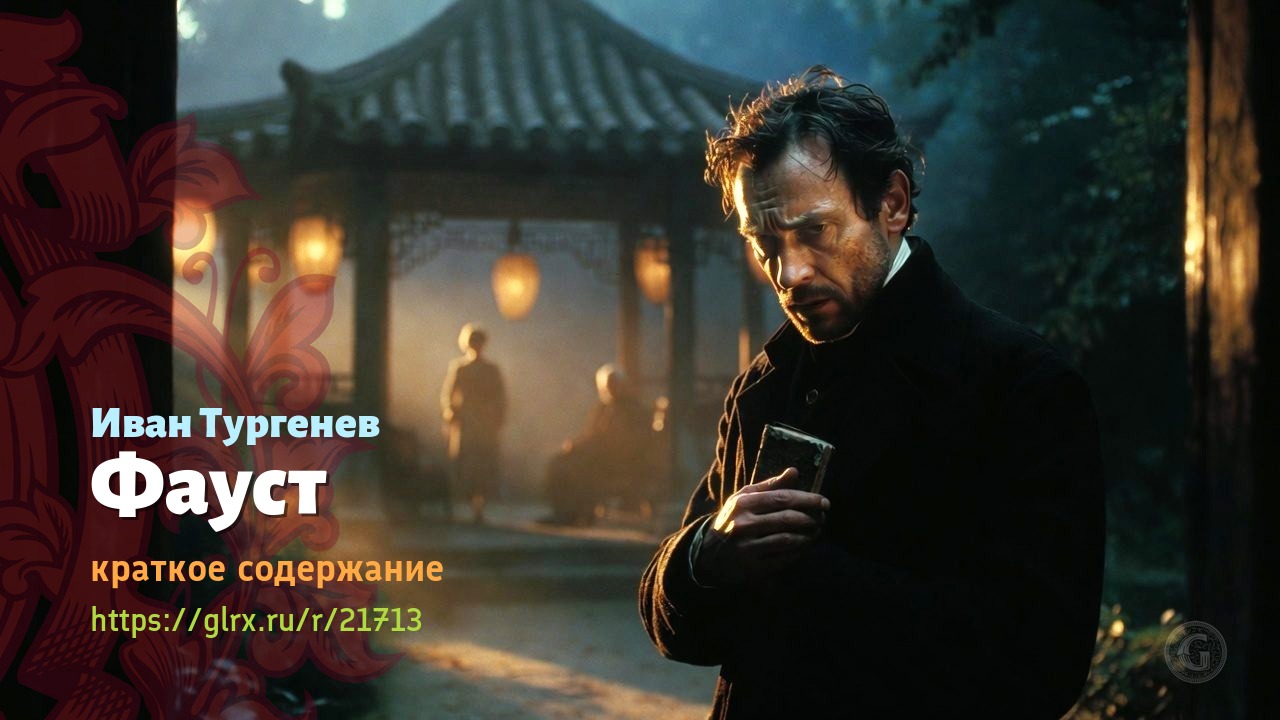
The reading takes place on June 20th in an old Chinese house on the estate grounds. Vera’s husband and the old German teacher, Schimmel, are present. Pavel reads with great enthusiasm, addressing Vera exclusively. Priimkov is frankly bored. The German man constantly gasps with delight. Vera listens motionless. After the tragic scene of Faust’s meeting with Gretchen, she turns pale. The heroine silently rises and walks into the garden at night.
Later, Priimkov reports finding his wife in tears. The next morning, Vera complains to Pavel of insomnia. The German book has seared her mind. She asks him not to speak of what she’s read for now, but she clearly understands there’s no turning back. Anyone who sets foot on this path will never return to their former peace.
Spiritual rapprochement
Throughout July, Pavel frequently visits the Priimkovs. He reads to Vera for long periods. They enthusiastically discuss literature. Vera perceives poetry with a surprisingly virginal purity. She cannot stand falsehood and senses the truth instantly. Pavel notices how much she changes. Her soul eagerly opens to new experiences.
The hero clearly understands his influence on Vera. At the same time, he himself becomes a better person around her. Vera’s husband is good-natured, but completely incapable of understanding his wife’s lofty aspirations. Pavel begins to develop deep feelings for the young woman. One day, he kisses her hand while reading Pushkin. Vera sternly asks him never to do so again.
In August, they go on a boat ride on the lake. Priimkov stays home with a headache. Schimmel, a German, cheerfully sings student songs and smokes his pipe. The wind picks up sharply, and the boat takes on icy water. Vera boldly steers the helm, her face splashed with water. She looks happy and free. Pavel feels infinitely at ease with her.
Later, Vera shows her guest an antique medallion. Concealed within it is a portrait of her Italian grandmother. Pavel is stunned. A passionate southern woman, full of sensual, animalistic strength, gazes out from the miniature painting. Pavel detects an elusive resemblance between the fiery Italian and the outwardly reserved Vera. He understands that this fragile woman conceals vast, untapped treasures of the soul.
Recognition and disaster
By the end of August, Pavel can no longer deceive himself. He’s madly in love with his married wife, Vera. The realization of his hopelessness is excruciatingly painful. At thirty-seven, he experiences such a powerful and devastating feeling for the first time. He decides to leave for St. Petersburg. He sends his friend Semyon Nikolaevich a crumpled letter, promising a quick meeting.
The departure is postponed. Events take an unexpected turn. On September 7th, Pavel finds Vera alone in a quiet study. Her husband has gone hunting. The young woman asks her guest to read the scene where Gretchen asks Faust about his faith in God.
Having finished reading, Pavel looks closely at his interlocutor. Vera is breathing heavily. She quietly asks what he did to her. The girl stands up, goes to the door, and suddenly utters a confession. She says, "I love you." After these fateful words, she quickly leaves and locks the heavy door behind her. Pavel is shocked. He wanders the garden in a complete daze.
That evening, Vera arranges a secret meeting. After tea, they go for a walk and enter an empty Chinese house. In the semi-darkness, they embrace. Their first and last passionate kiss.
Suddenly, Vera wrenches herself from his arms in a horrified shudder. She recoils. In a trembling voice, the woman orders Pavel to look back. She imagines her mother’s spirit standing in the dark corner. Vera gasps with a chilling fear. She sends Pavel away, vowing to come tomorrow evening to the garden gate by the lake.
Redemption by debt
The next day, Pavel tensely awaits her at the appointed place. He hides in the tall willow bushes. The sun sets, it grows dark, and stars appear in the black sky. Vera does not come. Losing hope, the hero returns to his estate. That night, he is overcome by a causeless, gnawing melancholy. He imagines a plaintive call. A distant death groan bursts through the open window. Pavel, in animal terror, screams her name.
In the morning, Pavel rushes to the Priimkovs. The alarmed master reports terrible news. Vera returned from the garden in a distraught state. She told the frightened maid that she had seen her late mother. That night, she developed a high fever and became delirious.
The illness progresses rapidly. Doctors are completely helpless. Two weeks later, Vera Nikolaevna dies. Just before her death, Pavel secretly enters her bedroom. The emaciated woman opens her bloodshot eyes, points at him with a trembling hand, and recites lines from "Faust." She asks why this man has come to a holy place. In a feverish delirium, she calls for her stern mother.
Pavel attends the funeral. Afterward, he remains forever in the remote village. He completely sever his ties with society. The death of the woman he loved shatters his destiny forever. He ponders at length about the mysterious chain that binds generations. His mother’s warnings proved prophetic. Madame Yeltsova protected her daughter until her first careless step, and then mercilessly took her with her to a damp grave.
Grief-stricken, Pavel concludes his final letter with bitter reflections. He comes to a grave conviction: life is neither pleasure nor easy fun. It is constant, rigorous labor. The primary meaning of human existence becomes renunciation. One must voluntarily don the iron chains of duty, abandoning personal dreams. Without this, it is impossible to reach the end of the road without falling. The hero urges his friend to preserve the pure image of the lost Vera in his soul and to honestly fulfill his harsh duty in life.
You cannot comment Why?