A Summary of "A Cold Snap:
A Winter Book" by Anna Starobinets
 Automatic translate
Anna Starobinets’s book was published in 2008; it’s a winter collection of prose in which the everyday environment quickly becomes a source of horror, and anxiety is born not on the distant periphery, but within the apartment, family, the metro, and the protagonist’s own memory. The most powerful element here is cold as a real state of the world and as a form of human alienation: snow, cramped rooms, dark courtyards, and utility rooms weigh on people as powerfully as fear, guilt, and cruelty.
Homebody
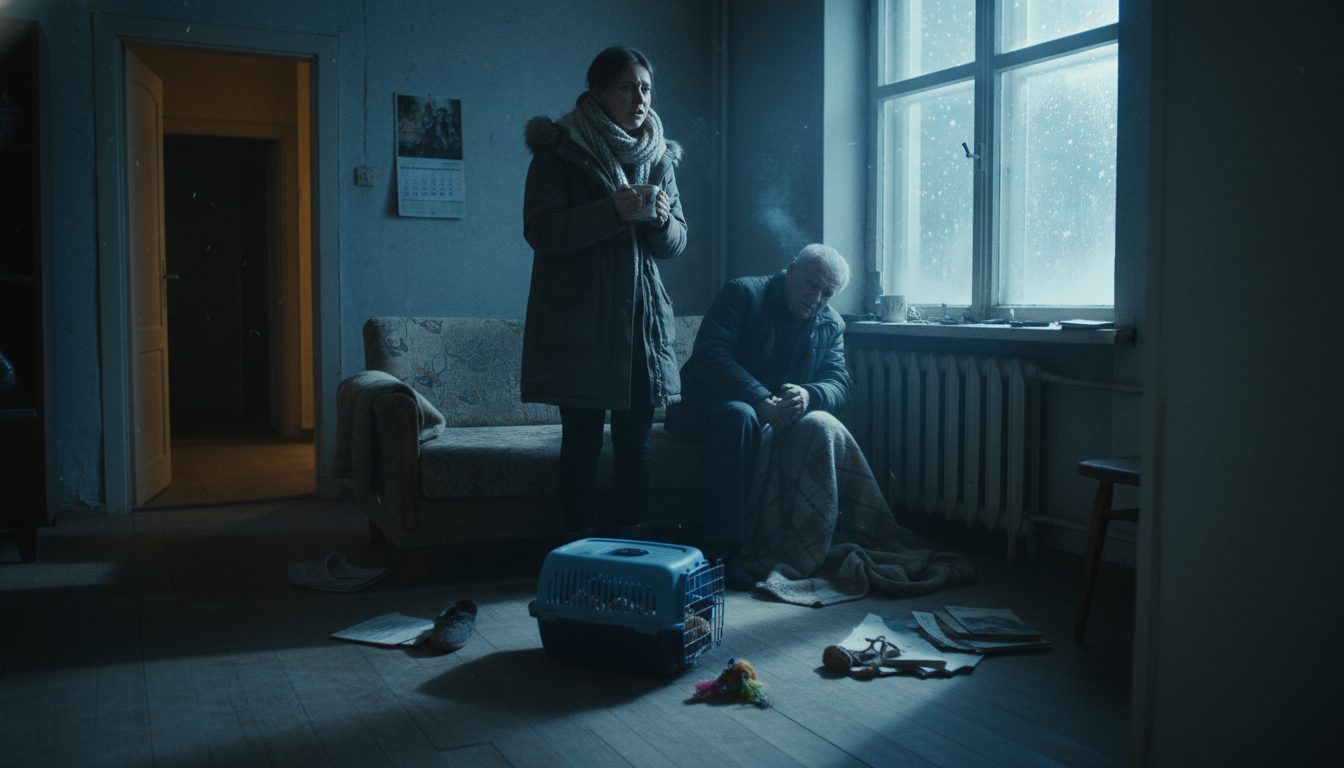
The first and most extensive piece is narrated by a being connected to the house, who perceives the apartment as a living organism with its own rules, smells, and history. It watches as the old man dies a slow and painful death, while the young woman living nearby poorly manages his care, disrupts the usual routine, and increasingly irritates the narrator. It’s clear from the beginning that this is no neutral witness: the house is more important to it than human grief, and any change is almost catastrophic.
The story then unfolds like a chronicle of a besieged space. The narrator recalls former residents, old family ties, long-lost and missing, and his own strange kinship with creatures that seem to have always lived alongside humans, remaining in the shadows. His memory clings to details — furniture, rooms, the smell of food, the habits of the owners, routes through the courtyard, an old photograph of the church, and Xiao the cat.
When new people and new routines arrive in the house, anxiety turns into an open struggle for territory. The narrator observes quarrels, attempts to leave, stolen belongings, intrusions, suspicious visits, and a strange religious circle that begins to gather in the apartment, changing its atmosphere beyond recognition. What seems like ordinary domestic confusion to others signifies the disintegration of a sacred order for him, and he responds to this with increasing pain and jealousy.
Gradually, the text reveals that his concern for the house has long since degenerated into an obsession. He judges the living as objects that are either in their place or not, and has difficulty distinguishing between pity, love, and the right to control the fate of others. By the end, he pins his hope on the dying old man’s ability to take his place after death and continue to oversee the apartment, but an encounter with the surviving cat, Xiao, shatters this illusion: even the animal recognizes him no longer as the master of the house, but as a terrifying creature.
Clumsy
In the second piece, the action shifts to the subway and a city crowd, where the familiar crush is immediately tinged with hatred. People take turns lifting black bags and chanting the same formula of hatred for others, after which they disperse, as if performing a long-learned ritual. The usual irritation on public transport here doesn’t remain a petty emotion: it quickly becomes something communal, almost contagious, and deprives a person of individual will.
The story’s meaning hinges on physical awkwardness, cramped conditions, and the anger that accumulates in the touches, scents, and forced intimacy of others. The characters can no longer be near each other without disgust, and this internal deformation becomes almost physically visible. The denouement takes everything to the realm of a disturbing fairy tale: Snow White quietly leads them off the train, and they, eyes closed, follow her along the colorful metro lines all night, like a fascinated procession that has lost its former human form.
Straight ahead and to the left
This story begins with pain and a mundane conversation, already betraying the weariness that has accumulated over a long period. Anton suffers from a severe headache, and Nastya responds almost mechanically, with a casual concern that stems from the habit of living alongside someone else’s constant ill-being. Illness quickly blurs ordinary reality, and the domestic scene in the kitchen becomes a threshold into another space, where everything hinges on turns, signs, and the precision of choice.
The story then develops the motif of the lost path. Between the spouses, there remains no direct conversation, but rather anticipation, the memory of some nocturnal explanation, and a letter left on the kitchen table as instructions for returning. Anton writes that time moves differently where he finds himself, and asks Nastya to think of turning back if she has the chance; this request sounds both like a literal command and a last hope for reconnecting.
The tension stems from the impossibility of determining where the illness ends and another layer of the world begins. For Anton, Nastya remains the only recipient, and the apartment the only place where meeting is still possible, even though he himself seems to have been removed from the confines of his familiar life. The ending leaves the hero in a space of almost complete immobility, where "there’s nowhere to go," and all human intimacy comes down to whether the other person can correctly read the trace left behind.
A sharp cold snap
The book’s central story centers on Sonya and her childhood, where the cold, the journey to school, and family fear are intertwined from the very beginning. The girl walks alone, painfully experiencing loneliness, caring about her appearance, the ridicule of others, and the constant warring between her mother and father at home. Her mother fears her father, calling him a monster, while her father stubbornly imposes his harsh will on his daughter, primarily through skiing, discipline, and tests of strength.
Sonya tries to protect herself with childish methods. She writes letters to the sorceress, asking for someone to go to school with her, for her fear to disappear, and for her to learn to skate the way her father demands. Renat, who begins accompanying her in the mornings, and Lenochka, who begins to harbor jealousy, humiliation, and a desire for secret revenge, expressed in new letters and fantasies of otherworldly intervention, also appear in this world.
Skiing trips with her father become the ultimate challenge. He teaches Sonya through cold, fatigue, falls, and pain, disregarding her terror and her mother’s tears. Meanwhile, a dual feeling gradually develops within the girl: she fears him and yet greedily seizes the rare moments when speed, snow, and a successful descent give her true happiness, a feeling of lightness and almost complete liberation from weakness.
The further the plot progresses, the more noticeable it becomes that the family drama isn’t limited to scandals. The mother loses her temper and faints, the father hides his inner breakdown behind a habit of ordering, and the child’s consciousness translates the unbearable into the language of miracles, witches, and cherished requests. Then, the story’s fabric incorporates motifs of murder, police work, grave guilt, and official paperwork, where living misfortune is already broken down into dry, bureaucratic formulas, and this makes the story even more terrifying.
The title is justified both literally and viscerally. Frost, snowdrifts, forests, long hikes, and athletic drills are juxtaposed with the sudden cooling of human connections, when a child is left alone before the force of adult decisions. The final feeling of this story is not romantic fortification, but a harsh experience of survival, in which love easily mingles with violence, and care with submission.
In hell
The last thing traps the hero once again in a cramped room, where almost nothing remains of reality except bare green walls, a table, a lamp, and someone else’s gaze. The man sits before an investigator or a superior, feeling confined, trying not to break down, and constantly losing himself in his thoughts. The present time is fractured here, and each new burst of memory reveals not a coherent biography, but a collection of painful scenes he had long hidden from himself.
These scenes paint a difficult life, ruined by rudeness, empty official bravado, family impotence, and a habit of burning out every living emotion before it has a chance to take shape. The stronger the heat, fear, and delirium, the weaker his defenses: excuses disappear, self-confidence vanishes, and in their place remains the image of a little red-haired girl in a glittering tinfoil crown. The final episode is especially painful, because the child asks for the simplest thing — attention and response — and the hero understands the price of this too late, when almost his entire life has already been reduced to emptiness, shame, and the impossibility of making anything right.
You cannot comment Why?