Ivan Turgenev’s "Rudin," a summary
 Automatic translate
This academic narrative revolves around an educated nobleman who suffers from an inability to translate lofty words into concrete actions. Published in 1856, the novel introduced the image of the "superfluous man" to the literary stage — a gifted idealist lacking the will to constructive work and condemned to eternal wandering.
Soviet director Konstantin Ershov adapted this story for the screen in 1977. Oleg Basilashvili played the lead role in the film of the same name, convincingly conveying the tragedy and inner emptiness of the wanderer.
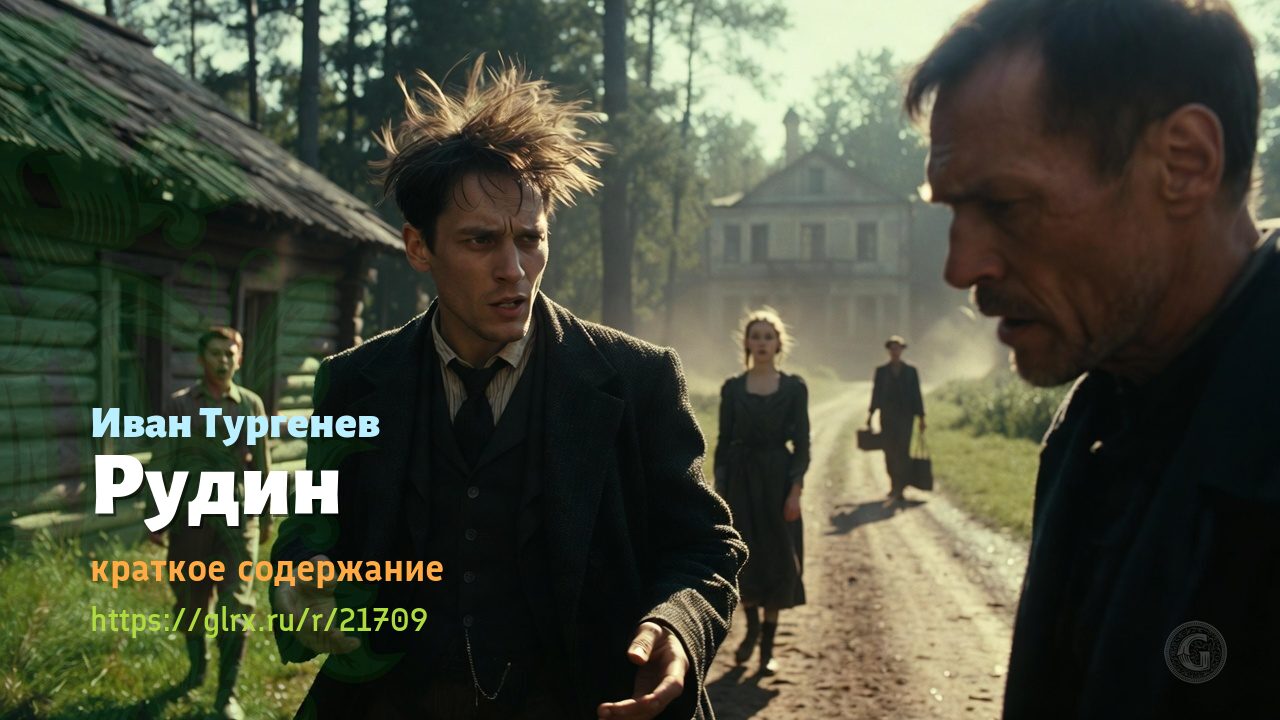
The plot begins on a quiet summer morning. A young widow, Alexandra Pavlovna Lipina, visits an ailing peasant woman, Matryona, in a dilapidated hut. On her way home, she encounters a neighbor, the shabbily dressed Mikhail Mikhailovich Lezhnev, riding in a racing droshky. She is soon joined by her brother, retired staff captain Sergei Pavlych Volyntsev, and Konstantin Diomidych Pandalevsky, the obliging parasite of the wealthy landowner Darya Mikhailovna Lasunskaya. Pandalevsky extends an invitation to dinner: the lady is expecting Baron Muffel from the capital.
The Lasunskaya house is famous throughout the province. Darya Mikhailovna herself fancies herself a socialite and patroness of intellect. Afrikan Semyonovich Pigasov, a bitter old man who adores paradoxes and fervently hates women, is a frequent guest in her salon. The baron doesn’t show up for dinner. Instead, Dmitry Nikolaevich Rudin, a thirty-five-year-old man with a passionate gaze and expressive face, arrives in the evening. He brings the baron’s article.
Triumph in Lasunskaya’s salon
The new guest immediately captures everyone’s attention. A heated argument with Pigasov ensues. Afrikan Semenovich scoffs at philosophy and general arguments, declaring that no beliefs exist. Rudin catches him in a logical contradiction, arguing that belief in the absence of beliefs is also a belief. With his eloquence, ability to summarize thoughts, and lofty tone, Dmitry Nikolaevich captivates the audience. Lasunskaya asks her guest to stay the night. The young teacher, Basistov, listens to Rudin’s speech with his mouth open. The hostess’s seventeen-year-old daughter, Natalya, is struck by the beauty of his words.
The next morning, Darya Mikhailovna has a long, one-on-one conversation with Rudin, relishing his listening skills. During this meeting, Lezhnev enters the office to discuss land demarcation. He maintains a cool demeanor, leaves quickly, and makes it clear he dislikes Rudin. It turns out they went to school together.
Life on the estate
More than two months pass. Rudin is staying with Lasunskaya, becoming her main interlocutor. Pigasov appears less frequently, overwhelmed by his guest’s authority. Volyntsev suffers: he has long been silently in love with Natalya, but now he sees her drifting away from him, enchanted by a metropolitan intellectual. Dmitry Nikolayevich takes long walks with Natalya in the garden, reading German Romantics to her, discussing vocation, freedom, and the tragedy of love. The girl’s young soul opens to these ideas.
Alexandra Lipina demands that Lezhnev explain his dislike of the orator. Mikhail Mikhailovich recounts the story of their youth. In Moscow, they were members of a student circle led by the brilliant and pure-hearted Pokorsky. Even then, Rudin impressed everyone with the clarity of his logic, but he drew his ideas from others. Later, Lezhnev fell in love with a sweet girl. He recklessly confided his secret to Rudin. Rudin began actively interfering in their relationship, philosophically analyzing every emotion and tyrannically directing the lovers. Ultimately, Dmitry Nikolaevich, out of a misguided sense of duty, told the girl’s father everything. Their relationship was broken, and Lezhnev was forever disillusioned with his friend.
Love and cowardice
In the garden, Rudin compares his old love to withered oak leaves, which fall only under the pressure of new buds. The girl takes this as a hint. During their next meeting, Rudin bluntly confesses his love to her. That night, they secretly meet in a lilac-colored gazebo. Natalya reciprocates his feelings and promises to marry him. Pandalevsky watches from the bushes.
The spy immediately reports everything to Lasunskaya. In the morning, the lady gives her daughter a dressing down, declaring she’d rather see her in a coffin than married to a penniless wanderer. Natalya writes a note to Rudin requesting an urgent meeting.
They meet early on a windy morning at the abandoned Avdyukhin Pond, a gloomy place with dead oaks. Natalya tells him of her mother’s anger and expects her lover to take decisive action. She is ready to abandon her family and follow him. However, Rudin balks at reality. He urges Natalya to submit to her mother’s will. Her illusions are shattered. She bitterly accuses him of cowardice, faintheartedness, and deceit. She realizes that behind his passionate words there was no real commitment. Natalya leaves forever.
Departure
Broken and hurt, Rudin decides to leave the estate immediately. Before doing so, he commits a foolish act: he goes to Volyntsev to frankly declare his love for Natalya. The retired military man perceives this frankness as mockery and can barely contain his rage.
Upon returning, Rudin finds Lasunskaya giving him a cold reception. She clearly knows everything and politely sends him away. Dmitry Nikolaevich writes a long farewell letter to Natalya, admitting his failure, and leaves in a rickety, bourgeois wagon. Volyntsev calms down, and Natalya’s life plunges into the darkness of her first bitter disappointment.
Two years later
Two years pass. Alexandra Lipina has married Lezhnev, and they have a son. An aging Pigasov sits on the balcony of their home, habitually berating women. Mikhail Mikhailovich arrives with his teacher, Basistov. They bring good news from Moscow: Volyntsev has proposed to Natalia, and the wedding is a done deal.
Rudin’s name comes up in conversation. Basistov explains that he disappeared without a trace. Pigasov gleefully predicts the wanderer’s death in poverty. Unexpectedly, Lezhnev rises to his former comrade’s defense. He raises a glass to Dmitry Nikolaevich. Mikhailo Mikhailovich asserts that Rudin lacks the character for creation, but his passionate speeches awakened souls, sowed the seeds of goodness, and inspired young people to reach for the light. Lezhnev forgives him all his mistakes for the sake of this noble fire.
Epilogue: Broken Hopes
Several more years pass. On a frosty autumn day, Lezhnev arrives in the provincial town on business. In the hotel corridor, he accidentally bumps into a hunched, gray-haired old man in a worn frock coat. It’s Rudin.
The comrades dine together. Dmitry Nikolaevich confesses his failures in life. He sincerely tried to find a business. First, he settled with a wealthy landowner in the Smolensk province, hoping to introduce agronomic innovations, but the owner’s stubbornness ruined all plans. Then, together with the impoverished enthusiast Kurbeyev, he tried to make the river navigable. The comrades lived in dugouts, subsisted on bread alone, and spent their last pennies, but failed due to a lack of funds.
The last attempt and death
Finally, Rudin found a job teaching Russian literature at the gymnasium. His lectures were a triumph, and the students adored him. But his independent spirit, broad views, and desire for reform alienated the inspector and the bitter mathematics teacher. After conflicts with his superiors, he was forced to resign.
Lezhnev listens to the exhausted wanderer with deep respect. He invites his friend to settle permanently in his home, declaring, "Thought also has its invalids: they, too, must have a home." Dmitry Nikolaevich thanks his friend but declines. He compares himself to a tumbleweed, unable to take root. Rudin leaves that same stormy autumn night.
The book ends in France. On a sultry afternoon on June 26, 1848, fighting rages in the streets of Paris. The workers’ uprising has been all but crushed. A tall, gray-haired man climbs to the top of a cannon-battered barricade, right on top of a toppled omnibus. He is wearing a red scarf, clutching a red flag in one hand and a blunt saber in the other. A shot rings out from the Chasseurs de Vincennes. The man falls dead, a bullet in his heart. The fleeing French rebels mutter among themselves: "They’ve killed a Pole." This unknown hero was the Russian idealist Dmitry Rudin.
You cannot comment Why?