A summary of Ivan Bunin’s "Dark Alleys"
 Automatic translate
The collection (a cycle of stories united by a common theme) was created between 1937 and 1945, with the two final texts written in 1946 and 1949. This book serves as a direct catalog of lost pre-revolutionary life and meticulously captures the mechanics of human passion through dozens of disparate love encounters.
Estate meetings and road romances
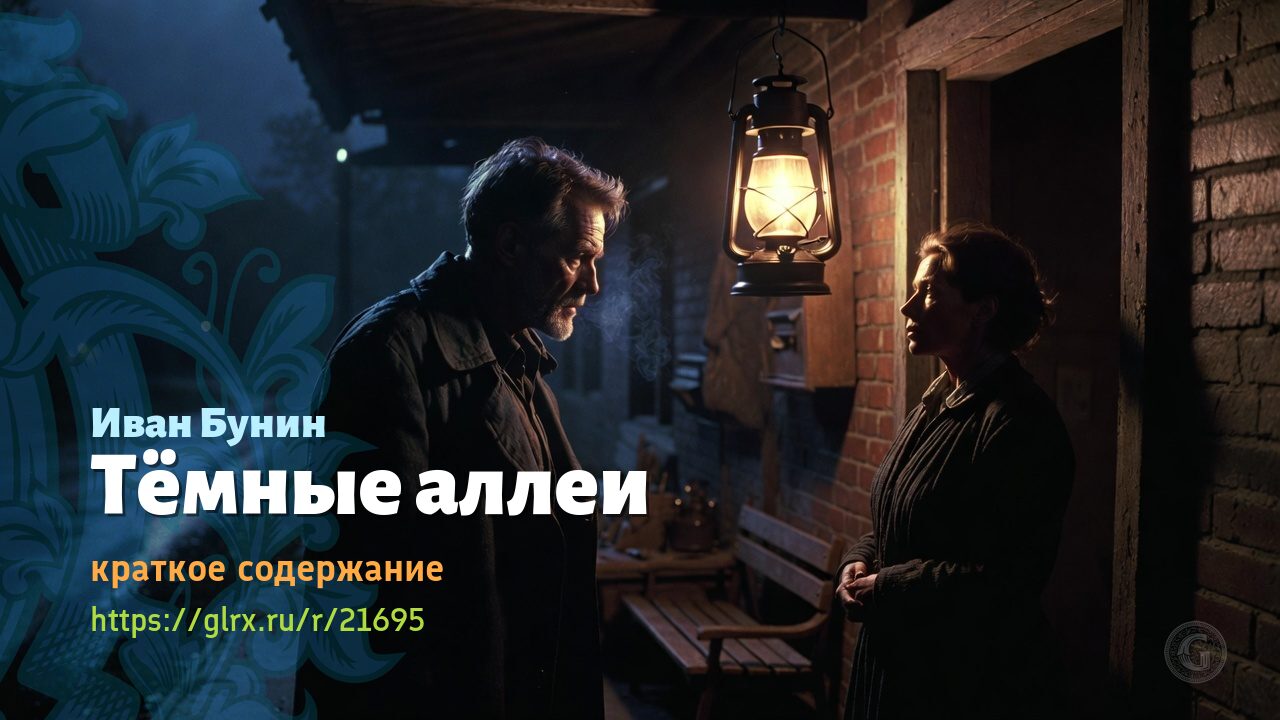
The title story, "Dark Alleys," sets the tone for the entire narrative. An elderly military man, Nikolai Alekseevich, stops at a post office in Tula. The hostess turns out to be Nadezhda, the woman he abandoned thirty years ago. She admits that she has retained her feelings for him forever and has not forgiven his betrayal. The soldier leaves, reflecting on his unhappy family life.
In the short story "Caucasus," lovers secretly elope to the southern coast, hiding from the heroine’s husband. The deceived husband searches for them in Gelendzhik, Gagra, and Sochi. Unable to find his wife, he drinks champagne at a hotel and shoots himself with two revolvers.
The text of "Ballad" describes a winter night in a village. The wanderer Mashenka reads psalms and recalls the legend of God’s wolf. This mystical beast killed a fierce prince who was pursuing his son and young daughter-in-law.
In the story "Styopa," the young merchant Krasilshchikov waits out a thunderstorm at an inn. He seduces the innkeeper’s fifteen-year-old daughter, Styopa. The girl begs him to marry her. Krasilshchikov promises to return soon, but leaves for Kislovodsk.
Conservatory student Muza Graf, from the text "Muse," comes to the aspiring artist’s hotel room. They live together in a dacha estate near Moscow. In winter, Muza suddenly abandons the artist and goes to live with his unattractive neighbor, Zavistovsky. The artist suffers greatly from the breakup.
In "Late Hour," the narrator walks through his sleeping hometown at night. He visits the old stone bridge, the school, and the street where his first love lived. He reaches the cemetery and finds her grave with a green star above it.
Urban dramas and emigrant destinies
The story "Rusya" describes a train stop at a night station outside Podolsk. The protagonist recalls his long-ago affair with a girl named Marusya. They used to meet secretly and go boating. Marusya’s mother, who suffered from melancholy, shot the protagonist with a pistol and drove him away forever.
In the text "The Beauty," an elderly widower civil servant marries a young woman. His new wife hates her husband’s seven-year-old son. The boy is forced to sleep on the living room floor, living in complete solitude.
The short story "The Little Fool" tells the story of a deacon’s son. The seminarian has an affair with a cook, who gives birth to a deformed boy. After completing his studies, the hero demands that the woman and child be thrown out. The cook goes off to beg.
The student from the story "Antigone" comes to visit a paralyzed general. He becomes infatuated with the beautiful nurse, Katerina Nikolaevna. After a brief encounter, the nurse hurriedly leaves the house after learning that the old maid noticed men’s shoes by her bed.
In the story "The Guest," the gloomy Adam Adamych bursts into the house and forcibly seizes the cook, Sasha. She cries, but at night she hopes for his return.
The cycle’s short sketches complement the overall picture. The sketch "Emerald" captures a fleeting kiss with a girl on a windowsill against the backdrop of the night sky. The sketch "Wolves" shows a young lady and a schoolboy in a cart: the horses are frightened by the predators, the young lady falls and cuts her lip, scarring her for life.
The play "Visiting Cards" introduces a famous writer. On the Volga steamship "Goncharov," he meets a poor married woman. The writer takes advantage of her naivety, and they spend the night together. In the morning, the woman flees to the pier.
In the short story "Zoika and Valeria," the doctor Levitsky is visiting the Danilevskys. He is tormented by his love for Valeria, who prefers Dr. Titov. Young Zoika is secretly hunting Levitsky. Upon learning of Valeria’s final rejection, the hero races his bicycle in front of an express train.
The text "Tanya" describes a relationship between a master and a young maid. The hero spends nights with her, promises to return in the spring, but leaves forever. Tanya remains in the wintry village, suffering from separation.
The story "In Paris" takes place in France. Former White Army general Nikolai Platonovich meets Olga Alexandrovna in a Russian canteen. They become friends and live together. On the third day of Easter, he suddenly dies in a subway car.
In "Gala Hanska," the artist recalls the Odessa spring. Young Galya surrenders herself to him in his studio. The artist refuses to cancel their trip to Italy, after which the girl takes deadly poison.
The plot of "Heinrich" unfolds on an international train. Glebov is traveling to Europe with his girlfriend, Elena Genrikhovna. They drink wine and enjoy intimacy. Soon after their separation, Glebov reads in a newspaper that an Austrian writer murdered Elena in a Viennese restaurant.
The work "Natalie" spans many years. The student Meshchersky loves the pure Natalie Stankevich, but becomes involved with his cousin Sonya. Natalie catches them together. Three years later, Meshchersky visits the widowed Natalie. The hero confesses, "On that terrible night with the lightning, I loved only you." Soon after, Natalie dies in premature labor.
Memories of fatal passions
The short story "On a Familiar Street" recreates the memory of a brief affair with a student in snowy Moscow. The sketch "The Beginning" tells the story of a twelve-year-old high school student who observes a sleeping woman on a train and experiences carnal desire for the first time.
In "The River Inn," a military doctor notices a beautiful girl on the street. She enters a church and prays fervently. That evening, the doctor sees her in a cheap tavern in the company of a drunken gambler. The hero forcibly takes the girl away; she weeps and walks off alone into the darkness.
The text "Kuma" shows a sudden intimate relationship between a guest and his hostess while her husband is in the office.
In the story "Oak Trees," the village elder Lavr leaves for the city. His young wife, Anfisa, calls for the master to come to her. Lavr returns from a snowstorm and finds them alone. That night, the village elder kills his wife with a green sash, for which he is sentenced to hard labor.
In the text "Miss Klara," the Georgian Meladze meets a striking brunette in a St. Petersburg restaurant. They go to her apartment. An argument breaks out, the woman hits him, and he hits her over the head with a bottle. Meladze robs the dead woman and escapes.
In the short story "Madrid," a man brings young Polya from Tverskoy Boulevard to a hotel room. The girl naively recounts her life with two prostitutes. The man feeds her apples and promises to get her a job. "The Second Coffee Pot" describes the morning of an artist and his model, Katya. The girl makes coffee and recalls her difficult life before meeting him.
The story "Iron Wool" is told from the perspective of a wanderer. In his youth, his young wife refused their wedding night, citing a vow. The hero takes her by force. The wife flees into the forest and hangs herself. The wanderer finds her body, near which sits a wild bear.
The heroine of the text "Cold Autumn" recalls her farewell to her fiancé in June 1914. The groom asks, "If I’m killed, will you still remember me right away?" A month later, he dies in Galicia. The woman experiences wanderings across Europe. She realizes that that autumn evening remains the only true event in her life.
In the work "The Steamship ’Saratov," an officer visits his mistress. She declares she’s returning to her former patron. The officer draws a Browning and shoots her. Sometime later, he finds himself a convict on a ship in the Indian Ocean.
The text "The Raven" depicts a gloomy official. A young, blonde girl, Elena Nikolaevna, arrives at his home. The official’s son falls in love with her, but his father puts an end to the affair. He sends his son away to the countryside and marries Elena Nikolaevna himself.
Exotic motifs resonate in the stories "Camargue" and "One Hundred Rupees." The first describes a brief episode in a train car, where the narrator’s neighbor sadly observes the wild beauty of a Spanish-Gypsy girl. The second depicts a beautiful, silent Asian woman on a tropical island, with whom a Malay man respectfully names a price for a night with him.
In the story "Revenge," a woman confesses to an artist on a rocky shore. In Monte Carlo, she had an affair with a con man, squandered her money, and was abandoned by him in a casino. The artist reassures her by suggesting they go to Paris together.
The scene "Swing" depicts a summer evening, where the characters swing, kiss, and joyfully acknowledge the inevitability of their impending separation. And the text "Chapel" shifts our gaze to the children of an old estate: they peer into a dark crypt, where lies the remains of a young man who shot himself for love.
The novella "Clean Monday" describes the relationship of a wealthy couple in Moscow. The heroine frequents restaurants, theaters, and courses, but secretly yearns for ancient Russian holiness. She declares, "No, I’m not fit to be a wife." On Clean Monday, she gives herself to the hero, and the next day, she leaves for a convent forever. Two years later, the hero sees her among the sisters at the Martha and Mary Convent.
In the text "Springtime in Judea," a traveler visits the camp of Sheikh Hades. He buys goat cheese from the sheikh’s niece and has sex with her. As the hero departs, Hades shoots him twice and wounds him in the leg, crippling him.
The final story, "Night Stop," takes place in Spain. A tall Moroccan man stays at an inn. At night, he enters a teenage girl’s room and attempts to buy her kisses with gold. The girl resists and cries for help: "Negro!" A huge black dog bursts into the room and rips out the Moroccan’s throat.
You cannot comment Why?