Vladimir Korolenko’s "Marusya’s Farmstead," a summary
 Automatic translate
The essay was written in 1899. It deeply explores the survival of broken human destinies in the harsh conditions of Siberian exile, demonstrating the exiles’ desperate attempts to recreate their familiar peasant life far from their native land. It is part of Vladimir Korolenko’s cycle "Siberian Essays and Stories," along with such well-known works as "Makar’s Dream" and "At-Davan." Within this cycle, this text takes its place as an independent description of the lives of exiled settlers and the clash of different cultural traditions.
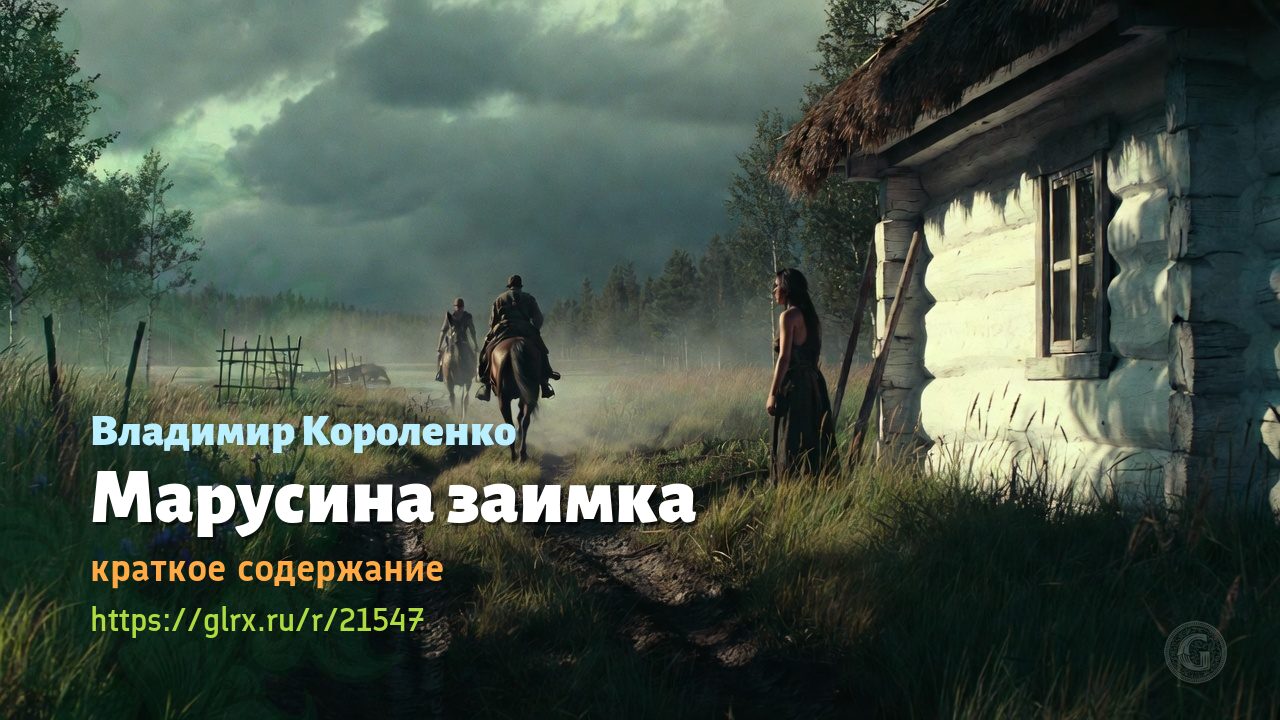
The narrator and his companion are traveling on horseback through the Amga River valley. They travel along narrow Yakut trails amidst lush grasses dotted with irises. The quiet beauty of the northern nature evokes melancholy. Along the way, they encounter wild herds of horses. Soon, the travelers accidentally stumble upon a beautifully cultivated vegetable garden with greenhouses, unusual for these latitudes. In the middle of the taiga stands a genuine Little Russian hut with a thatched roof and whitewashed walls. The mistress of the house is a young, dark-haired, somewhat wild woman, Marusya, a migrant from Little Russia. She greets the guests warily. Soon, her partner, Stepan, a tall native of the Don, arrives on a raft from hunting. Having killed a bird, he cordially invites the travelers to the fire.
The relationship between the hosts is that of a vagabond marriage. Around the campfire, Stepan eagerly tells his guests the story of how they met. As an escaped convict, he hid in the forests of Transbaikalia with two comrades. At the same time, Marusya and her friend Dasha made a daring escape from the Chita prison hospital. Finding themselves in the taiga, the fugitives lost their accomplices and accidentally stumbled upon Stepan’s group. The men took the women under their wing, earning a living by begging.
The group joined a river crew on a raft. They were later caught by the women’s former accomplices, who demanded the return of the fugitives. The crew held a trial. Marusya publicly rejected the accusations of her pursuers. She bowed deeply to Stepan, voluntarily accepting him as her husband for his kindness and caring attitude. The long journey led them to Perm Province, where the couple was arrested and sent to serve their sentence in Yakutsk Oblast.
Peasant labor and the philosophy of the plowman
While exploring the outskirts of the farmstead, the narrator comes to a clearing in the forest and meets the third inhabitant of the farmstead. This is Timofey, an elderly man from the Kaluga province. The worker is strikingly different from the dapper Stepan, with dirt on his clothes, but he nevertheless possesses a colossal work ethic. Timofey shares his memories of his attempts to introduce the local population to farming 15 years ago. Previously, Timofey served the exiled Pyotr Ivanovich. Together, they decided to plow virgin soil in a remote Yakut ulus. The locals fiercely opposed the innovation.
The Yakut chieftain summoned the plowman to a meeting. She declared that God had created the earth with grass on top and roots below. Turning over the sod was like flaying a man and turning his entrails inside out. Timofey couldn’t argue with their convictions with words. That night, a crowd of Yakuts manually turned over all the plowed soil. Later, Timofey and the landowner had a falling out over a dispute over the division of livestock.
Timofey himself found himself in exile due to a peasant revolt and the illegal plowing of someone else’s land. Left alone, he hired himself out as a laborer to Marusya. He speaks of Stepan with open disdain, considering him lazy, prone to violence, and incapable of systematic work. Marusya passionately desires a church wedding with Stepan, attempting to regain her status as his legal wife, but Timofey openly doubts the success of this venture. At the edge of the forest, the narrator notices a young larch tree: its trunk was once broken, but it straightened and continued to grow, reminiscent of the stubborn nature of the owner of the farmstead.
Night terrors and Tatar raids
Stepan is openly burdened by the monotony of hard labor and the oppressive silence of the taiga. One white night on the shore of a lake, he confesses his spiritual crisis to the narrator. The former convict longs to go to the gold mines to get rich instantly, but Marusya is categorically opposed. Stepan undertakes a long journey beyond the Nelkan River to visit a Tungus nomadic priest, hoping to secretly arrange his long-awaited wedding.
With the onset of autumn and snowstorms, the long-standing feud between the Tatar settlers and the indigenous Yakuts in the settlement intensifies. The Tatars, led by clever thieves like their neighbor Abram Akhmetzyanov, organize regular nighttime raids. They aggressively break into barns and steal livestock. The Yakuts defend themselves timidly, simply firing into the air at night. The narrator witnesses a tragic scene: a blind old man and woman, who had long saved money by grinding grain in hand mills, are deprived of all their property by robbers. Abram Akhmetzyanov justifies these brutal robberies by citing the severe hunger and poverty of the Tatars’ large families.
One night, during a snowstorm, the narrator’s horse runs away. Together with the exiled Pole Kozlovsky, they set out on a night search. At a dark river ford, they encounter the armed Stepan. It soon becomes clear that Stepan has secretly defected to the weak indigenous population. He leads the Yakut guard, organizing a fierce fight against the raiders. The former vagabond has finally found an active outlet for his boundless physical energy.
Open conflict and mob justice
Under Stepan’s direct leadership, the Yakuts achieve a series of victories. They skillfully set ambushes, recapture stolen horses, including Abram Akhmetzyanov’s chestnut, and send the captured thieves straight to prison. The Tatars are seriously demoralized, suffering losses, and are afraid to leave the settlement. In retaliation, petty thefts within the settlement itself have increased. Assessor Fedoseyev is displeased with Stepan’s excessive activity, as it is spoiling the official statistics of the otherwise peaceful police station.
The priest, who arrived in the village, flatly refuses to marry Marusya to Stepan in exchange for the 15 rubles and heifers he had prepared. He cites Stepan’s scandalous military reputation and his uncertain status as a vagabond. Timofey takes Marusya back to the farmstead, declaring the final failure of her long-standing matrimonial hopes.
The hero’s relationship with the village comes to a close on a clear, frosty day. Stepan rides down the street, straight through a crowd of aggressive Tatars. Abram’s wife, Marya, and Abram himself block his path. They publicly accuse Stepan of treason: he ate bread with them, considered them a brother, but stood up for strangers. Abram angrily reproaches him: "You’ve become a better dzhyakut than a Tatar." The crowd laughs mockingly. A beautiful Tatar woman makes an obscene gesture toward her former comrade. Morally crushed by the crowd’s cruel logic, Stepan blushes, finds no strength to justify himself, and rides away in disgrace. Soon, he finally abandons the village and goes to the gold mines.
New life on the farm
A year and a half pass. Assessor Fedoseyev informs the narrator of Timofey’s strange gunshot wound at the farmstead. According to the official version, the man himself handled the gun carelessly. Fedoseyev is certain that it was the work of Stepan, who had returned for a while. A surprising fact is revealed: the wandering priest did marry Marusya, but it was the worker Timofey who became the legal husband. The rebellious Stepan likely shot him out of intense jealousy and disappeared forever.
Later, from a long letter from an acquaintance, the narrator learns the final details. Marusya is living openly under the name Zakharova, legally married to Timofey. The farmstead is thriving, gradually becoming the center of a new, settled Siberian settlement. Marusya has two healthy sons who speak Little Russian. She runs the entire household with an iron fist. Timofey drinks frequently and periodically beats his wife. Marusya is strangely proud of these beatings in front of her neighbors, seeing her husband’s brute physical strength as a return to the comprehensible patriarchal peasant norm. The rebellious Stepan disappears without a trace in the distant gold mines.
- Vera Petrova. Quantum forest
- Exhibition "E = hν" and the project "Ministry of Eternal Life" by Vera Petrova
- Exhibition of Alexander Yakut "Neon"
- "2000 years of war. Episode I." Alexander Rukavishnikov
- Vladimir Obruchev’s "Sannikov Land," a summary
- Who received the award to them. O. Permyakova this year
You cannot comment Why?