A summary of "The Story of a Real Man" by Boris Polevoy
 Automatic translate
This book is based on the biography of Soviet military pilot Alexei Maresyev. The author changed one letter in his last name, calling the hero Meresyev. It describes his physical and mental overcoming of a terrible disability to return to combat aviation. The work was written in 1946. The author personally interviewed the hero on the Bryansk Front. The writer recorded his memories in a diary, which later became the basis for the plot.
The text was awarded the Second Degree State Prize in 1947. A year later, in 1948, director Alexander Stolper made a feature film of the same name. The film achieved enormous acclaim. Composer Sergei Prokofiev created an opera based on the story.
Air battle and fall in the Black Forest
The events begin in early spring on the Northwestern Front. Lieutenant Alexei Meresyev’s flight of Soviet fighters is escorted by attack aircraft. During a successful attack on a German airfield, Alexei becomes engrossed in pursuing transport aircraft. The pilot expends all his ammunition. The unarmed aircraft is caught in a double pincer movement by four German fighters from the renowned Richthofen Division. The experienced enemy forces attempt to force the Soviet aircraft to land on their airstrip. Meresyev makes a sharp maneuver. He escapes the escort, but the German pilot manages to shoot down the engine.
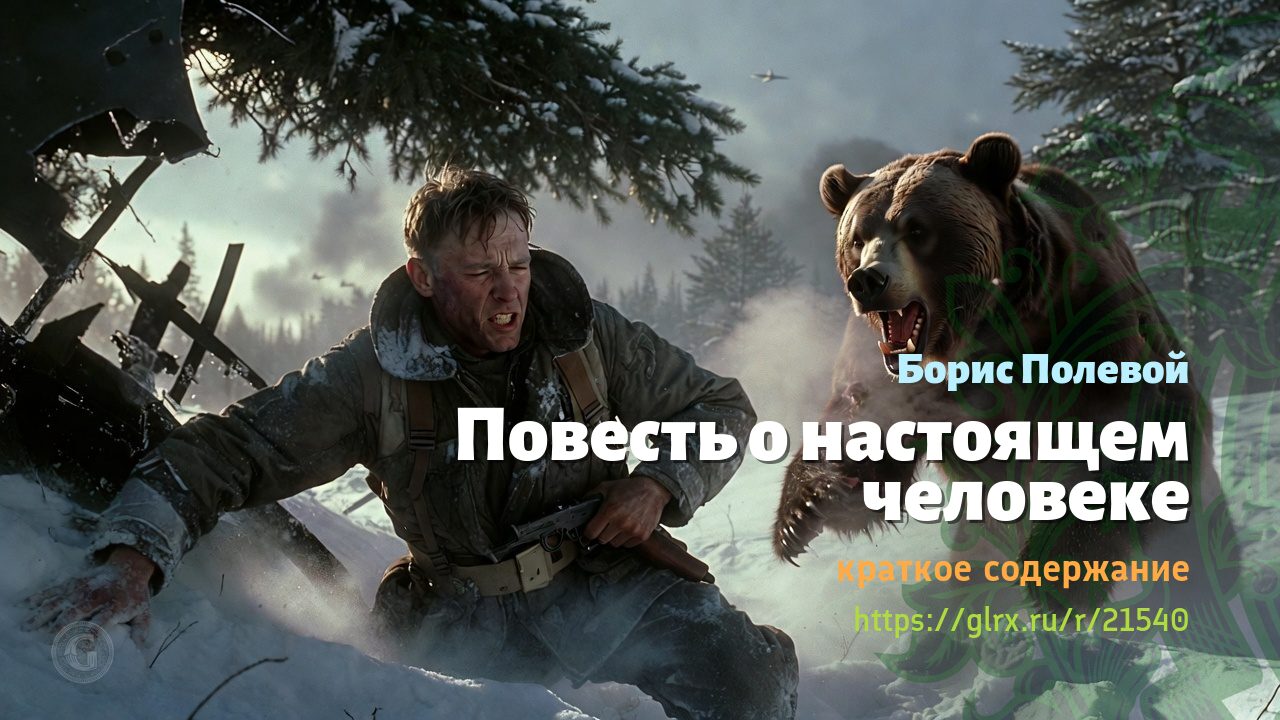
The plane crashes. The tops of centuries-old pine trees graze the plane. The powerful impact throws the pilot from the cockpit. The branches of a spreading spruce and a deep snowdrift cushion the fall. Alexey comes to in intense pain. He hears the crunch of dense snow crust. A huge, hungry bear approaches him. The bear is awakened by the roar of war. The enormous beast tears at his thick overalls with its claws. The pilot stealthily pulls a pistol from his pocket. He shoots the predator point-blank, killing it instantly.
Survival in the winter taiga
After a brief skirmish, Alexei inspects his injuries. His feet are badly damaged from the fall. The small metatarsal bones are shattered. His legs are blackened and terribly swollen. Finding himself thirty-five kilometers from the front line, Meresyev decides to walk east through the dense forest. At first, he walks, leaning on two sticks made from juniper bushes. Severe pain forces him to stop every thousand steps. He feeds on young bark, birch buds, and snow.
After several days, walking becomes impossible. The pilot breaks his spear. He rests his chin on it and drags his body forward through the loose spring snow. Later, he begins crawling on all fours. A lighter, a gift from his mechanic, Yura, saves him from certain death. Alexey warms himself near fires of dry moss. Meresyev manages to catch a hedgehog. He then feeds on forest ants and cranberries. Frostbite completely numbs his legs.
Residents rescued a burnt village
The pilot’s arduous journey to his positions lasts eighteen days. Crawling, he reaches a wide clearing. There, two local boys, Serenka and Fedka, spot him. The children call for their elderly grandfather, Mikhail. He takes the exhausted officer on a sled to an underground shelter. The residents of the village of Plavni are hiding in forest dugouts. The Germans burned their homes and hanged many of their fellow villagers. The peasants selflessly care for the wounded hero. The grandfather’s daughter-in-law, Varya, nurses him day and night. Grandma Vasilisa makes broth from the only surviving chicken, named Partizanochka.
Soon, a small U-2 aircraft appears over the forest. Alexey’s friend, squadron commander Andrei Degtyarenko, pilots the plane along with nurse Lenochka. Degtyarenko is shocked by his comrade’s pitiful condition. He looks like a skin-tight skeleton. Meresyev is carried to his home airfield on a stretcher. During a surprise attack by enemy bombers, Lenochka selflessly shields Alexey with her body. An air ambulance quickly transports the wounded man to a specialized Moscow clinic.
Moscow Hospital and Surgical Amputation
The capital’s hospital is overflowing with wounded soldiers. Alexei is temporarily placed in the hallway. The head of the clinic, Professor Vasily Vasilyevich, orders him transferred to the "colonel’s" ward, number forty-two. Meresyev’s roommates include tanker Grigory Gvozdev, Siberian sniper Stepan Ivanovich, and a fellow pilot, Konstantin Kukushkin. Later, regimental commissar Semyon Vorobyov is moved in with them. This large man suffered a severe concussion.
The gangrene progresses. Vasily Vasilyevich decides to amputate both feet. Meresyev endures the operation stoically. However, he then falls into a deep apathy. He regularly reads warm letters from his girlfriend, Olya, from Kamyshin. His mother also sends him affectionate messages. The pilot cannot admit his disability to his family. Alexey believes his active life is over.
Revival of the Spirit
Commissar Vorobyov influences the morale of the entire ward. Despite enduring monstrous physical pain, he maintains a cheerful demeanor. The commissar reads newspapers, learns German, and constantly offers advice to his comrades. Vorobyov finds an article in an old magazine about the Russian lieutenant Valerian Karpovich. This officer lost a foot during World War I. He invented a comfortable prosthesis and returned to flying on an outdated Farman aircraft.
The magazine article has the effect of a bomb going off on Meresyev. A clear goal emerges: to pilot a combat aircraft again. Alexey begins grueling daily training. On May 1st, Komissar dies. He leaves an indelible mark on his neighbors. Major Pavel Struchkov joins the ward. This pilot carried out an aerial ramming attack over Moscow. Tanker Gvozdev is discharged from the clinic. He meets Anyuta, a medical student with whom he had maintained a long correspondence.
Complex training on prosthetics
An old master, Zuyev, makes high-quality prosthetics for Meresyev. His first independent steps cause severe pain. Alexey falls heavily, but continues his training. At first, he walks along a long corridor with crutches. Then, he uses a sturdy cane given to him by the professor. The pilot gradually increases his daily walking distance to several kilometers.
To develop perfect coordination, Meresyev asks nurse Zinochka to help him. This girl works at the Air Force sanatorium. Alexey asks her to teach him complex salon dances. To the rhythmic sounds of the accordion, he learns the difficult moves. Zinochka is unaware of her diligent partner’s lack of vitality. Olya writes Alexey a long letter from the construction of defensive lines near Stalingrad. She accuses him of coldness and distrust. However, the pilot decides to tell the truth only after shooting down his first enemy aircraft.
A persistent return to aviation
Meresyev negotiates an audience with high command. Recognizing the officer’s unprecedented willpower, the military command sends him to a training school. The school’s chief of staff and the strict instructor, Naumov, are initially skeptical of the idea of flying on artificial legs. Meresyev orders special leather straps from the garrison shoemaker. These are needed to firmly attach the prosthetics to the foot pedals. On his very first flight in a U-2 trainer, he impresses the instructor with his unrivaled skill.
Next comes a transfer to another school to quickly master the newest, high-speed La-5 aircraft. Alexey experiences enormous difficulties. The prostheses lack their natural elasticity. His motor coordination is often impaired. After his first unsuccessful landing, the pilot despairs. Political Officer Kapustin secures a customized program of additional flights for him. Gradually, Meresyev completely merges with the powerful machine. He instinctively transfers the muscular sensations of his work to his shins. Having successfully passed a rigorous examination, the pilot is assigned to an active combat regiment.
Baptism of fire at the Kursk Bulge
In the summer of 1943, Alexey arrived at the Guards Fighter Regiment. Regiment commander Ivanov appointed him the experienced leader of a pair. The massive Battle of Kursk began. While providing cover for advancing Soviet tanks, the squadron engaged in a fierce battle. They attacked German Junkers-87 dive bombers. Meresyev shot down two enemy aircraft, including a highly experienced pilot from the Richthofen Division. He saved the life of his young wingman, Sasha Petrov. The fuel ran out completely. The engine stalled mid-air. Alexey glided and landed smoothly on the edge of the airfield.
That same summer evening, Meresyev takes out a photograph of Olya in a formal officer’s tunic with the Order of the Red Star. The girl is rebuilding Stalingrad, devastated by the bombings. Now the pilot feels morally equal to her sublime courage. In the silence of the forest at night, Alexei writes the whole truth to his fiancée. The forest is interrupted only by the rumble of distant cannon fire and the ringing song of Kursk nightingales. The pilot reports his amputated legs.
Meeting with the author of the book
The story concludes with the author’s afterword. The writer visits this air regiment during the successful conclusion of the Oryol operation. He meets the commander of the third squadron. The officer had flown seven combat sorties in one day. That evening, in a spacious dugout, the writer is amazed to notice the officer’s prosthetic legs. The pilot tells his guest the story of his miraculous survival and describes the arduous process of returning to duty.
Almost five years later, Guards Major Alexei Maresyev calls the author at home. This happens after a radio dramatization based on this astonishing story. Old friends meet in Moscow. Maresyev shares his news. He survived the war to victory. The pilot shot down several more planes over the Baltics. His homeland awarded him the prestigious title of Hero of the Soviet Union. He is happily married to his beloved girlfriend. The family is raising a young son, Viktor. Maresyev has brought his elderly mother to live with him from distant Kamyshin.
You cannot comment Why?