A summary of Vladimir Nabokov’s "Invitation to a Beheading"
 Automatic translate
The novel was written in 1934. It recounts the final days of a prisoner awaiting execution for "epistemological abomination," that is, his opacity to those around him. The author himself later called this text his only prose poem. A lonely man with a living consciousness is forcibly placed in a grotesque, false society, where people are completely intelligible to one another, and all events resemble a bad spectacle.
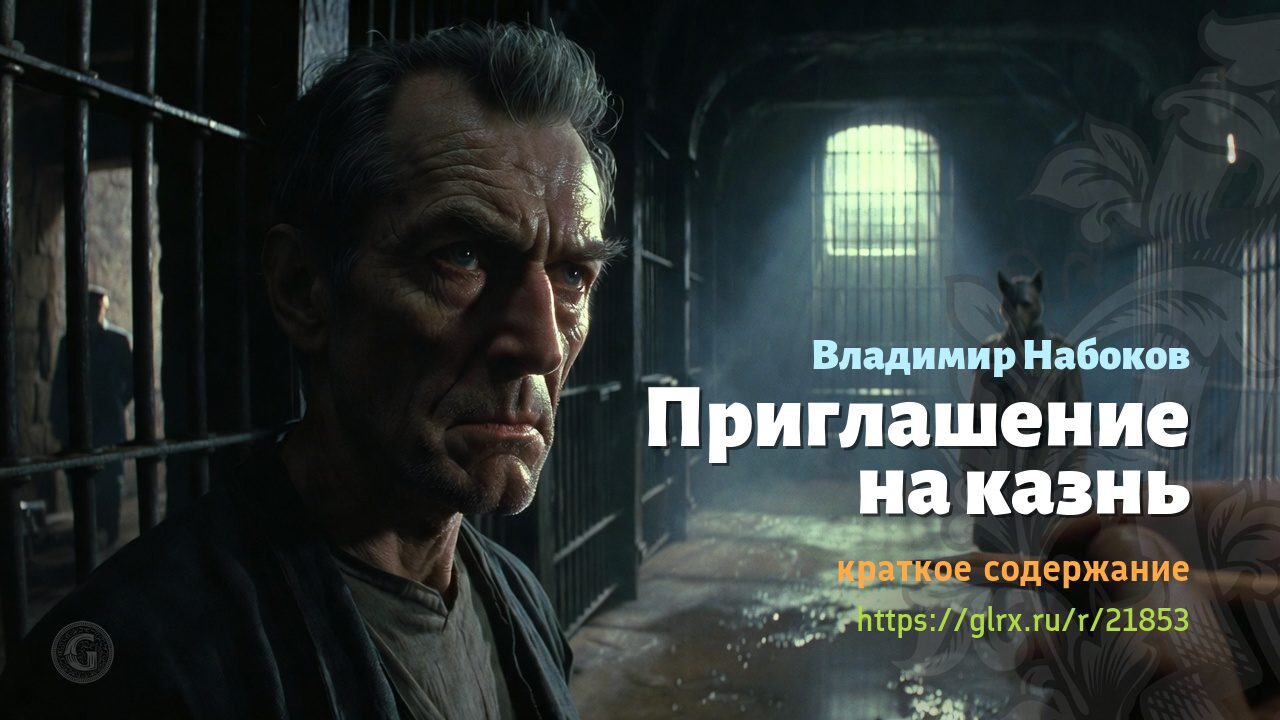
The confinement and absurdity of the dungeon
Cincinnatus C. receives the death sentence, announced to him in a whisper by a gray-haired judge. The court accuses him of impenetrability. In the company of transparent souls, Cincinnatus appears as a hidden obstacle, blocking the rays of others’ gazes. The hero is taken to a cell in a high fortress. There, he encounters strange prison rules. The jailer, Rodion, exuding the smell of garlic and tobacco, invites him to dance a waltz, while guards in dog masks patrol the corridors. Prison director Rodrig Ivanovich vanishes into thin air and behaves unnaturally. Defense attorney Roman Vissarionovich is preoccupied only with a lost cufflink. All the representatives of the administration merge into a single, farcical mass of actors in a cheap theater.
The main torture for the hero becomes concealing the exact date of the execution. The prison director evades direct answers, citing the rules. Cincinnatus writes down his thoughts with a sharpened pencil on paper. He feels a pressing need to speak out, to describe the "syncopation" and pause in time in which he has become accustomed to living. The hero recalls his childhood in a dormitory beyond the Strop River, his work in a workshop where he created dolls of figures from the mythical nineteenth century. He recalls his work as a teacher of category F, where he swung on swings with the disabled. Cincinnatus constantly turns to his wife Marthe in his thoughts, analyzing their lives.
Betrayal of loved ones and a new neighbor
Cincinnatus’s relationship with Marfinka brought him much pain. They met in their youth, strolling in the spacious Tamara Gardens. Soon after their wedding, Marfinka began regularly cheating on her husband. She bore two children by casual lovers — an evil boy named Diomedon with a lame leg and a plump, blind girl named Polina. Marfinka openly justified her infidelities with her own gentleness and kindness. Cincinnatus endured her betrayals, masking his sobs with the sound of a flushing bathtub. He continued to love his wife hopelessly until he was arrested during a public meeting in a city park, when the crowd sensed his hidden nature.
The administration promises to alleviate the prisoner’s loneliness. Soon a new inmate arrives — a plump, amiable little man named Monsieur Pierre. The director proudly displays the newcomer through the peephole. Pierre, dressed in clean striped pajamas, entertains the administration with magic tricks and raunchy jokes. He persistently tries to befriend Cincinnatus, showing off his photo albums, boasting about his biceps, and performing acrobatic stunts with a chair. Cincinnatus treats him with profound distaste. They bring him old glossy magazines from the prison library and the novel "Quercus," about the centuries-old life of an oak tree. The book is considered the pinnacle of modern thought, but Cincinnatus finds it boring, pining for the unknown.
Family ghosts and hope for escape
One day, Marfinka’s family fills the cell. They bring their household furniture, including a sofa and a mirrored wardrobe with its own reflection of the bedroom. The relatives create a noisy commotion. The father-in-law bangs his cane, scolding his son-in-law for his disgrace. Marfinka flirts with her new beau, a telegraph clerk who smells of violets. The grandparents sit to the side, holding a portrait of their misty mother. The brothers sing songs, the children run around the cell. Cincinnatus is unable to get alone with his wife for a serious conversation.
Later, the prisoner is visited by his mother, Cecilia C., a woman in a black raincoat whom he has seen only once in his life. The conversation is strained. Cincinnatus accuses her of being a mere parody of his mother. Cecilia tells him about a childhood toy — a crooked mirror — and the distorted objects known as "netkas" (non-figures) that take on a slender appearance only in it. At the end of their meeting, the hero notices a glimmer of genuine, undeniable human suffering in his mother’s eyes.
The director’s daughter, Emmie, constantly darts through the stone corridors. She throws a red-and-blue ball, makes faces, and exchanges mysterious glances with the prisoner. The girl brings drawings that resemble a possible escape plan. Cincinnatus naively hopes that Emmie will help him escape. Soon, at night, he begins to hear a rhythmic knocking sound. Someone is purposefully digging a tunnel to his cell. Cincinnatus waits with bated breath for his liberators. The yellow wall collapses with a roar, but Monsieur Pierre emerges from the hole, accompanied by the director. It turns out they dug a passage from the neighboring cell solely for the sake of their shared amusement.
The True Role of Monsieur Pierre
The hero is forced to crawl on all fours through a filthy tunnel to Pierre’s cell. There, he sees elegant furnishings, pansies in a porcelain cup, and notices a large case. Pierre carefully opens it, revealing a wide, light-colored axe. Monsieur Pierre officially announces that he is the executioner, sent specifically to the fortress to carry out the death sentence. The director and lawyer are present, eagerly drawing up the paperwork. Pierre openly complains about Cincinnatus’s coldness, demanding from him sincere friendship, love, and voluntary submission during the upcoming execution.
On the eve of his execution, Cincinnatus is taken to a farewell dinner. The event takes place in the lavishly furnished suburban home of the deputy city manager. High-ranking officials are present: the chief of telegraph operators, the fountain manager, and the judge. Monsieur Pierre acts like an honored guest, pronouncing ceremonial toasts, joking, and entertaining the crowd with anecdotes. Cincinnatus sits impassively at the table, balancing a fish knife on a crystal salt shaker. Then the guests emerge onto the stone terrace. At the command of the chief engineer, a magnificent electric illumination bursts into life in the Tamara Gardens. A million colored bulbs form gigantic, flaming monograms of the executioner and the victim. The hero is returned to the dark fortress.
The disintegration of the illusory world
At dawn, Cincinnatus prepares for death, hastily writing his final lines on a piece of paper. He notes that fear is shameful and futile. However, time passes, and no one comes for him. The jailer, Rodion, brings breakfast and catches a huge moth in a towel, but it escapes and settles on the bedpost. During the day, Marthe is allowed to visit the prisoner briefly. She rudely reproaches her husband for compromising her with his frank letters. His wife asks him to repent for the sake of his children’s reputation and informs him of her upcoming wedding to an unpleasant elderly neighbor. The conversation brings no consolation. Cincinnatus becomes completely disillusioned with earthly attachments.
M’sieur Pierre, the director, and the lawyer enter the cell to fetch the prisoner. They look pale, frightened, and bereft of their former theatrical polish. Their clothes have been reduced to pitiful rags. The cell begins to rapidly disintegrate: the window bars fall off, a chair breaks, the walls crack. Cincinnatus is led out into the sun-drenched street. The city is abundantly decorated with welcoming banners, and a crowd of citizens joyfully hurries to the square. On the scarlet scaffold, M’sieur Pierre puts on a white apron and orders the prisoner to lie flat on the block, urging him not to tense his muscles. Meanwhile, the deputy manager advertises a furniture exhibition.
Cincinnatus obediently lies down, but begins counting out loud and, at the last moment, questions the meaning of what’s happening. He realizes the complete illusory nature of the world around him and his own primal fear. He simply rises from the block and slowly descends the platform, ignoring the cries of the dwarf director. The staged reality begins to crumble around him. The wooden railings are visible through the figure of the spinning executioner. A pale librarian vomits on the steps. The trees turn out to be flat scenery without relief, and the audience loses its outlines. The square, the scaffold, and the remnants of false existence finally dissolve in a whirlwind of dry dust. Cincinnatus heads in the direction where, judging by the sound of his voices, creatures similar to himself are standing.
You cannot comment Why?