Vladimir Nabokov’s "The Luzhin Defense," a summary
 Automatic translate
Vladimir Nabokov’s novel was written in 1929 and published in 1930. The story unfolds the tragedy of a brilliant chess player whose consciousness is gradually consumed by the game, blurring the boundaries between the real world and the chessboard. Chess replaces the protagonist’s human attachments, transforming life itself into a complex and destructive game.
The work was successfully adapted into a film in 2000. The film of the same name, starring John Turturro and Emily Watson, brought widespread attention to the novel.
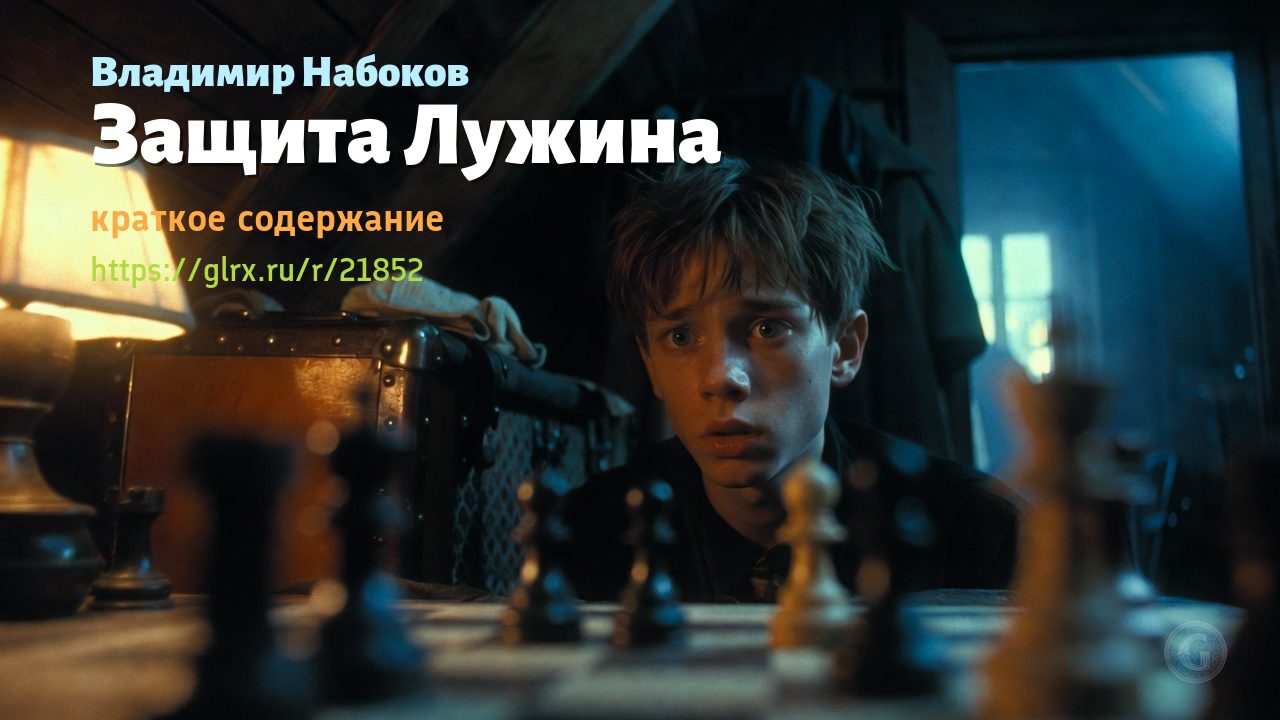
Childhood and the discovery of chess
Little Luzhin is a withdrawn and sullen boy. His family moves from the estate to St. Petersburg. His parents inform their son of a new detail about his school life: from now on, he will be addressed exclusively by his last name. A plump French governess reads him the story of the Count of Monte Cristo. School frightens the boy; he finds it difficult to connect with his peers.
His classmates mock him, slipping him tattered books. The hero’s father, an author of mediocre young adult novels, tries in vain to discover musical or artistic talent in his son. The bullying takes a toll on the boy. He runs away into the damp forest, soils his shorts, and hides in the attic for long periods. Only mathematical riddles and card tricks fascinate him.
Some time later, a crowded musical evening is held at the house in memory of his late composer grandfather. The boy hides in his father’s dark study. There, he overhears a telephone conversation with a visiting violinist. The musician openly admires chess, calling it the game of the gods. This confession awakens a burning interest in the child.
A boy asks his red-haired aunt to teach him the rules. The aunt demonstrates the basic moves. The student begins skipping classes regularly, going to her home. There, he meets an elderly visitor bringing flowers. This old man reveals to him the true beauty and strict logic of chess.
From that moment on, the game completely captivates his mind. The young player diligently studies old magazines in his late grandfather’s damp study. He effortlessly reconstructs other people’s games from memory and solves the most complex puzzles blindfolded. Little Luzhin secretly buries his father’s chess pieces in the garden, fearing a sudden ban on his favorite pastime.
Becoming a Grandmaster
His missed lessons are quickly discovered. The father finds an old chess set in the attic and tries to play with his son. The boy easily defeats his father and his surly doctor friend. The teenager’s phenomenal talent is revealed. His photograph appears in Moscow’s illustrated magazines. Soon, the teenager suffers from a nervous breakdown, after which school becomes a thing of the past.
The father begins taking his son to major tournaments in various cities. Later, Valentinov, an enterprising businessman, appears and takes on the role of manager. He strictly isolates the young man from other hobbies and meticulously monitors his strict diet. The manager encourages his talent in every possible way and brazenly exploits the child prodigy’s gift for financial gain.
Later, the player gives blindfolded chess exhibitions on multiple boards simultaneously. He skillfully operates solely with pure chess forces in his mind. As the years pass, the grandmaster matures. Valentinov abandons his protégé, becoming seriously interested in cinema. His father’s death passes almost unnoticed by his son.
Before his death, the writer Luzhin Sr. attempted to write a story about his brilliant son, but he died without completing the project. The son simply visits a cemetery in Berlin, wanders alone in the drizzle, and immediately returns to his thoughts over the blackboard.
Meeting at the resort
Sixteen years pass. The former child prodigy has transformed into a heavyset, unkempt, and extremely unsociable man. At a German resort, strolling among the alleys lined with clay dwarfs, he meets a young Russian girl. She comes from a wealthy émigré family. The unusual nature of this strange guest evokes in her a keen pity and an inexplicable sympathy. She sees him as a defenseless man in desperate need of protection.
The hero barely knows how to communicate. He constantly drops things on the pavement — handkerchiefs, cigarettes, coins. The man is completely absorbed in preparing for the upcoming match. He is facing the Italian master Turati. The Italian uses bold, innovative openings. The grandmaster is agonizingly searching for the perfect defense.
During a short walk, the chess player awkwardly proposes marriage to the girl. She immediately accepts. The bride’s parents are horrified by their daughter’s choice. The mother angrily screams and calls the groom a Bolshevik. The father suggests a life-saving trip to the Italian lakes, but the bride remains adamant.
The Berlin Tournament and the Disruption
In the fall, a grand chess tournament begins in Berlin. Nervous tension quickly mounts. The player gradually loses touch with reality. Everything around him seems like a pale backdrop. Chess games drain the last of his physical strength. Nights become a sophisticated torture of insomnia. He successfully defeats a tenacious Hungarian and a gray-haired Englishman, but the main battle is yet to come.
The day of the main match arrives. The hero sits down at the board with Turati. The Italian unexpectedly abandons his aggressive opening. The game enters a phase of complex positional maneuvers. Neither can gain a clear advantage. Mental tension reaches its absolute limit.
A break is called, but the player’s mind is unable to emerge from its trance. It seems as if the pieces continue to advance relentlessly, dragging him into a fatal abyss. In a state of severe confusion, he leaves the café. The chess player wanders the city at night for a long time and falls into unconsciousness. Two tipsy passersby find him on a sidewalk and take him to his fiancée’s apartment. A doctor arrives and diagnoses him with severe nervous exhaustion.
Recovery and an attempt at a normal life
A former child prodigy awakens in a white sanatorium room. A doctor with an Assyrian beard and his fiancée convince the patient to give up chess completely. They insistently explain to him that the game was the direct cause of his terrible illness. The patient dreams of enormous chess pieces, and he feels like a tiny pawn. Surrounded by constant care, the man willingly agrees to forget the past. A period of quiet, measured life begins.
A modest church wedding takes place. The newlyweds settle into a spacious Berlin apartment. The study is furnished with brown velvet armchairs, and a bust of Dante in a bathing helmet adorns the shelves. His wife tries her best to fill her husband’s everyday life with new interests. She reads Jules Verne to him and takes him to museums and the cinema. Luzhin is introduced to the noisy Russian émigré community.
The father-in-law gives his son-in-law a fine typewriter. The former chess player diligently learns to type. He even draws pencil cubes with neat shadows. Harmless images of early childhood emerge in his memory — an old water-powered elevator, a plump governess. It seems as if the terrible shadows of the past have receded forever.
Return of the game
The everyday tranquility proves temporary. During a visit from a persistent guest from Soviet Russia, the host wants to perform a card trick for her son, Mitka. He accidentally finds a morocco pocket chess set in the pocket of his old jacket. This unexpected discovery instantly awakens a dormant passion. Soon, Luzhin begins to notice familiar patterns in everyday life.
He imagines an invisible adversary conducting a complex, merciless game. Events from the past begin to repeat themselves in a frightening way. A meeting with his former school friend Petrishchev at a charity ball confirms this terrifying suspicion. The hero desperately tries to find a defense against this life-changing combination. He commits absurd, spontaneous acts, hoping to confuse the invisible enemy. While walking down the street, he suddenly enters a hair salon and asks to sell a wax mannequin.
Fatal ending
The final crushing blow comes with the sudden appearance of Valentinov. The cunning businessman ambushed his victim on the street, bundled him into his car, and whisked him off to a film studio. His former manager offered him a role in a film alongside Turati. This treacherous offer fully reveals the invisible adversary’s plan: to bring the broken player back to the chessboard. The hero clearly understands the impossibility of escape and tells his wife, "The only way out is to drop out of the game."
He quickly returns home. His wife is busily preparing to receive numerous guests. Realizing the hopelessness of his situation, Luzhin removes everything from his jacket pockets. The husband kisses his wife’s hands and locks himself in the bathroom. While the guests and his sobbing wife try to break down the door, the fugitive smashes the frosty windowpane with a heavy chair.
He climbs onto the dresser and, with great difficulty, squeezes through the frame. Below, eternity stares down at him, obediently disintegrating into pale and dark squares. The window becomes a saving square on a chessboard. He unclenches his numb hands. When the broken door finally gives way, the cramped room is empty.
You cannot comment Why?