A summary of "The Jokers" by Alexander Ostrovsky
 Automatic translate
This book is a classic comedy with strong elements of social drama, written in 1864. The narrative centers on the conflict between poor commoners and wealthy merchants. The author masterfully depicts the deformation of personality under the weight of constant deprivation. The protagonist voluntarily adopts the role of a jester for the sake of his family’s physical survival.
The work has been adapted for television several times. The most famous was the 1989 Soviet television production, in which Yevgeny Leonov brilliantly portrayed the title character. This television production faithfully captured the dark tone of the classic author’s original text.
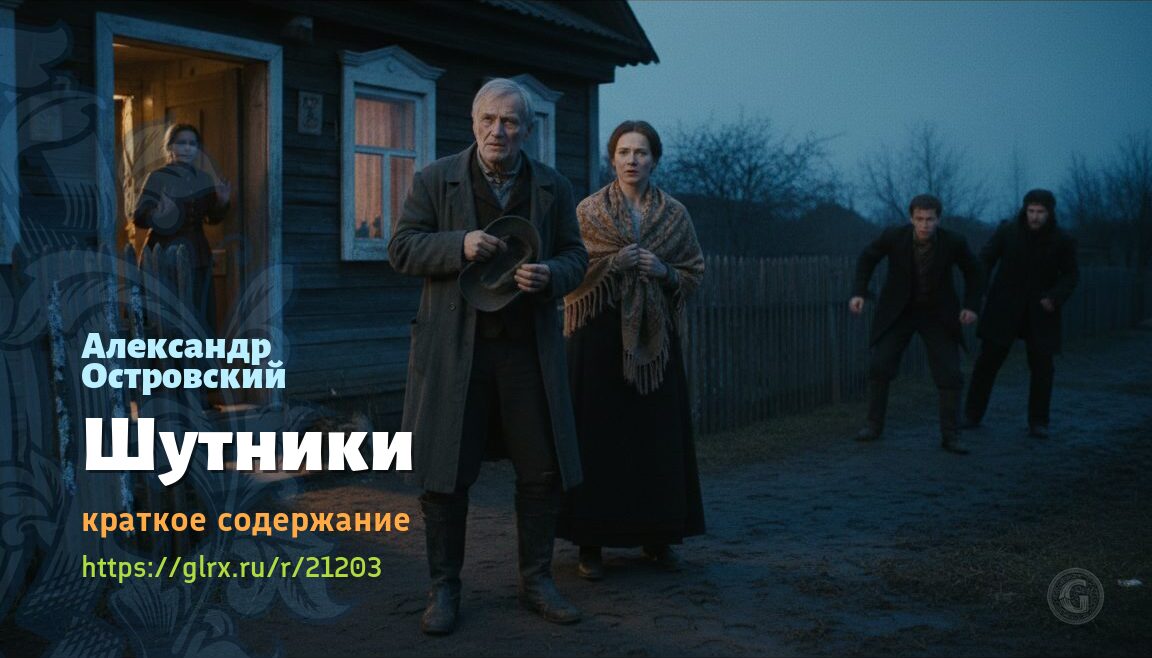
Everyday life of the Obrosov family
The action unfolds near the small house of retired civil servant Pavel Prokhorovich Obrosnov. He lives with his two daughters, twenty-five-year-old Anna and seventeen-year-old Verochka. The family suffers constant poverty. The mezzanine rooms are empty, and the rent-to-own notices are regularly torn down by the mischievous children of wealthy neighbors. Obrosnov complains to Anna about the coarse manners of these people. Anna sympathizes with her father and condemns him for his habit of groveling before the rich.
The old man explains his behavior in detail as a result of absolute desperation. In his youth, he was proud, but the need to feed his children forced him to compromise his principles. He recalls his first order from a wealthy neighbor. The client invited him to a tavern, remained silent throughout the meal, and then began running his fingers over Obroshenov’s face and hair. The retired official tolerated the taunt and brought his wife three gold coins. From then on, he entertained merchants, allowed them to smear his face with soot, and grimaced in public.
Behind the doors of his home, Obrosnov remains a loving father, willing to make any sacrifice for his daughters. He saves money, arranges his household, and secretly purchased a small house for two thousand rubles for his youngest daughter’s future family. He searched long and deliberately for a son-in-law. Obrosnov chose a modest orphan who doesn’t frequent taverns and leads a quiet life.
Matchmaking and the first troubles
A young civil servant, Alexander Petrovich Goltsov, comes to the Obrosovs. He asks for Verochka’s hand in marriage, but is extremely depressed. Goltsov urgently needs three hundred rubles. Anna assures him that her father has no available funds. The young man confesses that he hopes to get the money from his wealthy neighbors, Nedonoskov and Nedorostkov.
Verochka, waking up, goes out to see her guest. At first, she’s capricious and refuses marriage. She insists she wants to always sit next to her father and sister. Goltsov describes their future life together. He promises to take care of her and call her by affectionate names. The girl gives in to his persuasion and agrees to marry him. The hopeful groom goes to his wealthy neighbors for a loan.
A rude sixty-year-old merchant, Filimon Protasyich Khryukov, enters the courtyard. He behaves unceremoniously, boasting of his enormous wealth and willingness to spend money on personal pleasures. Khryukov ridicules Verochka’s fiancé, calling Goltsov a lowlife who doesn’t know how to steal. Old Obrosnov fawns over the merchant, calling him a father and benefactor. As he says goodbye, Obrosnov even crows in Khryukov’s ear, eliciting a disdainful reaction.
Goltsov’s drunken escapade and confession
A drunken Goltsov stumbles through the gate, accompanied by Nedonoskov and Nedorostkov. The neighbors tricked the teetotal youth into giving him champagne. They brought him to a stranger’s house and brought out a fake bride, disguised as a maid. Realizing he was being laughed at, Goltsov fled. Now, in desperation, he demands three hundred rubles from Obrosov, accusing the old man of stinginess and concealing his capital. Verochka refuses the drunken groom. Anna and Obrosov chase the young man out of the yard.
The action shifts to the street near the gate. A crowd gathers. Obroshenov and a sobered-up Goltsov appear. The young man repents of his rude behavior and reveals to the old man the true reason for his search for the money. It turns out he embezzled three hundred rubles from the state. The landowner had sent them to the Council for payment. The money had been used for his mother’s funeral and rent. Goltsov hoped to recoup the amount from his salary, but he was denied a bonus. If the debt is not repaid immediately, Goltsov will face a shameful trial. Obroshenov promises to save the young man.
Cruel fun with an envelope
Nedonoskov, Nedorostkov, and the shopkeeper Shilokhvostov are strolling around. Obrosov approaches them and shames them for bullying the weakling. The rich men decide to punish the old man for his insolence. They persuade Shilokhvostov to plant a fake bag of newspaper on Obrosov.
Obroshenov notices an envelope lying on the ground. It says it contains banknotes worth sixty thousand rubles. The old man blindly believes in his luck. He hopes to receive his rightful third share for this valuable find. In a state of complete euphoria, he runs home. A crowd of onlookers laughs loudly at the gullible official.
At home, Anna talks with Ulita Prokhorovna, Obrosnov’s sister. The elderly woman is wandering around the houses of her acquaintances with a large sack, collecting food and belongings. She, too, is complaining about the foolish behavior of Nedonoskov and Nedorostkov, who recently dropped a bag on her head. After her aunt leaves, Anna persuades Verochka to forgive her fiancé. Goltsov appears and awkwardly apologizes. The girl initially takes his hat, but soon completely forgives the young man. Obrosnov runs in with a bag in his hands.
The old man opens the package, expecting to find banknotes. Inside, he finds only old newspapers and a note with an illiterate taunt. Obroshenov falls into a state of severe shock. He refuses to believe what’s happening and frantically searches his coat pockets for money. He feels sick from the terrible grief. Anna urgently sends Goltsov for a doctor, promising to personally solicit a loan from Khryukov.
Khryukov’s proposal and defense of honor
Obroshenov is gradually recovering from a severe attack. Khryukov arrives at the house. Anna asks him to lend her exactly three hundred rubles. The merchant places the money on the table. In exchange, he offers the girl to move in with him as his housekeeper, promising full support. Anna takes these words as a deep personal insult. Angrily, she throws the bills back and demands that the merchant leave the house.
Obroshenov enters the room. Upon learning of the sordid proposal, he instantly transforms. The old man forgets his buffoonery. He demands that Khryukov kiss Anna’s hand and apologize for his ignorance. The merchant refuses and continues to humiliate the family, rudely citing their extreme poverty. Obroshenov grabs a chair and throws his recent benefactor out. He promises to kill anyone who encroaches on his daughters’ honor. Insulted, Khryukov threatens him with prison and demands immediate repayment of all old debts.
The family is left in a dire situation. Obroshenov confesses to Anna that his sudden courage has vanished without a trace. He fears Khryukov’s wrath, as he owes him a huge sum of money in bills and promissory notes. The merchant’s clerk appears and curtly demands that the old man report to his master immediately. Obroshenov meekly takes his hat and leaves to face humiliation.
An unexpected plot twist
Deep gloom descends on the house. Goltsov breaks catastrophic news to Anna. The landowner he deceived will arrive in Moscow in two days. The young man confesses that he is ready to commit suicide out of desperation. Vera tearfully embraces her fiancé, foreseeing a quick separation, trial, and public disgrace.
Suddenly, Obroshenov’s loud voice is heard from the street. He runs into the room with cries of joy, ordering the young official and Verochka to kneel before Anna. The old man announces incredible news. Khryukov claimed that his recent remarks about the housekeeper were merely a test of a woman’s modesty. In fact, the wealthy merchant is asking for his eldest daughter’s hand in marriage and voluntarily giving her twenty thousand rubles as a substantial dowry.
Anna unhesitatingly agrees to marry the older man. She soberly realizes that this union will save her aged father from inevitable debtor’s prison and Goltsov from trial for embezzlement of state funds. The girl is genuinely delighted at the opportunity to provide peace for Obrosnov and a dignified future for her younger sister. The family celebrates their victory over dire poverty. A happy Obrosnov promises to dance merrily at his daughter’s wedding. He is confident that their great wealth will forever protect them from cruel ridicule.
- The Center for Theater and Cinema, led by Nikita Mikhalkov, is restarting the fifth Metamorphoses
- "A Month in the Village" by Ivan Turgenev, summary
- Mikhail Lermontov’s "Princess Ligovskaya," a summary
- "Office Romance" by Emil Braginsky and Eldar Ryazanov, summary
- "Comrades in Arms" by Emil Braginsky and Eldar Ryazanov, summary
- Local axonometry and promising effects
You cannot comment Why?