A summary of "The Girl with Silver Blood" by Tatyana Korsakova
 Automatic translate
Tatyana Korsakova’s novel, published in 2016, combines historical adventure, mysticism, and romance. The action revolves around Ivy, the heir to a family whose silver blood gives her the power to descend into the Netherworld and subdue the master of the lake, who demands a bloody tribute. The book’s most compelling plot stems from the fact that Fyodor Shumilin’s personal fate is linked from the very first pages to someone else’s ancient debt, and his ordinary feelings for the girl gradually draw him into a strange, very old, and dangerous story.
Escape and rescue
At the beginning of the novel, Count Fyodor Shumilin, convicted of involvement in a political case, wanders through the forest after a prison sentence, nearly dying from heat, hunger, and thirst. He recalls Sasha Epstein, her revolutionary speeches, and Fyodor’s own naive belief that social order could be softened without bloodshed. His escape no longer seems like a heroic achievement, but the last effort of a tormented man who has lost his strength, his name, and his former life, but still stubbornly clings to existence.
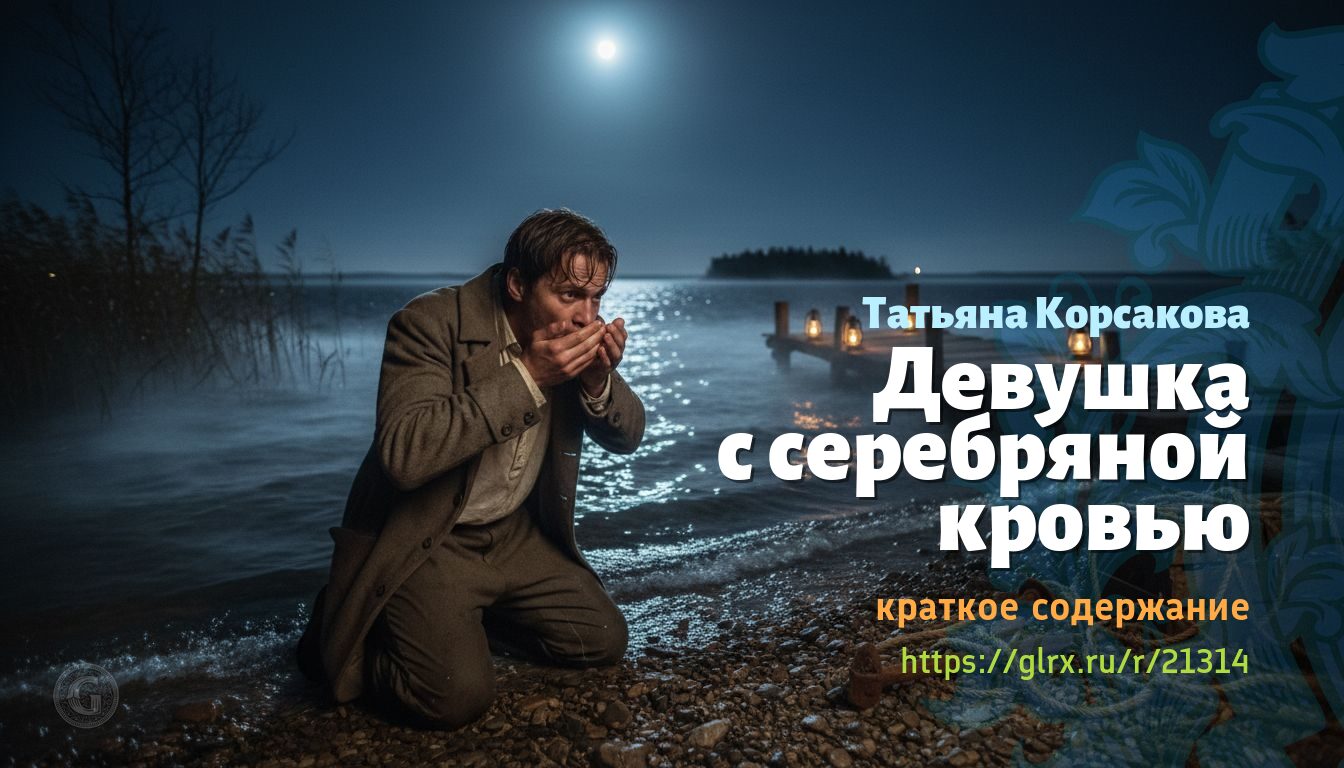
At night, he comes to a vast lake, silver in the moonlight, greedily drinking the water and feeling the lake give him life again. Then, it begins calling him to a distant island, promising salvation but simultaneously instilling fear. The crossing turns into a confrontation with an unknown force: Fyodor experiences visions, finds himself in a strange, dead space, hears strange voices, and for the first time comes into contact with the world from which the thread will later stretch again and again to Ivy and Yellow-Eyes.
Upon awakening, Fyodor realizes he’s arrived at the Guard Stone, home to the old man Akim Petrovich, his granddaughter Ivy, and the stern Evdokia Tikhonovna. Akim Petrovich is initially wary of his guest, even testing his blood with a strange ritual. He then spares him and places a silver bracelet on his wrist, as if he knew immediately that the escaped convict has already been marked by the lake and needs protection, not pity.
Guardian Stone
While Fyodor recovers, the novel slows down and carefully depicts life on the island: the hard work of the household, Akim Petrovich’s workshop, conversations around the table, Evdokia’s silent participation, and the uneasy silence in which everything here operates according to its own rules. Fyodor increasingly sees that Guard Rock is not just a secluded island, but a place of service, almost a post, where behind the outward simplicity lies knowledge of forces that must not be unleashed.
At first, Ivy remains a mystery to him: she has an unusual name, a light, almost bird-like gait, the gift of mind-reading, and the ability to appear where an ordinary person could not. A bond quickly develops between her and Fyodor, and this feeling grows not from empty confessions, but from shared danger, from caring, and from the fact that Ivy is the first to see him not as a fugitive criminal, but as a living, suffering person.
The bond deepens when Fyodor repairs a complex clock with moving figures, dear to Ivy’s heart and memory. For him, this work becomes a way to regain his dignity and rediscover the value of craftsmanship, and for Akim Petrovich, it’s proof that the man in the house isn’t just a random ragamuffin, but a man of intelligence, engineering acumen, and inner discipline.
Chernokamensk and Perm
Realizing that Fyodor can’t be hidden on the island for long, Akim Petrovich obtains new documents for him under the name Fyodor Timofeevich Lednev and, through Evdokia, arranges for him to work in the repair shop at the Kutasovsky Plant. Thus begins the second major plot line of the novel: the former count enters the working class of Chernokamensk, develops a new biography, and learns to live without his former title, relying no longer on his birthright but on his knowledge, skill, and endurance.
At the factory and in the city, Fyodor encounters a new circle of people — primarily Savva Kutasov and the architect August Berg, a talented but capricious man fascinated by mechanisms and the beauty of technical form. Fyodor’s attraction to August is no coincidence: both appreciate the structure of things, both are able to see iron as a living mechanism, and through this friendship, the novel shows how craftsmanship and ingenuity help the hero stay above water while mysticism grows around him.
However, this life doesn’t become peaceful, because the Guardian Stone and Ivy don’t let Fyodor leave even at a distance. He yearns for the island, writes long letters to Ivy, finds himself strangely drawn back, and later, together with August and Sergei Zlotnikov, finds himself in Perm, where he commissions a medallion and bracelet with a swallow from the jeweler Solomon Yakovlevich — a token of his love and memory of the one whose presence he feels almost physically.
Silver Blood
As the story unfolds, Fyodor learns that the women of Ivy’s line bear a grave gift: they are able to descend into the Netherworld and communicate with the master of the lake, known in the book as Yellow-Eyes. This gift is not a blessing — it drains, demands retribution, and makes the silver-blooded woman both a guardian and a victim, because each such encounter drains her strength and brings her closer to the boundary between worlds.
Fyodor himself repeatedly finds himself drawn into these transitions and sees the Netherworld as a space of dead boats, dilapidated objects, dust, and ancient horror. In one of the most intense episodes, Ivy engages in direct confrontation with Yellow-Eyes, expending almost all her energy, and Fyodor, no longer thinking, carries her out of the dead world, finally accepting that from now on his life will be governed not by the laws of reason and career, but by the struggle for this girl.
From this point on, the novel increasingly links love with doom. Fyodor longs for an ordinary future, dreams of giving Ivy jewelry, writing her letters, and living nearby. In return, he receives the knowledge that the lake always stands beside her, behind which lies an old hunger, an alien will, and a debt from which it is almost impossible to emerge alive and unharmed.
Denouement
The final chapters draw the action back to the lake, where the old call returns as a command, and where Fyodor, exhausted, wounded, and nearly lost, walks toward the water as if called by two names and two destinies at once. The lake responds to him like a living being; the path along the water seems like an open path, but behind this miracle looms a deadly trap — the call of the bottom, which he finds increasingly difficult to resist.
On the shore, Kaisa and Evdokia try to stop him, and the scene unfolds with extreme brutality: Evdokia shoots Fyodor and begs his forgiveness, because she sees before her a man on the verge of transformation, not the guest once brought to the Guard Stone. As he sinks, Fyodor realizes the lake has rejected him, notices Yellow-Eyes’s frustration, and at the last moment sees a swallow soaring toward the sun. With this, the novel ends the action, leaving a sense of loss, liberation, and ambiguity immediately, without any final explanation.
- "Come into My Dreams" by Tatyana Korsakova, summary
- Summary of "The Serpent’s Daughters" by Tatyana Korsakova
- A summary of "The Heart of the Beast" by Tatyana Korsakova
- A summary of "Earthling" by Roman Zlotnikov
- A Summary of Roman Zlotnikov’s "Step to the Stars"
- "In the Service of the Great House" by Roman Zlotnikov, summary
You cannot comment Why?