Summary of "The Serpent’s Daughters" by Tatyana Korsakova
 Automatic translate
"The Serpent’s Daughters" is a novel by Tatyana Korsakova, published in 2017. It combines the story of an old island estate with a family secret, orphanage life, and the arc of an ancient curse that suddenly ceases to be a legend. The action unfolds around Strazhevoy Kamen Island, a castle over Strazhevoy Lake, and a family whose women are marked by silver hair and a special, almost inhuman vitality.
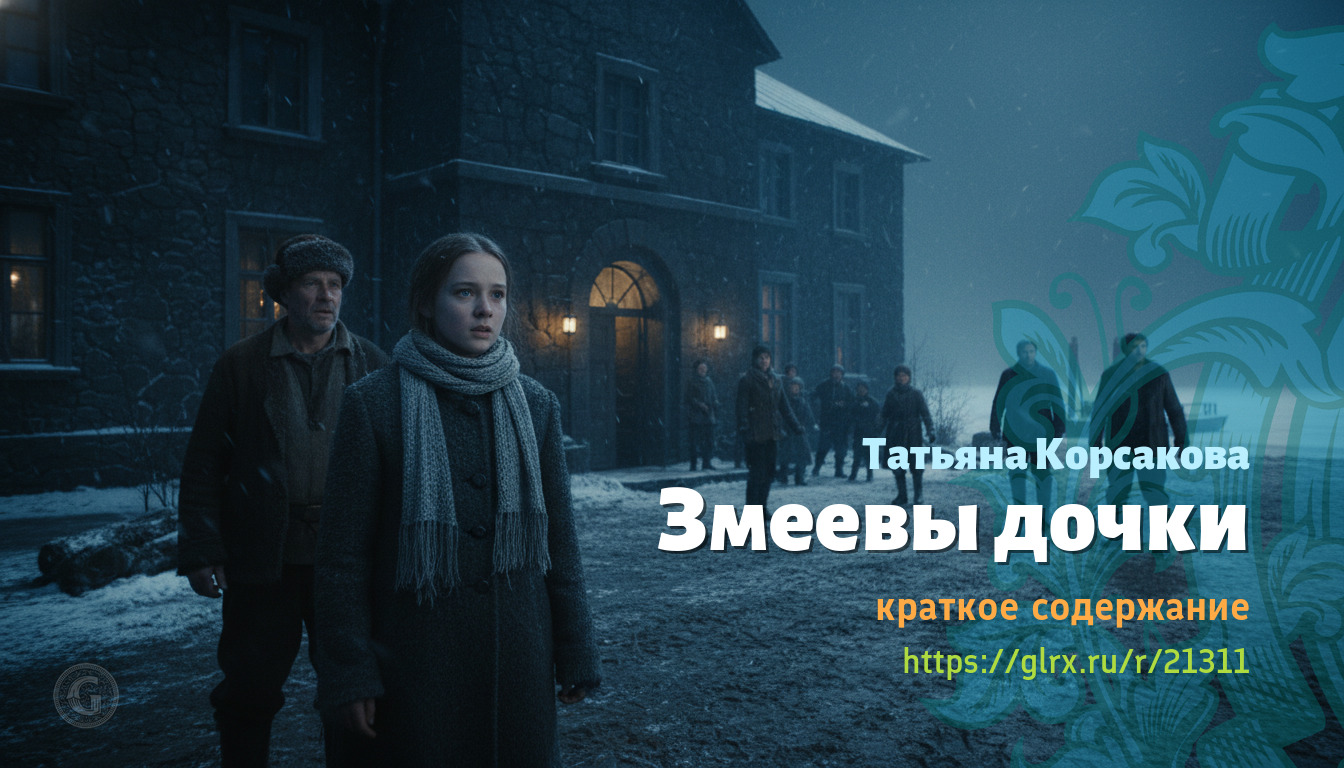
The story begins in winter, when Galka is brought to an island, to an old estate where the Soviet authorities have decided to temporarily establish an orphanage. She is accompanied by a gloomy man named Kuzma, and along the way, Galka is still unsure who he is to her — a guide, a guard, or a man who knows far more about the place than he’s letting on. The very first minutes on the island set the tone for everything that follows: devastation, darkness, an icy lake, a heavy castle, and the feeling that behind the ordinary poverty and economic disarray lurks a long-standing danger.
At the orphanage, Galka encounters Adelaida Volfovna, the strict headmistress obsessed with discipline and economy, and immediately sees the conditions the children live in. Among the residents, Mark, Sashka, and other children stand out, desperately lacking simple warmth, food, and peace. Galka quickly becomes one of them, demeaning herself without the aloofness of a bureaucrat, and Kuzma, initially intimidating, gradually reveals an unexpected caring spirit and also joins this fragile circle.
Almost immediately, Demyan Petrovich and Alexey appear near the island — people from the outside world who assist with practical matters and gradually become embroiled in the island’s mystery. Demyan is a man of action, accustomed to a sober view of everything, but very soon he, too, is forced to admit that on the Guardian Stone, ordinary logic is no longer sufficient. Personal attachments develop between the characters: Alexey is drawn to Galka, and Demyan increasingly finds himself near Liza, although at first both feelings grow amid anxiety, mistrust, and other people’s secrets.
Everyday life on the island is soon disrupted by a chain of strange events that cannot be attributed to fear, rumors, or a child’s imagination. Barefoot footprints appear where they shouldn’t, an old woman and silhouettes from the past appear, and beneath the castle and around the lake, the old memory of the place seems to stir. The Guard Stone gradually reveals itself as a space where several eras coexist: the current orphanage, the noble estate of its former owners, and the almost mythical story of women with "snake" blood.
Liza becomes one of the central figures, her fate from the very beginning linked to violence and miraculous rescue. She is found gravely wounded, then suffers another blow that would normally have been fatal, but survives, breaking the boundary between a domestic romance and a story about a family gift. Demyan, Dr. Paliy, and other witnesses realize that the case is no longer limited to a single crime: the island itself intervenes in human destinies, seemingly testing those who find themselves there.
As events unfold, it becomes clear that Galka’s connection to this place is no coincidence. Her appearance reveals traits reminiscent of women of the old clan, and in the darkest scenes of the dungeon, her hair casts a pearly glow, transforming the vague legend of silver blood into a direct plot fact. Galka ceases to be simply a young assistant at the orphanage and becomes one of those through whom the island is attempting to either continue its long-held rule or finally break it.
Alongside the mystical arc is a very mundane one — one of human meanness, fear, and self-interest. Someone on the island is acting covertly, pushing Galka into the well, concealing the truth, exploiting the chaos, and counting on ancient rumors to cover their tracks better than any alibi. Therefore, the investigation here is always twofold: the heroes must simultaneously deal with specific criminal acts and the darkness inherited by the current people from the estate’s previous owners.
Kuzma occupies a special place in this story. At first, he appears to be a sullen old man with dangerous habits and an incomprehensible hold on island life, but gradually it becomes clear that he is one of the few who retains the memory of the true value of the local secrets. His actions sometimes seem terrifying and even cruel, especially in scenes involving Lisa and the awakening of an ancient power, but the text insistently demonstrates that Kuzma’s brutality stems not from sadism, but from the hard knowledge of how easy it is to lose the living here.
The middle of the novel revolves around a series of dangerous encounters — the castle, outbuildings, underground passages, a well, the shore of Strazhevoye Lake, and the lighthouse tower. The deeper the characters delve into this stone labyrinth, the more clearly the figures of the past emerge: August Berg, Evdokia, the silver-haired girl, the man with the scar across his face, the old men who knew the island’s history from beginning to end. These figures don’t seem like mere props for a scary tale: they influence the living, guide them, warn them, and literally stand by their side at crucial moments.
The climax comes with an attempt to save Galka and Lisa, when human strength is almost exhausted. A chain of people, holding hands, appears in front of the lighthouse tower, and among them are those who belong to the island’s past; August Berg directly commands the living to save "our girls." Here, ancestral memory, love, and duty are united in a single act: the dead help the living, and the living finally stop running from the truth about their origins, blood, and an old crime.
After this turning point, the island begins to change almost physically. Spring arrives abruptly: overnight, the Guardian Lake melts, and the black granite strip between the shore and the island resembles a giant serpent, as if the place itself is revealing its own secret form to the heroes. Galka and Liza are brought back to life, and with them, the former hold of darkness over the castle, which for too long has existed as a trap for the destinies of others, collapses.
The denouement simultaneously reveals a family truth. On the shore, the heroes are met by Anna Tumanova, née Countess Shumilina, a woman with hair the color of molten silver, whose features clearly reveal a kinship with Galka. Then Klim Andreevich Tumanov, Galka’s grandfather and a military engineer, appears, and this return of the family gives the ending not an abstract but a very concrete meaning: Galka finally has found her own people, and her past is no longer a void.
The final chapters shift the story from siege mode to peacetime. For the first time in years, music and children’s laughter resound in the castle, and the children no longer seem like prisoners in a gloomy house — they act like masters of a place they’ve managed to survive and defend. Even the memory of the dead no longer weighs heavy: Augustus and Evdokia are almost visibly present, and it’s no longer a horror, but a quiet acknowledgement of how much they’ve done to save the others.
The novel ends with the wedding of Demyan and Liza. The children weave colorful ribbons into the horse’s mane, the adults accept Kuzma as one of their own, and at the celebratory table they fondly remember Augustus, Evdokia, and all those whose destinies were woven into the Guardian Stone. Galka and Alexey stand next to each other, holding hands, their future already clearly defined: before their own wedding, they only have to wait until Galka comes of age.
The ending doesn’t erase the horror experienced, but rather transforms it into a memory that can now be lived with. The old estate ceases to be a place of isolation and fear, the orphanage takes on a human face, and the family history that has crippled silver-haired women for centuries no longer holds absolute sway over them. Therefore, the novel’s final tone is not about mystery per se, but about the return of home, family, and the right to a normal, earthly life to those whom the island had previously sought to subjugate entirely.
- "Light at Heart" by Maria Metlitskaya, summary
- "Come into My Dreams" by Tatyana Korsakova, summary
- A summary of "The Girl with Silver Blood" by Tatyana Korsakova
- Demyan Lenkov. Exhibition "City of Zero"
- Demyan Lenkov. Exhibition "Two dollars a day"
- A summary of Alexander Voronsky’s "Literary Silhouettes"
You cannot comment Why?