"Hector Servadac" by Jules Verne, summary
 Automatic translate
The French writer’s novel was published in 1877. Its fantastical plot revolves around an unusual cosmic event: an unknown comet collides with Earth, sweeping small sections of the Earth’s surface, along with the people trapped on them, into interplanetary space. Several films have been made based on the novel. The most famous is the Czechoslovak film "On the Comet," directed by Karel Zeman in 1970. Earlier, in 1961, American filmmakers released "Valley of the Dragons."
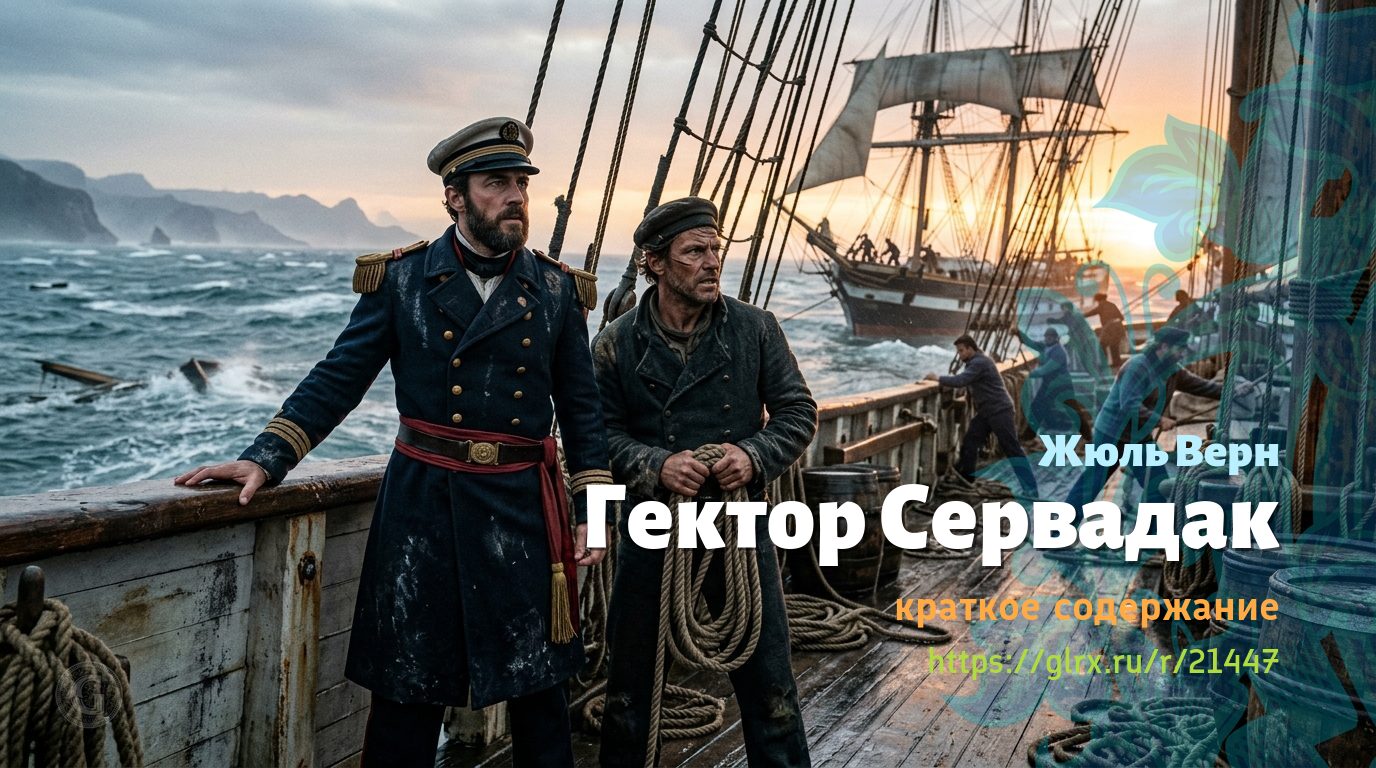
The book is part of the author’s renowned "Extraordinary Voyages" series. It is the seventeenth work in the extensive cycle that brought Jules Verne worldwide fame. This literary series also includes such celebrated novels as "The Children of Captain Grant" and "Twenty Thousand Leagues Under the Sea."
Sudden cataclysm
French army captain Hector Servadac and Count Vasily Timashev prepare for a duel on the coast of Algiers. The rivals officially declare a dispute over music. The Frenchman declares, "I am for Rossini." The Count replies, "I am for Wagner." The men separate, preparing for the morning duel. Servadac returns to his gully, where he lives with his faithful orderly, Ben-Zouf. On the night of December 31st to January 1st, a colossal earthquake occurs. The earth trembles, the skies are illuminated by a powerful flash, and the sea overflows its shores in a gigantic wave.
In the morning, the captain and his orderly awaken to discover strange changes in their surroundings. The sun now rises in the west and sets in the east. Daylight hours have shrunk to twelve. Gravity has noticeably decreased, giving the crew an unusual sense of lightness. Trying to solve the mystery, the heroes head to the Sheliffe River. Instead of the familiar riverbed, they see an endless sea. A vast portion of the African continent has vanished without a trace.
Soon, the Russian schooner Dobrynya docks at the island, which Servadac calls Gurby Island. On board the luxurious vessel are Count Timashev and the experienced Lieutenant Prokofiev. The Russian sailors also barely survived the night’s catastrophe on the high seas. The former rivals postpone the duel until the situation is fully clarified. Hector Servadac boards the schooner. The combined force makes a firm decision to survey the remaining land areas and determine the extent of the destruction.
Exploring new shores
The Shkuna sets out on a long voyage. The explorers quickly discover that an entirely new sea basin has formed in place of the old Mediterranean Sea. During the voyage, they discover the complete disappearance of major cities: Algiers, Marseille, and Tunis. Depth measurements reveal a flat seabed strewn with an unknown metallic dust. The sailors find only a few tiny rocks. On one of them, the tomb of King Louis the Saint miraculously survives. On another rock, which turns out to be a fragment of Gibraltar, two British officers and eleven soldiers have taken refuge. The British stubbornly refuse to abandon their post.
During the expedition, the heroes encounter a small merchant vessel, the Hansa. The ship is owned by a stingy moneylender, Isaac Haccabut, who refuses to share his supplies and tries to sell them at exorbitant prices. Hector Servadac forces the merchant to sell the goods strictly at established European prices. On a Sardinian island, the travelers rescue a little Italian girl, Nina, and her tame goat, Marzi. Later, they pick up a young Spaniard, Pablo, and a group of Andalusian majos led by the guitarist Negrete. The new settlers join the schooner’s crew.
Soon, the expedition reaches a rocky cape with an active volcano. This uncharted territory is dubbed "Warm Land." Due to a rapid cold snap, the colonists are forced to build a winter shelter in a labyrinth of mountain caves heated by volcanic lava flows. They call this safe haven "Nina’s Hive." In the sea, the explorers recover several hermetically sealed messages containing mathematical calculations. These documents, signed in various languages, provide data on the orbit of Comet Gallia.
The Secret of Professor Rosetta
While searching for the author of the mysterious notes, Servadac and Prokofiev find a freezing man on a tiny fragment of the Balearic Islands. He turns out to be Palmiren Roset, Hector Servadac’s former physics teacher. The rescued astronomer angrily explains to his saviors the nature of what’s happening: "You’re on my comet!" It turns out that Earth has collided with Comet Gallia. The comet grazed the planet’s surface, tearing off sections of land along with its atmosphere and people. Now these thirty-six people are hurtling through the solar system.
Professor Roset, with fanatical diligence, calculates the orbital elements of Gallia. He determines that the comet moves in a highly elongated ellipse. Its density is significantly higher than Earth’s due to its enormous content of gold-bearing telluride. The colonists’ extreme distance from the Sun threatens them with deadly frost. Soon, the Gallic Sea does indeed freeze, becoming covered in a perfectly smooth sheet of ice. Russian sailors and Spaniards happily skate across the frozen surface. But the cold intensifies, and the colonists finally hide in the caves of the Warm Land. In the midst of winter, the volcano suddenly goes dark, depriving the people of their source of heat.
Having hastily cut a deep passage, the people descend into the deepest crater of the fire-breathing mountain, where remnants of the subterranean heat still linger. Here they spend long, dark months in incredibly cramped conditions, warming themselves with warm stones. The colonists’ spirits plummet, and many Spaniards fall into a deep apathy. Only little Nina, with her ringing songs, maintains the spirits of the weary captives of the comet. Palmyren Roset spends entire days in his tiny observatory, calculating the mass, density, and weight of Gaul using a steelyard and silver coins from the moneylender Haccabut. During his observations, the professor discovers Gaul’s moon, Nerine, which soon vanishes without a trace.
During its journey, Gallia flies dangerously close to the giant planet Jupiter. The colonists gaze in horror at the planet’s enormous disk, fearing that Jupiter’s powerful gravity will capture the comet and transform it into a new satellite. However, Gallia safely navigates the dangerous section. Having passed the outermost point of its orbit, aphelion, it begins its return journey to the Sun. Warmth gradually returns to the frozen surface. The ice melts rapidly.
Trapped in ice, the ships Dobrynya and Hansa are smashed against coastal rocks when the water level drops sharply. The loss of the ships deprives the colonists of the opportunity to cross the sea. Precise calculations by an astronomer indicate that Comet Gallia will cross Earth’s orbit exactly two years after the first cataclysm. Suddenly, Gallia experiences a new cosmic cataclysm. Due to powerful internal forces, the comet splits in two. A huge fragment detaches and flies into interplanetary space, taking with it Gibraltar, Ceuta, and the English soldiers stationed there. The remaining part of the comet accelerates its rotation, shortening the Gallic day to six hours.
The way back to Earth
Palmyren Roset is furious at the loss of a piece of his beloved comet, but confirms that the rendezvous time with Earth remains unchanged. A collision is inevitable. Lieutenant Prokofiev meticulously analyzes the consequences of a direct hit and devises a daring rescue plan. He organizes the construction of a large hot air balloon from the sturdy sails of a wrecked schooner — a huge hot air balloon inflated with hot air.
This aeronautical craft will allow humans to ascend high into the atmosphere of Gaul shortly before impact with Earth. When the atmospheres of the two celestial bodies merge, the basket should safely transition into Earth’s airspace. Captain Servadac ardently supports this idea, understanding that there is simply no other way to avoid destruction upon impact.
Last moments on the comet
The colonists are diligently working on constructing a massive aerostat. Professor Roset resists fiercely, completely unwilling to abandon his beloved comet. The moneylender Hakkabut laments the loss of his hoarded gold, which Captain Servadac forces them to abandon on the shore due to strict weight restrictions. Finally, at the appointed hour, the heavy balloon lifts smoothly from the surface of Gaul, carrying twenty-three people.
The Earth is rapidly approaching, filling the entire horizon. The comet and the planet are approaching at incredible speed. A colossal gravitational shock occurs, and their atmospheres merge. The passengers lose consciousness in thick swirling hot clouds. The balloon bursts, and the people fall softly to the surface.
Upon awakening, Servadac and Ben-Zouf recognize the familiar contours of the coast. They are in Algeria, near the city of Mostaganem. To the colonists’ great surprise, no one on Earth noticed the comet’s passing. The locals calmly go about their daily business. The rivals cancel their duel. Hector Servadac officially adopts Nina, and Count Timashev takes custody of the boy Pablo. Years later, the grown children are married, and the former involuntary travelers forever cherish the memories of their days on the comet.
You cannot comment Why?