"Distant Rainbow" by Arkady and Boris Strugatsky, summary
 Automatic translate
The story was written in 1962. This book is a socio-philosophical fantasy about the events of a single day on the planet-testing ground called Rainbow, where scientists conduct dangerous physics experiments. The fundamental determinant of the plot is a person’s moral choice in the face of an inevitable natural and man-made cataclysm. It is the third novel in the "World of Noon" cycle, following the stories "Noon, 22nd Century" and "Escape Attempt." This literary metaworld also includes such books as "Hard to Be a God," "Inhabited Island," "The Kid," "The Beetle in the Anthill," and "The Waves Extinguish the Wind."
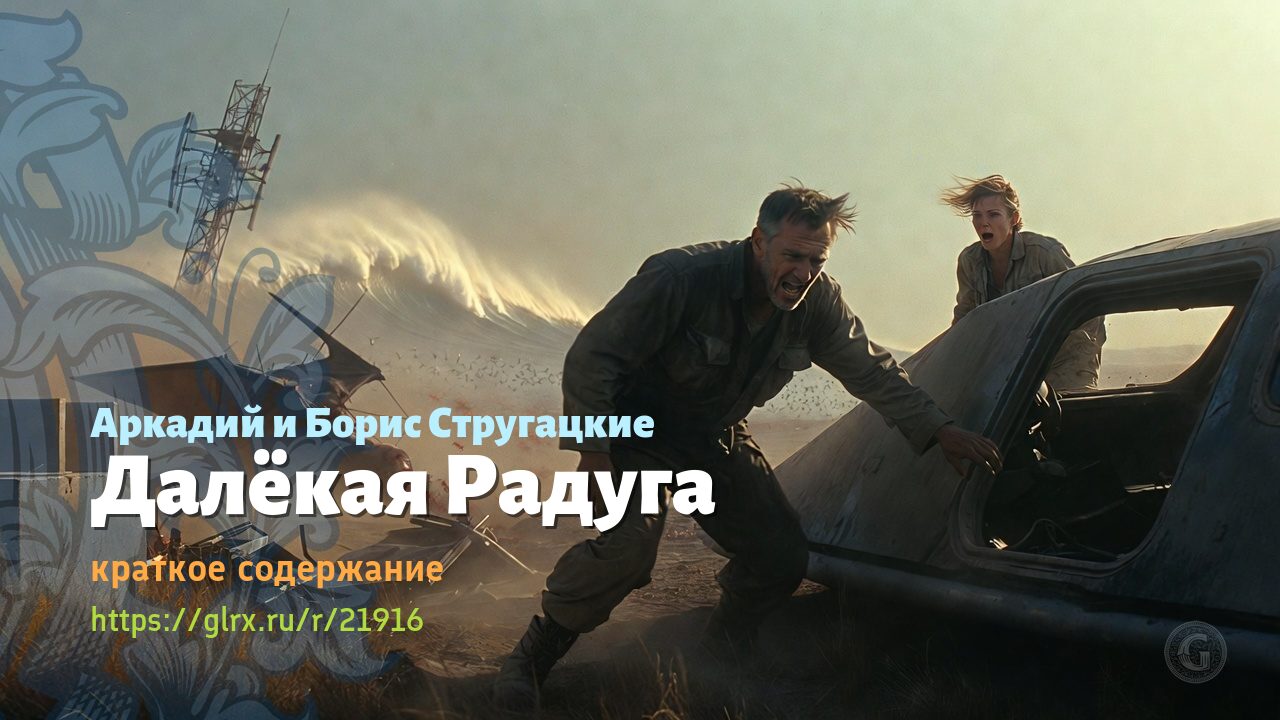
Alarm signals at the Stepnoy post
The events unfold on the planet Raduga, where research into null-transportation — the instantaneous movement of matter through space — has been underway for thirty years. Observer Robert Sklyarov spends the night at the southern outpost of Stepnoy with his lover, Tanya, a teacher at the Children’s Colony. A young null-physicist, Patrick, contacts him via videophone and reports strange instrument readings after yet another experiment involving the transfer of a 20-kilogram mass.
Robert goes to check the Ulmotron instruments. A scientist named Camille silently enters the lab. He’s a strange man in a white plastic helmet who never takes it off, instantly calculating enormous numbers in his head, and appears at his posts before every eruption. Camille delivers a halting and mournful monologue about science as a hopeless labyrinth.
Growing crisis and scientific debates
In the planet’s capital, Captain Leonid Gorbovsky of the landing starship Tariel-Second and navigator Mark Valkenstein are on their way to the Council building. Along the way, they encounter physicist Alexandra Postysheva, who is hauling a heavy cable. In the office of Raduga Director Matvey Sergeyevich Vyazanitsyn, passions are running high. Raduga is split into two camps: Etienne Lamondois’s group demands all the energy for null-transportation, while Aristotle’s group is studying the Wave — a byproduct of the experiments, manifested in the movement of two organic-burning energy walls from the poles to the equator.
It turns out that Alexandra Postysheva and Simeon Galkin have illegally connected to the zonal station and withdrawn enough energy for two days. The enraged director suspends Postysheva and decides to send her back to Earth. Senior biologist Gina Pickbridge requests that people be assigned to protect the fisheries from giant squid. Matvey assigns her a team of testers led by the athlete Gaba.
The Wave eruption and the evacuation of Greenfield
In the morning, a fierce heat wave rises at the Stepnoy outpost. Suddenly, a wave of red grain-eating insects rushes across the dry grass from the north, and thousands of birds fly away into the sky. Camille warns Robert that a Wave is moving from the pole, destroying all life. The observer contacts his superior, Fyodor Malyaev, who orders the immediate dismantling of both 100-kilogram Ulmotrons, boarding a helicopter, and flying to the village of Greenfield.
A hurricane-force wind rises, ripping apart the tower’s frames. The elevator breaks. Robert kicks open the shaft door, lowers one Ulmotron, and jumps out from a height of four meters. Near the tower, he finds a wrecked pterocar, beneath which lies a crushed Camille, his face covered in dust. Robert tried to move the heavy machine, but was unable to. Seeing the glowing crest of the Wave on the horizon, Robert boards the two-seater flyer Camille abandoned and flies to Greenfield.
In Greenfield’s control room, Robert tells Malyaev, Shota Pagawa, and Karl Hoffman about Kamille’s death. Malyaev clarifies the nature of the cataclysm — it’s a Liu-wave. Suddenly, Kamille appears alive on the videophone screen. His cheek smeared with dust, he announces that a catastrophic new type of P-wave is coming after the Liu-wave and demands the immediate evacuation of the entire north. The screen then goes black.
A feat in tanks and an escape to the equator
The Wave’s black wall is approaching Greenfield. Enormous Charybdis telemechanical tanks, absorbing energy, flare up and explode one after another. Residents of the village hastily load into helicopters and pterocarts. To buy 15 minutes to evacuate his colleagues, Robert boards the backup Charybdis and steers it directly to the Wave’s front, activating the absorber at full power.
A second Charybdis, driven by Patrick, takes up position next to him. The adjacent tank explodes. Robert manages to jump out of his vehicle just before the tanks detonate and runs toward the village. Patrick is waiting for him in the running flyer. They fly south just as Greenfield is already enveloped in black nothingness.
Robert learned from the radio that a planet-wide evacuation had been ordered, the Southern Archipelago was burning, and all resources were being deployed. The starship Strela was en route, but would not arrive for another 10 hours. There was only one ship on Rainbow — the landing craft Tariel II, which could only accommodate a small number of people.
Robert leaves Patrick at the power plant and flies to the Children’s Colony. The settlement is empty, but there’s a note in Tanya’s room asking him to find her in the Capital. A light-diffusing ridge is already visible to the north. Flying over the jungle, Robert spots a broken-down airbus. Near it are a dozen seven-year-old children, Tanya, and the test pilot Gaba. The airbus is out of fuel, and Robert’s two-seater flyer won’t be able to carry everyone.
Gaba takes the children into the forest, playing a fairy tale about wild animals with them. Robert realizes the impossibility of saving the entire group. He forces Tanya into a flyer and flies off to the Capital, leaving Gaba and the children to certain death.
The Council’s Choice and the Rescue of Children
The entire planet’s population gathers in the Capital at the equator. Heavy earthmoving machines, known as "moles," begin digging a deep underground shelter shaft. Scientists microfilm scientific archives, and rocket scientists assemble small satellites to launch documentation into orbit.
A general meeting gathers in front of the Council building. Étienne Lamondois delivers a speech about the value of the thirty years of work of the null-physicists and proposes rescuing scientists and proponents of scientific ideas first and foremost. Following him, Captain Leonid Gorbovsky takes up the megaphone. He announces that the choice has already been made: Tariel II will only take on board children and mothers with infants. Those gathered greet this decision with silent approval and relief.
At the cosmodrome, Gorbovsky, Mark Valkenstein, Percy Dixon, and Stanislav Pishta liberate the starship. They dismantle the main control unit, computing units, and furniture, converting the ship into a self-propelled barge. The artist Johann Surd gives Gorbovsky his latest painting, "Wind," and Malyaev gives him a folder containing ten years of observations of the Wave.
Over a thousand children of all ages are placed on the ship. The high school students initially refuse to fly without caregivers, but Gorbovsky convinces them to go inside to care for the infants. Robert Sklyarov pleads for Tanya to be allowed on board, claiming she’s pregnant. Mark Valkenstein and Percy Dixon give up their seats in favor of the children and remain on the planet. The director’s wife, Zhenya Vyazanitsyna, secretly sneaks on board with her son, Alyoshka.
Stanislav Pishta assumes command of the ship. Tariel II launches into near-planetary orbit to await the arrival of the Strela. Gorbovsky, Matvey Vyazanitsyn, Mark, and Percy watch the starship take off. Two shining streaks converge on the horizon to the north and south.
The last hour at the seaside
Gorbovsky, Mark, Percy, and Alexandra Postysheva return to the deserted city. Mark and Alya walk off into the steppe, hand in hand. Percy Dixon drives off in a car into a narrowing corridor between two black walls. The streets of the Capital are filled with paintings on display, and the hymn "Distant Rainbow," sung on a choriole, can be heard from a café.
Gorbovsky arrives at the sandy beach and lies down on a lounge chair. Kamil approaches him. The scientist reveals his secret: he is the last representative of the "Devil’s Dozen" experiments, a cyborg, a fusion of man and machine. He is capable of death and resurrection, but is doomed to absolute loneliness and melancholy due to the loss of his emotional state. Kamil confesses that tonight he will rise for the fourth time on a dead planet covered in ash and snow.
Robert Sklyarov sits down next to Tanya on the seashore, and she doesn’t push him away. Eight test pilots descend onto the beach. Seven of them carry the eighth on their shoulders — a blind pilot with a bandaged face, playing the banjo. Singing a song of courage in a shy voice, they enter the ocean waves and sail westward toward the setting sun, straight into the narrow blue slit of sky between the two hundred-kilometer-long black walls of the converging Wave.
- In Tver, the premiere of the play "Barbara" closed the festival "Cherry Orchard"
- The premiere of the play "Fantasy Faryatyev" from the St. Petersburg director Oleg Kulikov took place in Pskov
- "Great Catherine" 12+
- Signature examination: basic provisions of the procedure
- Igor Oleinikov. Snark hunting 18+
You cannot comment Why?