"Honor and Courage" by Vasily Sharapov, summary
 Automatic translate
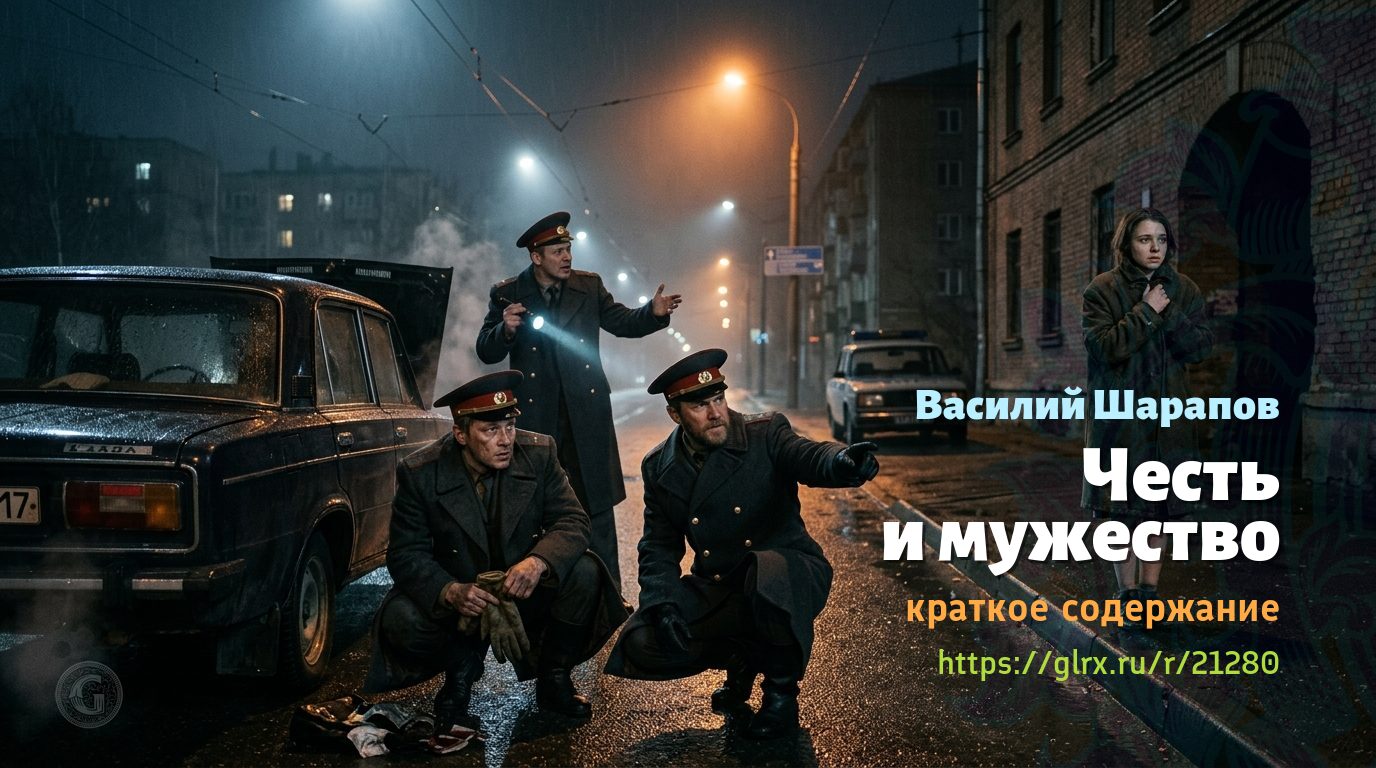
Honor and Courage, a collection of documentary and fiction essays and stories published in 1981 by the Kuibyshev Book Publishing House and edited by Major General Vasily Sharapov, head of the regional police department, tells the story of the Soviet police’s fight against crime in the Volga region. This book is a faithful chronicle of the daily life of criminal investigation and embezzlement departments. It is based on actual criminal cases investigated in the Kuibyshev region during various years of Soviet rule.
The formation of the police and heroic everyday life
In his essay "Service — Days and Nights," Vasily Sharapov describes the milestones in the history of Samara law enforcement. Law enforcement agencies were established here in December 1917 under the leadership of the Bolsheviks Kuznetsov, Kuzmin, and Karklin. Galaktionov became the first Commissar of Internal Affairs. Samara detectives had to fight anarchists, stop raids by Larin’s gang in 1943, and save people during the famine of 1921. The author pays special attention to the memory of fallen comrades such as Anatoly Silaev and Alexander Kalimullin. These former workers and peasants, with no experience, solved complex crimes, learning the intricacies of detective work as they went.
The story of police heroism continues in stories set in peacetime. Traffic police officers Vitaly Ishutov, Vladimir Kurenkov, and Vasily Bespalov neutralize an armed criminal in a stolen car during a dangerous chase on the Syzran-Tolyatti highway. Galina Sokolnikova’s essay "We Have No Other Way!" depicts the heroism of Senior Lieutenant Ivan Shumnik, who, at the cost of his own life, blocked the path of a car carrying armed robbers in winter. He delayed their progress until reinforcements arrived, protecting the lives of civilians.
The Case of the Golden Sand
Eduard Kondratov and Vladimir Sokolnikov’s novella "The Gold Bag" reveals the dismantling of a major currency trading network. OBKhSS captain Viktor Katenev, while interrogating speculator Elizaveta Ridenger, uncovers a lead on the illegal gold trade. A market search leads the detectives to the laurels of the seller, Giglu Kiziria. Surveillance of his car leads the police to the home of renowned dental technician Israel Nahbo. Katenev places him under 24-hour surveillance, hoping to locate the wholesale supplier of the precious metal.
The dental technician’s brother, Petr Nakhbo, reveals his relative’s hiding place out of personal vendetta. During a search, Colonel Anatoly Bulushev finds a stash of jewelry in the piano and a bundle of gold coins in the refrigerator. Nakhbo mentions a mysterious "Pilot." Senior Lieutenant Alexander Zemskov begins his search at Kurumoch Airport and traces the driver, Yevgeny Kazhdazh, who was transporting gold disguised as blood. Kazhdazhda frequently flew to the mines in Magadan and Yakutsk, supplying the dental technicians with raw materials.
The courier turns out to be air traffic controller Vasily Shurpin, nicknamed "Pilot." During a search of his home in Bereza, Major Maksimov finds the money in children’s felt boots. The accomplices attempt to warn relatives in Khabarovsk and Almetyevsk. Bulushev flies to the Far East, where he detains Shurpin’s sister and confiscates the gold nuggets. Inspector Tamara Kuzmina convinces his sixteen-year-old sister, Masha, to reveal the location of a ten-kilogram sack of gold mine gold buried at their dacha in Almetyevsk. The state treasure is returned to the treasury, and the entire gang is brought to trial.
Combating juvenile crime and embezzlement
Tamara Shvets’s essay "Hurry to Do Good" is dedicated to juvenile inspector Sergei Balbashov. The officer is trying to find a way to approach twelve-year-old runaway Igor Fedorov, who committed a robbery near the Vympel movie theater. Balbashov views teenagers as victims of family dysfunction. This police officer previously worked as a lathe operator in a factory. He also single-handedly apprehended the dangerous repeat offender Onishchuk. The inspector combines strictness with pedagogical tact when dealing with children who have stumbled.
Nikolai Kashtanov’s essay "As the Rope Twists…" describes the uncovering of embezzlement at a medical institute. An anonymous caller alerts Lieutenant Colonel Mikhailov to fraud in the accounting department. Young inspector Alexei Levkov seizes archives slated for destruction. Accountant Vera Azyazova created a payroll system for fictitious individuals, stealing 112,000 rubles. Levkov and investigator Svetlana Ulanova interview hundreds of witnesses and prove the criminal’s guilt.
Galina Vladimirova’s essay tells the story of Nelya Semyonova, head of the investigative department at the Leninsky District Police Department. She has dedicated her life to investigating crimes, balancing the strictness of the law with compassion for troubled teenagers. She helps Yuri, who committed a foolish theft due to a lack of money for a movie, find the right path in life and saves the associate professor’s family from domestic tyranny.
Forest secrets and revealed conspiracies
Boris Sokolov’s story "Shot in the Forest" begins with a negligent employee leaving a pistol in her desk drawer. A conscript’s body is found in a forest near Tolyatti. Deputy Chief of the District Police Department Yevgeny Korolkov and Prosecutor Nikolai Kutsenko discover a bullet lodged in a birch tree trunk. After questioning teenagers who stole oranges from the same office, the detectives trace Lenya, a tenth-grader. His friend Sanka stole the gun, and Lenya shot a random passerby. Korolkov urges the young man to repent, reminding him of the irreparable nature of his crime.
Tatyana Korsakova’s essay "Invisible Threads" investigates the murder of fifty-year-old Tamara B. in Chapayevsk. Lieutenant Colonel Ivan Perekrestov and Colonel Alexander Lipatov track down the deceased woman’s former daughter-in-law, Lyudmila Maksyutova. She hated her mother-in-law for the broken marriage. With the help of fifteen-year-old student Elena, Maksyutova hired nineteen-year-old Viktor Sarayev. Sarayev executed Sarayev with a shotgun. The court sentenced Sarayev to death by firing squad, and Maksyutova to fifteen years in prison. The accomplices also face severe penalties for their actions.
Alexander Mikhailov’s essay "The Third Option" is dedicated to the memory of traffic police inspector Viktor Abramkin. In October, he saw an out-of-control bus carrying passengers speeding downhill on the Moscow Highway. Abramkin placed his police car in the path of the crash, slowing the bus. All passengers survived, but the captain died from his injuries. The police officer’s heroic act saved twenty-five lives.
Tatyana Voskoboinikova’s essay describes the work of Major Valentin Sarychev and forensic scientist Albert Davydov. They coordinate the investigation of a series of nighttime thefts and the murder of an elderly woman on Leninskaya Street. The pair quickly identify the perpetrator thanks to clear fingerprints on a bottle of port wine.
Operation "Sign on Glass"
Eduard Kondratov’s central detective novella, "Sign on the Glass," centers on the fight against a gang of car thieves. Student Vadim Sorokin brings a package of money from Rostov for his boss, who goes by the name "Boss." Sorokin is unrequitedly in love with Valentina Nazarova. After being turned down, Vadim goes to a friend’s house, where the teenagers are celebrating Lyosha Gusev’s birthday. Lyosha gives his friend Vika cheap, patterned rings. These rings become the first clue in a complex criminal case.
Vika’s mother causes a scene over the gifts, and a neighbor informs the local police officer, Zhiganov. Inspectors Alexander Zuyenkov and Vladimir Bibishev investigate a series of Zhiguli car thefts. Zuyenkov discovers that the rings were stolen from a kiosk by repeat offender Pavel Ivakhnov. Lyosha Gusev admits to buying them from a fingerless man near the Vympel movie theater. The detectives set up an ambush and detain Ivakhnov on Gagarin Street. During a personal search, a large quantity of stolen jewelry is confiscated from him.
Meanwhile, Bibishev is searching for Associate Professor Pavlov’s stolen crimson Zhiguli on Michurin Street. A witness saw a car driven by a long-haired youth leave the courtyard that night. Sixteen-year-old Gennady Dergachev, nicknamed "Crocodile," is now under suspicion. It turns out the youth received a wire transfer for three hundred rubles from a fictitious "Mikhailov." Bibishev realizes that an experienced adult criminal is behind the theft.
Bibishev realizes that the mastermind behind the thefts is sending rewards to teenagers, postmarked, using the names of Soviet national hockey team players. Misha Zolotavkin receives another transfer from "Kharlamov" at the post office. Misha confesses to Bibishev at the Dubki tourist center that a pretty girl named Lyalya hired him to drive a car to Polyana Frunze, park it in a grove, and draw a sign on the dusty windshield with her finger. The boy fell for the easy money, wanting to buy fashionable imported items.
Misha’s father, the influential doctor Zolotavkin, takes his son home and refuses to cooperate with the criminal investigation. Bibishev then recruits Gennady Dergachev for the operation. With his parents’ consent, Gennady drives the decoy Zhiguli to Polyana Frunze at night, leaves a coded signal, "K," and leaves. The ambush is unsuccessful, as the drunken stoker Karasev, who was supposed to notify the gang, falls asleep on the steps of a kindergarten. Because of this, the couriers don’t come to pick up the abandoned car.
The detectives track down Igor Mangosov, the head of the driving school. A font comparison reveals that the threats to Lyosha Gusev were cut from Mangosov’s newspaper. The situation escalates: Vadim Sorokin beats Valentina Nazarova during an argument. Believing he’s killed her, Vadim flees in panic. The boss realizes Sorokin may expose the gang. He orders repeat offender Pavel Kondrashov, nicknamed "Kurok," to eliminate the courier. Kondrashov stabs Vadim and hides the body in the trunk of a taxi, but the car breaks down near Kurumoch. Kurok abandons the taxi on the road.
Mangosov attempts to escape by withdrawing all his money from savings banks. He hands a sports bag containing nine thousand rubles to Olga Zvenyagina (Lyalya) at a train station restaurant. Zuyenkov catches Olga red-handed. During interrogation, she agrees to reveal the meeting place with the murder suspect. Bibishev and Zuyenkov set up an ambush at Zvenyagina’s apartment and arrest Kondrashov-Kurka, who has arrived to collect the money. The operation to apprehend the dangerous bandits ends in complete success for the criminal investigation.
The evolution of law enforcement
In the afterword, Colonel Yuri Salomatin assesses the development of the Soviet police. The author notes that modern service demands a high level of education, psychological resilience, and constant communication with the public. Crime prevention is becoming a top priority, reducing the country’s crime rate. Yesterday’s volunteers are now becoming professional lawyers serving the public good.
You cannot comment Why?