"The Shortest Night" by Roald Nazarov, summary
 Automatic translate
"The Shortest Night" is a collection of four plays by Leningrad playwright Roald Viktorovich Nazarov, published in 1973 by Sovetsky Pisatel. The book includes "The Shortest Night," "Chance Encounters," "Hello, Krymov," and "Daughter." All four texts are based on a direct moral conflict, where personal fate comes to a head against duty, the memory of war, work, and family choice.
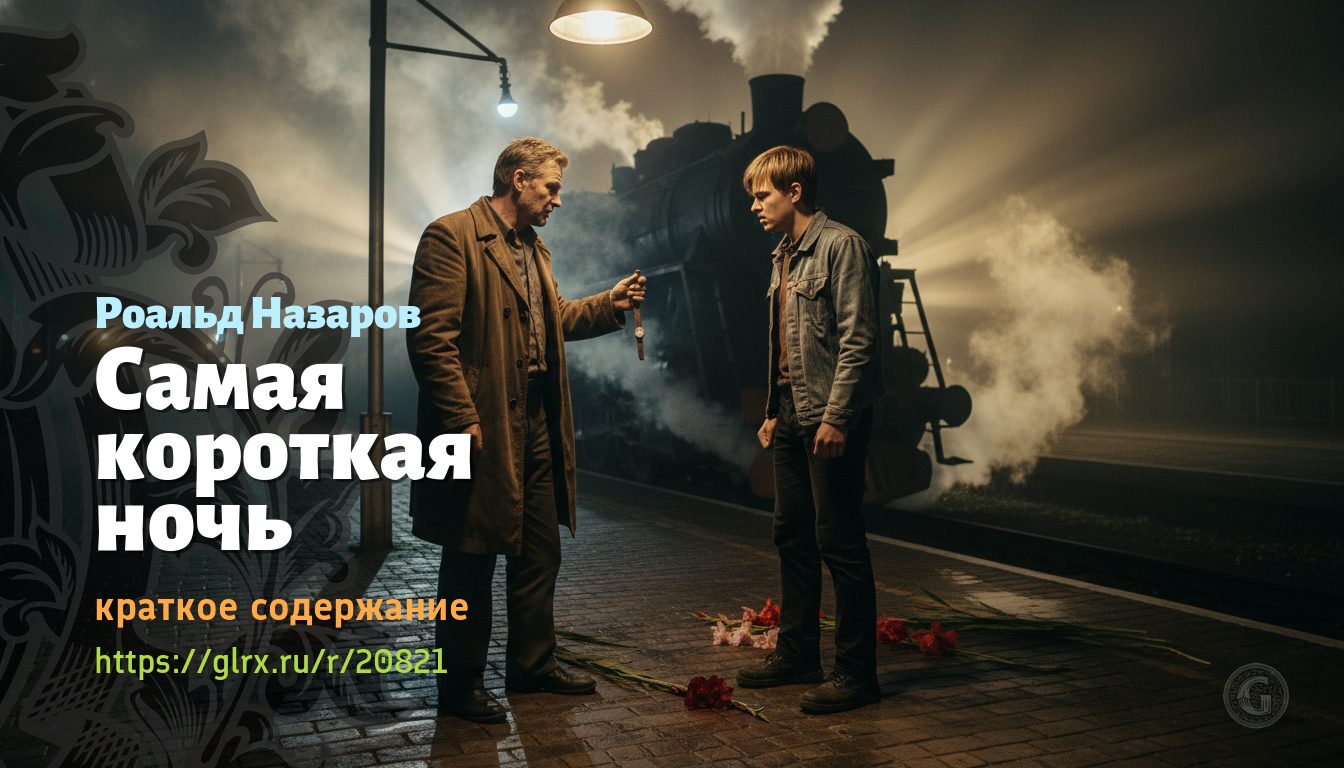
The Shortest Night
The first play is structured as a single night in the life of Alexei Veresov. He is summoned to his senior comrade, Matveyev, and informed that Grisha, Alexei’s close friend, has died while carrying out a dangerous mission. Now Alexei himself must fill the vacant position. He is allowed to refuse, but has almost no time to consider it: Matveyev gives him 12 hours to complete his earthly affairs. However, Alexei is not allowed to tell his loved ones the truth.
Immediately after the conversation, Lyusya, Grisha’s widow, is brought into the office. Alexey has known her for a long time and is certain she didn’t love her husband. He abruptly gives her the coded message about his death to read. Lyusya doesn’t believe it at first, then turns to vicious accusations: she accuses Grisha’s friends of sending him to his death while they themselves survived. This breakdown is followed by confusion, and Matveyev escorts her out of the office.
Alexey’s entire night then disintegrates into attempts to complete something he’s been putting off for so long. He calls home and learns that his wife, Natasha, is still on an emergency call, and his son, Alyoshka, hasn’t shown up for three days after an argument with his father. Alexey goes to the ambulance station with gladioli for Natasha, but finds only a nurse there. From her, he learns that Natasha has gone to the remote village of Pervomaysky, and a young voice has been calling for her. It turns out it was Alyoshka calling.
Then Alexey goes to see Kostya. There, he tries to distract himself with cognac, learns that Roman, their former friend from the front, has arrived in town, and tries unsuccessfully to write a letter to his mother. Finally, he decides to call her in the village through the village council. The conversation is painful: his mother is hard of hearing, but she still manages to ask about Natasha, her grandchildren, and her son’s arrival. Alexey promises to come, although he knows he might not keep his promise.
At the same time, a family conflict with his son unfolds. Kostya admits to seeing Alyoshka and taking him to Lyusya. Alexey goes there. Before this, the viewer witnesses Lyusya’s conversation with Alyoshka: he left home after an argument with his father over a trip to the state farm to pick potatoes. Alyoshka doesn’t consider himself a coward or a deserter: he left because no one really wanted the students at the state farm, their work was of no use to anyone, and he considers wasting time humiliating. However, he has already bought a ticket and decided to go back alone, although he still disagrees with his father.
When Alexei comes to Lyusya, his son is no longer there. Lyusya, left alone after Grisha’s death, suddenly refuses to let Alexei go. For the first time in the play, it’s clear that behind her nervous anger lies emptiness and genuine shock. Alexei forces her to get out an old typewriter and begins dictating poetry, line after line, as if the mechanical work could bring a woman back to life. Only during this dictation does Lyusya finally break down and begin to cry.
After this, Alexey rushes to the station and makes it in time for the train’s departure. In a brief conversation with Alyoshka, they don’t fully reconcile, but his father no longer pressures his son or lectures him. He merely advises him to write his mother a postcard and unexpectedly gives his son Grisha’s watch — a gift that should now remind him not of the second-hand market, but of the value of time and debt. Alyoshka departs back to the state farm, and Alexey remains alone on the platform.
The Night Line concludes with another encounter — with Roman. He comes to Alexey’s apartment and demands an answer: who is he now to his former friends — an enemy or someone they can talk to? An old wound is revealed: in 1952, Roman remained silent when Alexey was persecuted and accused of pseudoscience. Alexey says that the Roman disappeared for him then. Roman doesn’t fully justify himself, but he admits that all these years he lived with a feeling of being cut off from his former friendships and sent telegrams to his comrades every year on May 9th.
When Natasha finally returns from her call, Alexey greets her like a man who’s almost gone. He doesn’t tell her the truth, disguising the upcoming journey as a business trip, discussing Roman, his son, and the letter that will soon arrive without him. Natasha, unaware of this, packs his suitcase. In the morning, a voice offstage declares that his place in the line cannot remain empty. The finale makes Alexey a nearly silent figure of duty: everyone except him takes the stage, each briefly describing their role in his life. At the very end, Alexey appears alone, with a suitcase and a cigarette.
"Chance Encounters"
The second play begins at a small station. Fyodor Dubrov, just returned from three years in prison for theft, is pushed out of the waiting room by the attendant, who advises him to seek work with the construction supervisor, Sinyaev. Fyodor has already tried and been rejected. At the same moment, Vera, a sixteen-year-old girl who has come to visit her cousin, Volodya Nikitin, a doctor in a nearby village, exits the station. She is alone, carrying heavy suitcases and completely confident that everything will work out for her.
Fyodor reluctantly takes her things, and they walk to the village. Vera is talkative, simple-minded, and very trusting: along the way, she manages to tell him that she ran away from home after winning a bond, that she’s bringing her brother textbooks, old clothes, yeast, and even a broken iron. Fyodor is rude, hungry, and distrustful, but Vera gradually knocks his former harshness out of him. She feeds him, leaves him her watch and money while she washes herself by the river, and sees him as no threat.
A blow awaits them in the village. The landlady of the house where Dr. Nikitin rented a room reports that Volodya left for good two weeks ago. Nyurka from the hospital, sharp and angry, adds that the young doctor allegedly had a falling out with his superiors, was jealous of the old Dr. Rebrov, and simply ran away. Vera doesn’t believe a word of this and doesn’t know what to do. Fyodor takes her to Klava, an old acquaintance he once loved. Here, another blow awaits him: Klava is long married, expecting a child, and living with the same Sinyayev who rejected Fyodor for the construction job.
Klava finally accepts Vera for a few days and tries to help Fyodor. She asks her husband to get him a job as at least a handyman, but Sinyaev refuses. He remembers Fyodor as a man with a criminal record and doesn’t want to risk it. Meanwhile, something else is also evident: Sinyaev is secretly playing a game with the hairdresser Fayechka, who writes him notes and waits for him on dates. Fyodor, confronting Sinyaev at Klava’s house, loses his temper and hits him.
Vera meanwhile learns the truth about Fyodor. She overhears Klava and Sinyaev’s conversation about his past and is initially shocked, but almost immediately runs to find Fyodor. She doesn’t abandon him; instead, she splits her remaining money in half and tries to foist his share on him as a fellow sufferer. Fyodor is offended by such pity, Vera gets angry, throws the money on a bench, and runs away. But it is after this that the connection between them is no longer a casual one, but a genuine inner bond.
The plot then splits into two parallel threads. The first concerns Dr. Nikitin. Vera carries a letter from a certain Ivaneeva, thinking it’s from her brother’s old flame. Klava gradually reveals a different story: Nikitin left not out of envy, but after a fight with Rebrov, who was taking money and food from patients. Vera sees for the first time how easily people can distort someone else’s actions. The second thread concerns Sinyaev. A note from Faechka inviting her to Krutoy Bereg reaches Vera, and Sinyaev deliberately convinces her it’s a message from Fyodor. That night, Vera dreams of Fyodor declaring his love for her.
In the morning, Uncle Pavel comes to pick Vera up. He’s already received her telegram and found Volodya: he’s found a job as a district doctor in their own town. Vera is forced to pack for the return journey. At the station, she suddenly reads a postcard from that same Ivaneyeva and discovers it’s not her brother’s girlfriend at all, but a clerk demanding five rubles and forty-three kopecks for a red T-shirt he didn’t return after graduation. The mistake is almost farcical and immediately dispels the previous jealousy.
Just as the train is about to depart, Fyodor arrives on his motorcycle. He returns Vera’s money — 33 rubles from his first paycheck — and tells her he’s got a job at the state farm. He even managed to arrange for Vera to stay and work nearby if she wanted. Vera shows him the torn note about Krutoy Bereg. Fyodor guesses that Sinyayev is involved, but doesn’t launch into a lengthy explanation. Vera leaves, and Fyodor is left with a new job, his unformed feelings for Vera, and his firm resolve to stop Sinyayev from ruining Klava’s life any further.
"Hello, Krymov"
The third play begins with the breakup of a family. Gleb Krymov, a Leningrad teacher and a man of strong moral principles, is planning to move north to Buranovka after separating from his wife. The one who feels his departure most deeply is Galka, a girl who wasn’t his child but who loves him like a father. Krymov promises to write to her and tries to convince her that he’s not disappearing, but merely going to live with his cousin Masha.
In Buranovka, he immediately finds himself in a difficult environment. Masha lives with Lenya Ageyev, a former student of Krymov’s from the academy. Krymov had once tried to pull him back onto the straight and narrow, but now Ageyev has become a foreman and views his former teacher as a warden who’s come back to lecture him. Human Resources Manager Bashkin offers Krymov a more secure position, but he insists on a simple labor position and ends up on Ageyev’s team.
Ageyev is talented, energetic, and proud. He works hard and is easily spurred on, but the dangerous shadow of Vasya Khomutov — a rude, alcoholic, and, in his own way, cunning man — always hovers around him. Krymov quickly discerns an internal rift in his former student: he’s both a strong worker and a man who could slip into Khomutovism. Bashkin, on the other hand, is inclined to measure Ageyev by his output, his portrait on the honor roll, and his reported usefulness. This distinction forms the play’s central argument.
Several personal threads run parallel. Schoolteacher Larisa, who has arrived from Moscow, is drawn to Krymov, seeing in him both loneliness and a rare inner honesty. Masha loves Ageyev and painfully endures his abruptness, his ostentatious bravado, and his absurd flirtations with Larisa. Krymov himself dwells on Galka’s letters, which evoke memories of the Leningrad home, his former family, and the childhood loyalty he can’t shake.
The crisis comes via Savchuk. He needs parts for an old tractor to operate and feed his family. Khomutov obtains the parts by stealing them from a neighboring collective farm. Savchuk pays, not fully understanding where the goods came from. Ageyev also finds himself in the same trap: he borrows money from Khomutov and gives him his personalized lighter as collateral. This lighter is later found at the scene of the theft, and suspicion automatically falls on Ageyev.
By this time, Masha, hurt and exhausted, had already left the village. Bashkin wants to quietly settle the matter: remove Khomutov, protect the team, and give Ageyeva a stern lesson, but not to the point of openly disgracing the construction site. Krymov refuses this solution. He is convinced that you can’t leave someone else’s dirt on someone, even for convenience’s sake. To achieve this, he is willing to enter the danger zone himself: he writes a statement claiming to be a witness to the delivery of the lighter to Khomutov, although he understands the ambiguity of such a move.
Events then accelerate. Larisa accuses Krymov of "lying to save the day," but it later emerges that Ageyev does indeed have an alibi: he was at the train station that night, searching for Masha’s trail. Khomutov, sensing a threat, attacks Krymov. Ageyev manages to come to his aid, saves him, and then finally goes to Bashkin himself. He tells about Khomutov, Savchuk, and his trip to the station. Formally, the case against him collapses, but the investigation is now turning against Khomutov.
After this, the plot doesn’t collapse into a bare-bones industrial denouement. Masha writes to Krymov from the dining car, where she’s found a job as a barmaid, asking him not to tell Ageyev where she is unless he finds her himself. Larisa confesses to Krymov that being with him has changed her perception of both love and loneliness. And at the end, Galka appears: she arrives for the holidays and, with one "Hello, Krymov," brings the play back to where it began. The final scenes build around Krymov not the emptiness of the divorce, but a new circle of people: Masha is back with Ageyev, Savchuk is pushing a stroller with his son, Khomutov is being escorted, Larisa waves, and Galka walks beside the man she finally managed to keep in her life.
"Daughter"
The final play again centers on a family torn apart by war and a belated choice. Mariyka lives with her mother, Vera Platonovna, her brother, Boris, and the elderly Ludwiga Leopoldovna, who once sheltered them during the war. Mariyka loves cadet Viktor Gorelov and lives in anticipation of her father, who went missing during the war. A reason for hope had long since appeared: Boris once saw a man resembling him from a train window, and the family began searching again.
But the family home is crumbling even without this old wound. Boris is living a hard life; his wife Varya is increasingly absent, money is tight, and he finds gratitude to his old mistress humiliating. It soon becomes clear that Varya has left for Sverdlovsk, and Boris is planning to go to her, citing her pregnancy. Vera Platonovna doesn’t curse her son or hold him back. She asks Mariyka to help him pack, although this is a new blow for the family.
After Boris leaves, Mariyka grows up very quickly. She goes to work at the factory and transfers to night school. In her letters to Viktor, she no longer talks about her girlish dreams, but about the workshop, the machine, and her mentor, Oleg. At first, he seems a rude, silent man, but then he becomes increasingly close: he fixes her heel, comes to the house under the pretext of repairs, helps her mother, and builds an electric motor for the sewing machine. A bond develops between them, one that grows out of work, their shared life, and their shared sense of candor.
Mariyka, however, remains very strict in her moral judgments. When Varya returns for her things, Mariyka greets her coldly, almost with hostility. Now she knows there will be no future child: Varya gave up motherhood for a comfortable life with Boris. Varya counters that sometimes a person is forced to choose not by beautiful words, but by the real hardships of life. Mariyka rejects this justification.
In the summer, the tension mounts even more. Oleg becomes more and more familiar with the house. Victor returns as a junior lieutenant, proud of his uniform, and at first looks down on Oleg. Mariyka herself feels as if Victor has changed too — tougher, more self-assured, more straightforward in his judgments. At that moment, the long-awaited notification arrives: the address bureau reports that her father has been found. Mariyka immediately sets off alone, having already thought up a sign of welcome — a red carnation.
At a strange train station, she’s met not by her father, but by a stranger. This is his current wife. She admits that she intercepted Mariyka’s letter and telegram, told him nothing, and came to the platform herself because she was afraid for her husband. Her story paints a completely different picture: her father is alive, long married, with two daughters, a hard job, his health undermined by war and captivity, and an old photograph of his former family has stood on his desk all these years. He once searched for his first wife and son, but then life took a different turn.
For Mariyka, this encounter becomes a true moral avalanche. She rejects the stranger’s arguments, unwilling to share her father with someone else’s life, but she also refuses to go to his house. She returns home and lies, claiming she only met someone with the same last name. Boris, on the other hand, wants to approach the matter soberly, almost like an accountant: since his father is alive, that means his mother and Mariyka have rights that must be asserted. Vera Platonovna responds not with an argument, but with action — silently returning all the money Boris sent them after his departure.
After the train station, Mariyka sees her father, Viktor, and herself differently. When Viktor exasperatedly says that such a man can’t even be called a father, she flares up: no, her father is a good man, and he can’t be judged so easily. Later, on the stairs after the movie, she experiences another, personal turning point. She feels that Viktor has drifted away from her, while Oleg, on the contrary, is truly there. He tries to kiss her for the first time, then, after she disappears behind the door, he stays on the landing and, through the closed door, declares his love.
It’s at this point that the play takes its final turn. While Oleg passionately and helplessly declares that without Mariyka, there’s nothing for him, an elderly colonel carrying a briefcase comes up the stairs behind him. He’s the father. Without entering the apartment immediately, he quietly says that he came straight from the train to see how his daughter has grown up. The door swings open, Mariyka steps out, and sees him for the first time.
- University artists. To the 300th anniversary of St. Petersburg State University
- "The Book of Solitudes" by Max Fry and Lenore Goralik, summary
- Summary of "The Air Seller" by Alexander Belyaev
- Mikhail Bulgakov’s "Fatal Eggs," a summary
- "The Instrument of Language: About People and Words" by Evgeny Vodolazkin, summary
- "Nikolai Krymov" by Valentina Bialik, summary
You cannot comment Why?