"Memoirs of Stalin’s Former Secretary" by Boris Bazhanov, summary
 Automatic translate
This book is a documentary eyewitness account, detailing the hidden mechanisms of Soviet power. The text was first published in 1930. The author served as assistant to the party general secretary and technical secretary of the Politburo from 1923 to 1925. Bazhanov chronicles the behind-the-scenes intrigues, methods of governing the country, and the personal qualities of the Soviet leaders, whom he observed daily.
The path to the party apparatus
Boris Bazhanov was born in 1900 in Ukraine. As a young man, he witnessed revolutionary chaos. During a student demonstration in Kyiv, police opened fire, and Bazhanov was shot in the jaw. In 1919, the author joined the Communist Party. He believed in building a just socialist society. The young man worked in local party offices, where he immediately came into conflict with the local Cheka, stopping senseless executions.
In 1920, Bazhanov came to Moscow to study at the Higher Technical School. The country was starving, and economic devastation was rampant. To survive and earn rations, the student took a job with the Central Committee of the Party.
In 1922, the young man joined the Central Committee’s Organizational Bureau. Noticing the outdated nature of the party charter, the twenty-two-year-old Bazhanov drafted a new one. The document was highly praised by Lazar Kaganovich, Vyacheslav Molotov, and Joseph Stalin. The author became secretary of various Central Committee commissions. He brought order to the documentation, created the "Party Worker’s Handbook," and quickly formulated the necessary decisions. Molotov assigned him to serve as secretary of the Organizational Bureau. Bazhanov witnessed how the party apparatus was systematically seizing state power.
Secretary of the Politburo
In August 1923, Stalin appointed Bazhanov as his assistant and secretary of the Politburo. In this position, he prepared agendas for meetings of the highest governing body. He learned the main secret of governing the country. Officially, decisions were made by the Politburo. In fact, all political issues were decided in advance by the "troika" — Grigory Zinoviev, Lev Kamenev, and Joseph Stalin. They would meet in a small group and assign roles for upcoming meetings.
Bazhanov was given access to all state secrets. He reorganized the Politburo Secretariat and instituted strict document accounting. Secret documents were delivered to members of the Central Committee by a special GPU courier corps. Bazhanov worked alongside Stalin’s other aides — Lev Mekhlis, Grigory Kanner, and Ivan Tovstukha.
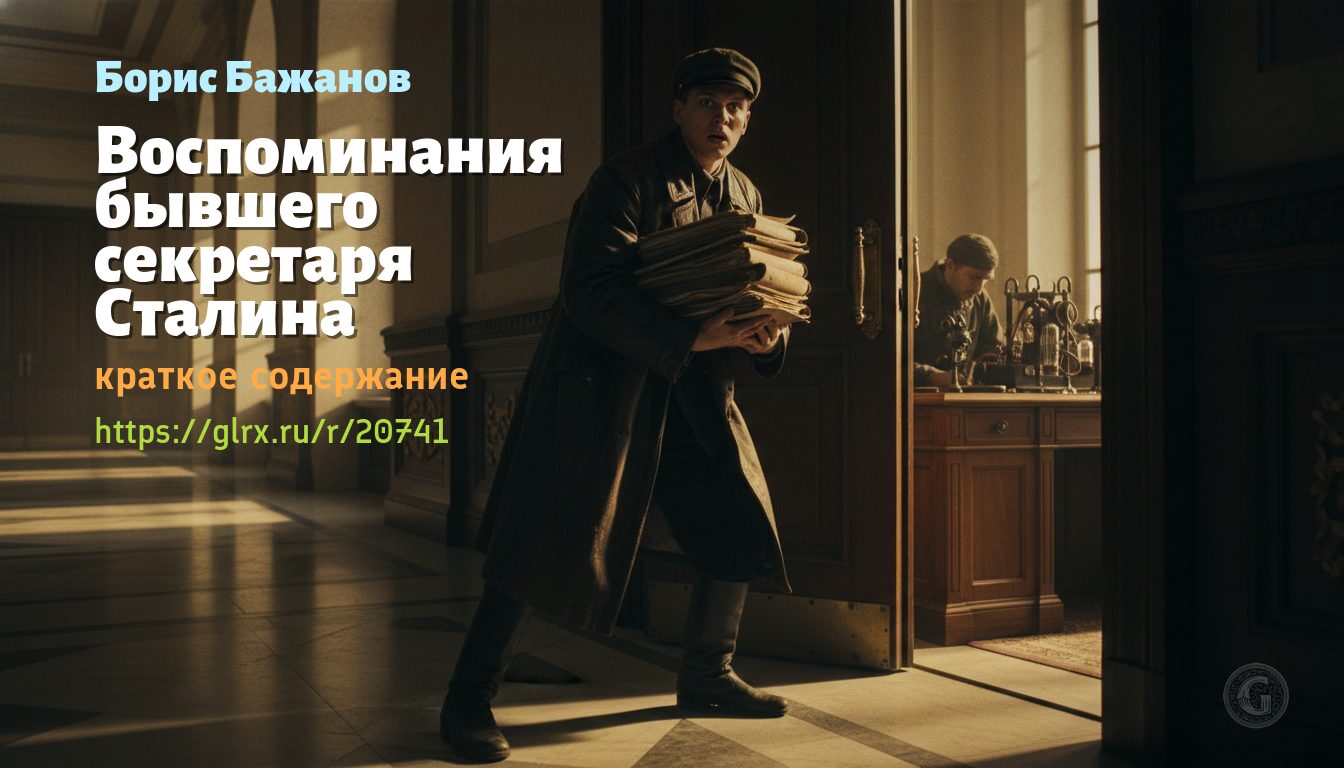
One day, the author entered Stalin’s office unannounced. He discovered that the General Secretary was eavesdropping on government members’ telephone conversations through a special station. The equipment had been installed by a Czechoslovak communist. After the work was completed, Kanner ordered the GPU to execute the technician under the trumped-up pretext of espionage. Stalin knew all the secret plans of his rivals.
Suppression mechanisms
The book describes political intrigue in detail. After Vladimir Lenin’s illness, the "troika" began to squeeze out Leon Trotsky. In 1923, the Politburo anticipated a revolution in Germany. The Bolsheviks sent millions of dollars and experienced agents there. The coup failed. The "troika" blamed Trotsky for the failure and removed him from command of the Red Army.
The party elite initiated a discussion about intra-party democracy. The opposition was gaining a majority in grassroots cells. Then Stalin’s aide, Amayak Nazaretyan, began falsifying the voting results in the newspaper Pravda. The apparatus suppressed the dissenting voices.
In January 1924, Lenin died. Nadezhda Krupskaya submitted Lenin’s "testament" to the Central Committee. Lenin advised removing Stalin from his post as General Secretary. The document was read at an emergency plenum in May 1924. Zinoviev and Kamenev saved Stalin. They persuaded the plenum to keep him in office, making a fatal mistake.
Tovstukha collected incriminating evidence from the archives on all prominent communists. During party congresses, he and a handwriting expert examined the ballots. Stalin compiled lists of delegates who crossed out his name. Years later, these people were eliminated.
Intrigues and secret murders
The author describes the hidden activities of the party. During the Civil War, the Politburo created a secret diamond fund. The jewels were kept by Yakov Sverdlov’s widow in case of the fall of Soviet power.
Trotsky’s deputy, Efraim Sklyansky, drowned in the United States under strange circumstances. Bazhanov is convinced that Kanner orchestrated the assassination on Stalin’s orders. Mikhail Frunze later died on the operating table. Doctors administered anesthesia, which the patient could not tolerate. Frunze was replaced by the submissive Kliment Voroshilov.
Faces of the Bolshevik elite
Bazhanov provides precise characterizations of the country’s leaders. Trotsky is described as a brilliant orator and a courageous man. At the same time, he was a stubborn fanatic and politically naive. Trotsky recognized the danger posed by Stalin too late. Zinoviev is portrayed as a cowardly schemer. Kamenev emerges as a clever administrator without leadership ambitions. Nikolai Bukharin was a talented publicist but a weak strategist.
Stalin is characterized as a cruel, vengeful, and utterly amoral man. He possessed natural common sense and a savage cunning. Stalin despised Marxist theory. His only passion was absolute power. He tyrannized his wife, Nadezhda Alliluyeva, and hated his eldest son, Yakov. The author considers Stalin a closet anti-Semite. The General Secretary deliberately removed Jews from the party leadership, capitalizing on discontent among the lower echelons.
Bazhanov exposes the falsehood of Soviet institutions. The GPU, under the leadership of Genrikh Yagoda, had become a machine of total terror. The Chekists recruited informants through blackmail and the threat of starvation. Felix Dzerzhinsky acted as an ideological front. The real work was carried out by a gang of unscrupulous executioners.
The author’s evolution and escape
Observing the leaders, Bazhanov became a staunch anti-communist. He realized that the revolution was not made for the good of the people. Communism proved to be a wolfish system, destroying humanity. The leaders used ideology merely as a means to seize power. The entire state apparatus was based on constant lies and outright violence.
Bazhanov decided to flee the country. He couldn’t leave legally. Stalin rejected his requests for foreign assignments. The Politburo Secretary knew too many secrets. In 1926, the author quietly transferred to the People’s Commissariat of Finance. He organized correspondence courses in finance, earning money for his future trip.
In the fall of 1927, Bazhanov secured a transfer to Central Asia. He arrived in Ashgabat. He was being followed by GPU agent Arkady Maksimov. Bazhanov took the spy along on a hunting trip to the border zone. On January 1, 1928, the Soviet outpost celebrated New Year’s. Taking advantage of the drunkenness of the border guards, Bazhanov crossed the Persian border. The frightened Maksimov was forced to follow him.
Through Persia to Europe
In Persia, the fugitives crossed snow-capped mountains and reached the city of Mashhad. The GPU immediately organized a hunt for them. Chekist Georgy Agabek planned Bazhanov’s assassination. At the same time, Moscow demanded the official extradition of the defector, promising Persia economic concessions in disputes over oil and fishing.
Bazhanov learned of the impending extradition. He met with the Persian military commander and passed on valuable information. The Persian court minister, Teymourtash, turned out to be a paid agent of Soviet intelligence. The Shah verified this information and court-martialed the minister. After this, Bazhanov traveled unhindered to the border with British India.
Hired smugglers helped him cross the Balochistan desert. In India, the author met with British authorities. He handed Home Secretary O’Hara a copy of an old Politburo decision. The document proved that Moscow had blatantly manipulated British socialists in the fictitious Lena Goldfields concession. This document forced British politician Ramsay MacDonald to reconsider his views on the USSR.
In the fall of 1928, Bazhanov arrived in France. He began publishing articles in the émigré press. He consulted with British intelligence, exposing forged Politburo protocols sold by GPU agents.
During the Soviet-Finnish War in the winter of 1939–1940, Bazhanov came to Helsinki. Carl Gustaf Mannerheim authorized him to form a Russian People’s Army from captured Red Army soldiers. The soldiers volunteered to fight against the Bolsheviks. The swift signing of a peace treaty put an end to this military action.
In the summer of 1941, Bazhanov was unexpectedly summoned to Berlin. Alfred Rosenberg was exploring the possibility of using the author in the coming war. Bazhanov explained to German officials the inevitability of their defeat. He bluntly stated that a war against the Russian people would be disastrous for Germany. Renouncing his collaboration with the Nazis, Stalin’s former secretary returned to Paris, permanently withdrawing from political activity and devoting himself to science.
- Exhibition Brezhnev era and not only. Life is the opposite
- "FREEDOM IS FREEDOM …" on the 40th anniversary of the Bulldozer Exhibition (painting, graphics, art objects, installations, photos, video)
- In the theater to them. Vakhtangov was awarded the prize "Theater Man"
- Picturesque Russia – 2018
- "Picturesque Russia"
- Igor Gusev, Maria Tyapkova "The way to follow" 0+
You cannot comment Why?