A summary of "Alyoshka’s Heart" by Mikhail Sholokhov
 Automatic translate
The tragic story of a boy surviving amidst total famine and social catastrophe in southern Russia. Written in 1925, this book is a brutally realistic account of the physical exhaustion and moral degradation of people during the Civil War. The author conveys the spirit of the times through the lens of a child’s perception, where the cruelty of fellow villagers contrasts with the unexpected rescue by representatives of the new government.
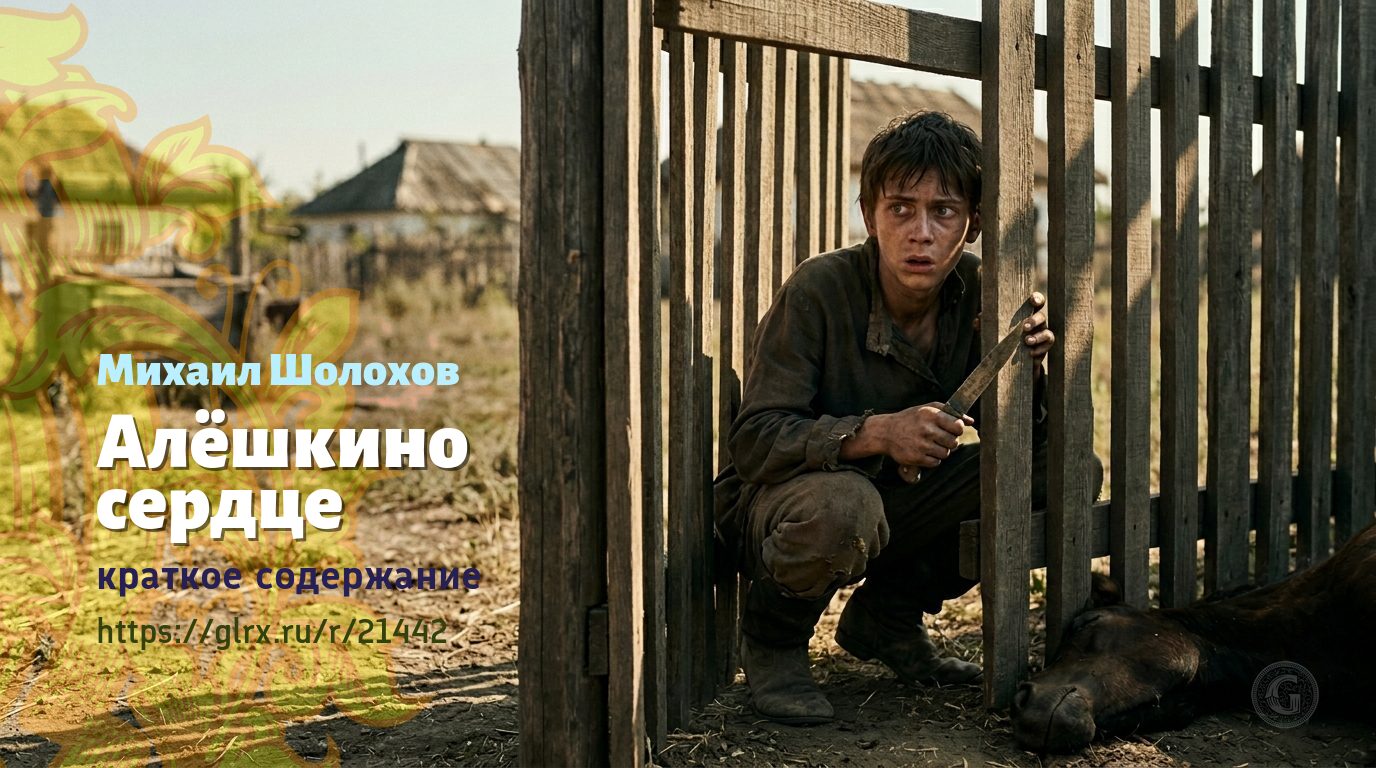
This text is part of Sholokhov’s famous cycle "Don Tales." The series encompasses works about class struggle and the destruction of the traditional Cossack way of life. Other well-known works in this cycle include the stories "Nakhalyonok," "The Birthmark," "Alien Blood," "The Melon Garden," and "Shibalkovo Seed." This work has no strict sequential number within the series, as the collection was assembled haphazardly from the author’s scattered early publications.
The Face of Hunger
For two years in a row, drought has scorched the farmers’ fields. A hot easterly wind blows from the Kyrgyz steppes. Following the drought comes famine. Fourteen-year-old Alyoshka imagines it as a huge, eyeless man wandering through the farmsteads, strangling people. The boy hasn’t eaten bread for five months. His body is horribly deformed by malnutrition: his belly is sagging, his legs are swollen. The skin stretches tightly over the bones of his face, like dried cherry bark, and his deep-set eyes seem like empty sockets. Pressing his toe with his finger leaves a white pit that slowly fills with dark blood.
Early in the morning, Alyoshka wanders to the fence. He’s giddy with joy. Nearby lies the still-warm carcass of a foal. The neighbor’s pregnant mare had been gored by the farm bull, and the animal had shed its foal. Alyoshka tries to lift the foal, but lacks the strength. The boy heads home for a knife. Upon returning, he sees a pack of dogs. The animals are already tearing at the pink flesh. With a cry of "Ah-ah-ah…" the teenager lunges at the pack, brandishing his knife. He manages to free part of the carcass and drag the entrails back to the house.
By evening that same day, the boy’s younger sister, Nyuratka, gorges herself on raw, stringy meat and dies. The exhausted mother orders her son to take the girl by the legs. They carry the body to a ditch behind the garden and lightly cover it with earth. The next day, a neighbor boy tells Alyoshka the terrible news. Dogs dug up Nyuratka and ate her insides. The boy adds that devils will torment those buried without a priest in hell.
The atrocity of Makarchikha
A week later, the teenager’s gums begin to fester. Hunger makes him gnaw on tree bark, and his teeth become loose. His mother, who has been in bed for three days, asks her son to pick some milkweed. The boy’s legs are giving out, and he refuses.
That day, Polka’s older sister notices that their wealthy neighbor, Makarchikha, has gone out to weed the garden. The hungry girl sneaks into the stranger’s house. She drinks Lenten cabbage soup straight from the cast-iron pot and fishes out the potatoes. Intoxicated by the food, Polka falls asleep right on the stove. A strong and angry Makarchikha returns for dinner. Seeing the uninvited guest, the hostess grabs her hair. In her other hand, she clutches a heavy iron. The neighbor silently beats the girl to death.
Alyoshka watches the murder through the cracks in the fence. Makarchikha drags the bloody body off the porch by the feet. The dead woman’s hair kicks up dust, leaving a trail of blood. The woman dumps Polka’s body into an old collapsed well and covers it with earth.
That night, Alyoshka sneaks into the killer’s yard. He’s hungry. The teenager calms the guard dog and goes down to the cellar. In the darkness, he greedily drinks milk from a jug. Suddenly, Makarchikha appears. She pulls out a metal pin from the cart and peers into the pit. Frightened, the jug slips from the boy’s hands and breaks. The neighbor jumps down heavily. After beating the child half to death, she carries his limp body to the river and throws it into the mud.
The next day, on Trinity Sunday, Makarchikha comes to the house of Alyoshka’s mother, Anisimovna. The woman is dead, flies crawling across her face. Makarchikha crosses herself and matter-of-factly asks the corpse about selling the house. At that moment, a bloodied Alyoshka appears in the doorway. He clutches the doorframe and pleads, "But I’m alive, Auntie… don’t kill me… I won’t!"
Rescue at the food detachment
In the evening, the boy wanders around the village. Near the school, he encounters a priest carrying a sack of salted meat and pies. The teenager begs for alms, but the priest curtly replies, "God will provide!" and passes on.
Alyoshka reaches the brick barns. This is where the Donprodkom procurement office, the government agency responsible for food collection, is located. Grain trickles through the cracks of the barn. The boy scoops up the hard wheat in his hand and chews greedily. A tall, bespectacled man calls out to him. It’s Political Commissar Sinitsyn. Instead of punishing him, the commissar takes the hungry child to his room. Sinitsyn gives him a pot of steamed wheat and sunflower oil.
At dawn, Alyoshka is sitting on the office threshold again. Sinitsyn notices a foul odor. The boy explains that after Makarchikha’s beating, maggots have appeared in his broken head. The teenager picks a bloody bunch of hemp from the top of his head. The political commissar sees a festering wound, swarming with white maggots. Sinitsyn barely suppresses his nausea. He cleans the wound with a sharpened stick, rinsing it with kerosene. From that moment on, a strong friendship develops between them. Alyoshka comes to the office every day, eats oatmeal, and feels the commissar’s inquisitive, affectionate gaze on him.
Work for a rich man
Alyoshka herds the company’s horses in the steppe. He often wanders into the rye thickets, lies on his back, and eats the milky grains straight from the ears. One day, the farm’s wealthy owner, Ivan Alekseyev, approaches him. The man offers to work for him in exchange for food. The teenager immediately agrees.
The farmhand has no property. His mother sold the house and farmstead for flour before her death. His only clothing is his father’s zipun (a peasant coat) and old felt boots. The farmhand’s wife is displeased with the new mouth, but Ivan Alekseyev cuts her off.
The work proves grueling. Alyoshka mows hay, cleans the cattle, and goes to the mill. He has to sleep under the shed’s eaves. The farmhand cruelly exploits the teenager. A neighbor reproaches Ivan Alekseyev for forcing the child to work like a horse. In response, the farmhand only curses and begins to take revenge on his protector. Even more work falls on Alyoshka. For the slightest misstep, the rich man beats the farmhand with his heavy fists.
The boy endures beatings and doesn’t complain to Sinitsyn, afraid of losing his daily bread. In the evenings, he sneaks off to the Komsomol club. There, the boys read books aloud and discuss workers’ rights. The commissar warns the teenager: a gang has entered the district. In the event of an attack, Alyoshka must come and defend the club.
In the morning, the farmhand catches the farmhand mowing. Ivan Alekseyev learns of his late-night absences at the club. Bogatey delivers a powerful blow to the back of the head. Alyoshka falls chest-first onto the metal fenders of the mower, spilling lubricating oil. The farmhand threatens to throw him out of the yard if he continues to associate with the Bolsheviks. Alyoshka has sparse teeth and a simple heart; he can’t hold a grudge. His mother often said that with such a gentle nature, he would quickly be pecked to death.
Night guests and betrayal
Before dawn, the boy is awakened by the clatter of hooves. Two armed men in greatcoats ride up to the porch. Ivan Alekseyev comes out to greet the night visitors. The farmhand feigns sleep, but listens intently.
Snatches of conversation can be heard through the darkness. The guests inquire about the Reds’ machine gun presence. The host reports the situation: only two platoons, the political commissar, and the weighers are stationed in the office courtyard. The unknown man promises to arrive the following night from the State Forest and slaughter the entire food detachment. Before dawn, the horsemen ride away.
In the morning, Alyoshka barely touches his food. After biding his time, he leaps over the fence and runs to the office as fast as he can. Bursting into Sinitsyn’s room, the teenager reveals the night’s plot. The commissar immediately arrests Ivan Alekseyev. The rich man is locked in a brick barn, despite his feeble excuses.
Fight and feat
Sinitsyn shows Alyoshka how a rifle works. The commissar teaches him how to cock the bolt and insert a magazine. That night, a detachment of Red Army soldiers takes up positions near the church fence. The boy lies down in line next to the political commissar.
At midnight, the clatter of hooves is heard from the direction of the cemetery. On Sinitsyn’s command, the company opens up with heavy fire. Panic erupts at the end of the wide street, with screams and squeals of horses. Bullets whistle overhead, knocking brick chips off the fence. The bandits retreat.
The Red Army soldiers give chase. Sinitsyn and Alyoshka are the first to flee. Two bandits who straggled behind them leap into the yard and hide in a sturdy adobe hut. The windows are boarded up with pillows. A lengthy firefight ensues. The Red Army soldiers take cover in the garden behind damp currant bushes. Before dawn, Sinitsyn offers the besieged forces a chance to surrender. Shots ring out in response.
The political commander removes a grenade from his belt. He hands it to Alyoshka. Due to his short stature, the boy has to crawl along the ditch and throw the projectile directly at the door. The distance is short, and the bullets fly seventy centimeters above his head. The teenager crawls safely to the barn and pulls the pin.
At that moment, the door of the house suddenly bursts open. Two bandits appear on the threshold. One of them is wounded and clinging to the doorframe. The other is holding a small four-year-old girl in a white linen shirt. The man shouts for surrender and asks them not to kill the child. A woman runs out from the back of the room. Wringing her arms, she covers the girl with her body.
Alyoshka turns around. He sees Sinitsyn, pale. The boy understands that something irreparable is about to happen. The man with the soft heart makes the only right decision. The teenager falls facedown on a grenade and covers his face with his hands to save the innocent child.
Sinitsyn rushes toward the boy. With a sharp kick, the commissar throws Alyoshka aside, grabs a grenade, and hurls it away. A deafening explosion rings out. A pillar of fire rises above the garden. Alyoshka smells the suffocating smell of sulfur, feels a sharp pain in his chest, and loses consciousness.
Ticket to a new life
The boy comes to. Sinitsyn’s tired face leans over him. The teenager tries to lift his head, groans in pain, but laughs joyfully, realizing he’s still alive.
The political commissar shows him a small booklet. It’s a membership card for the RKSM, issued to Alexei Popov. A grenade fragment missed his heart by just two centimeters, but doctors saved the hero. Sinitsyn firmly shakes the farmhand’s hand. Through the tarnished lenses of his glasses, Alyoshka sees two silvery tears. The commissar smiles wryly and pronounces the crucial words: now this saved heart must beat for a long time to come, for the benefit of workers’ power.
You cannot comment Why?