A summary of Mikhail Sholokhov’s "The Farm Laborers"
 Automatic translate
This early story by a Don writer exposes the class stratification of a Cossack village and the emergence of a youth political movement in the south of the country. Created in 1928, the plot is built on a sharp contrast between archaic peasant life and the new Soviet legal norms through which wage laborers learn to defend their rights. The story seamlessly complements the author’s "Don Stories" series. Along with such earlier books in the series as "The Birthmark," "The Impudent One," and "The Shibalkovo Seed," this work explores the theme of a teenager’s coming of age through the lens of hard peasant labor and social struggle. The story has no precise number in the collection.
The death of Naum and the family’s need
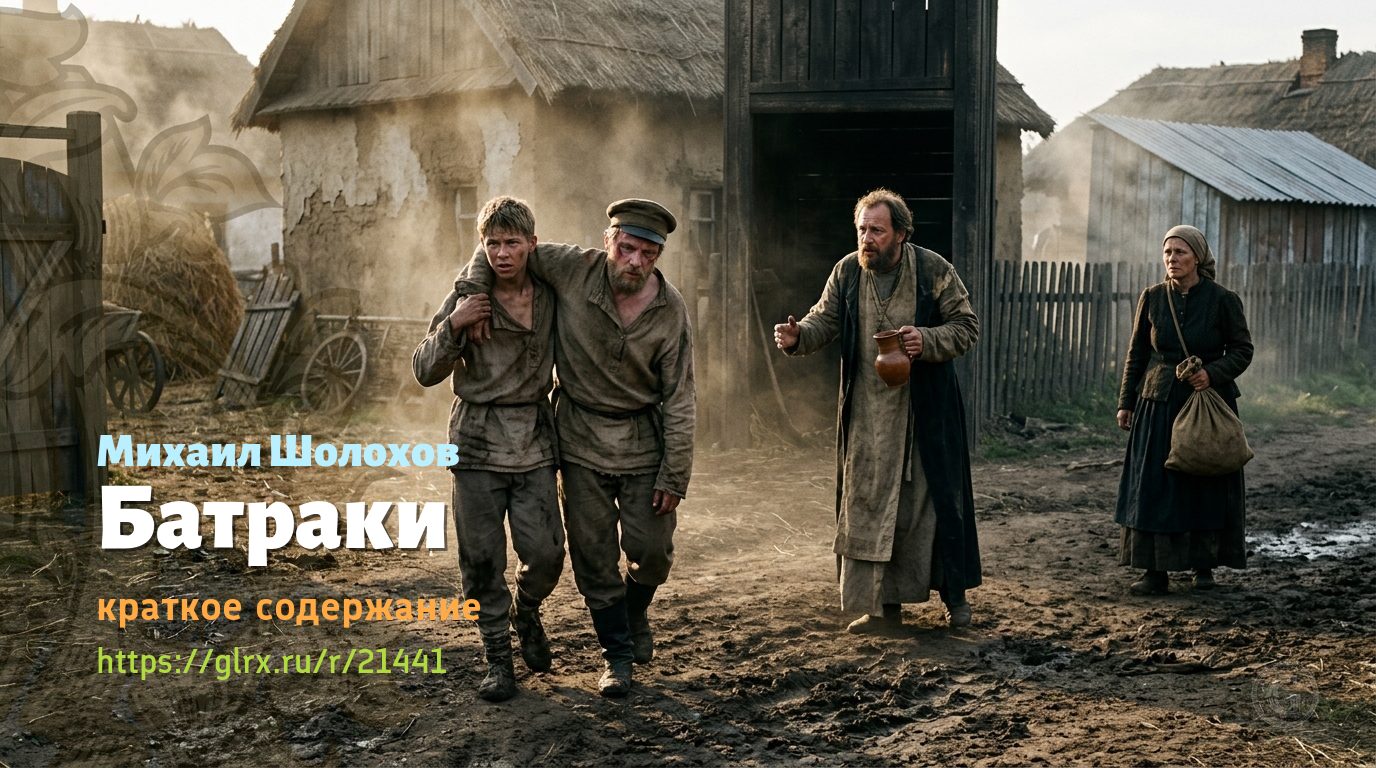
In the village of Danilovka, a sharp line separates the wealthy estates with tin roofs from the poor adobe houses of fire victims. A poor man, Naum Boytsov, takes on any job to support his family. Priest Alexander sends a laborer and hires Naum Boytsov to castrate a young stallion. Naum takes an oak stake and a thick rope, and enters the dark stable. The ferocious animal attacks the farrier. The stallion crushes Naum’s ribcage and leaps over the fence.
A terrified priest gives the dying man moonshine. The priest forces his sixteen-year-old son, Fyodor, to immediately take his bloodied father home. The owner is terrified of legal action for the man’s death. Naum struggles down the street, supported by his son, and dies from terrible injuries right there on the road.
The widow is left without a livelihood. The mother takes her bag and goes begging in the surrounding farmsteads. Teenager Fyodor is forced to find steady work on his own.
Hard labor at Blagurodov’s
In the neighboring village of Khrenovsky, a young man hires himself out to Zakhar Denisovich Blagurodov, a wealthy but ailing man. The greedy kulak takes advantage of the boy’s extreme poverty. He haggles and promises to pay just one ruble for a month’s work. Fyodor mentally calculates the timeframe. With such a modest salary, he’ll have to save up for the cheapest horse for thirteen years.
From early morning, the young man toils in the fields until late at night. He mows the grass, tends the oxen, and weeds vast tracts of potatoes. Zakhar Denisovich spends entire days sleeping under the cart. The farmhand is constantly dissatisfied with the farmhand. He yells at the teenager, reproaches him for putting too much lard in his porridge, and forces him to work on holidays.
Exactly two months pass. Fyodor asks for payment for his earnings. He wants to send the coins to his impoverished mother and buy new chiriks. Blagurodov cynically ridicules the farmhand. The owner flatly refuses to repay the debt until the grain is sold out.
Riot at the Threshing Floor
In the fall, a steam thresher is brought to Zakhar’s yard. The newcomers are completely unafraid of the village kulaks. A brazen former soldier, Frol Kucherenko, works as a thresher, feeding the sheaves. He brazenly demands a bucket of moonshine for the entire brigade. The former soldier openly despises the fussy owner. One night, a drunken Frol learns of Fyodor’s meager salary. The thresher advises the teenager to flee the exploiter immediately. He directs the boy to the Dubovskoy farmstead, where the local youth organization is based.
In the morning, Fyodor announces his resignation. Zakhar Denisovich threatens him with hard labor and refuses to pay. That afternoon, Fyodor’s impoverished mother arrives at the courtyard gates with a sack. Blagurodov’s angry wife refuses to feed the old woman. At the communal dinner, Zakhar loudly mocks the farmhand’s appetite. Frol stands up for the boy and threatens to beat his master bloody. Frightened, Zakhar falls silent. In a show of solidarity, the workers throw down their food and leave the kitchen. They leave in unison, in a single formation.
At dawn, his mother hurriedly leaves. Fyodor asks the landlady for some wheat to pay off his withheld wages. Blagurodov himself bursts into the barn, screaming. He snatches the sack and slaps Fyodor hard across the face. A crimson rage blinds the teenager. The young man throws fat Zakhar to the ground and brutally beats him with his heavy fists. Leaving his master screaming loudly, Fyodor walks out the gate without a single kopeck.
A new family in Dubovskoye
One night on the outskirts of the village, Frol Kucherenko treats a young man to a cucumber and moonshine on a dirty handkerchief. The former soldier strongly recommends seeking justice from the Dubovsky activists. The next day, Fyodor walks over twenty kilometers. At the Dubovsky village community center, he finds the cell’s secretary, Rybnikov. The local youths give the poor farmhand an exceptionally warm welcome. They help him draft a competent complaint to the people’s court. Fyodor moves into the house of activist Yegor.
The young man spends the long winter living with his new comrades. He tends livestock, attends club readings, and laboriously learns the ABCs of political writing. Boytsov’s peasant hands are accustomed to the handles of a plow, not a fine pencil. In December, Fyodor writes an awkward application to join the party. He bluntly calls the Komsomol his blood relatives. Blood, true blood relatives.
The organization unanimously votes for the candidacy of the farrier’s son. His comrades entrust him with organizing the young hired workers.
The village court and the good owner
In winter, Fyodor is summoned to the village. The judge interrogates Blagurodov. Zakhar Denisovich stutters, stutters, and openly lies. The court orders the rich man to immediately pay twelve rubles. Blagurodov is also fined thirty rubles for illegally exploiting a teenager.
On the way back along the snowy road, Zakhar catches up with Fyodor in his sleigh. He knocks the boy down with a heavy shaft. Fist slashes the teenager across the face with a whip and promises terrible revenge.
With the arrival of spring, Fyodor returns to the village of Khrenovskoy. He hires himself out to a tall, lonely old man named Pantelei Miroshnikov. Grandfather Pantelei proves to be an exceptionally fair man. He immediately pays Fyodor three rubles a month, feeds him at the same table, and signs an official document. The old man respects Fyodor for his perfect plowing of the melon field. Grandfather takes care of the young man and calls him a golden worker.
Farm laborers’ strike
On Sunday evenings, Fyodor gathers the Khrenovo farmhands behind the old threshing floors. He teaches his peers about labor rights. At first, the young people are terrified of the rich people’s wrath. Fyodor fervently convinces them to act as a united force. Fifteen farmhands agree to declare a general strike right before the start of haymaking. They organize to demand higher wages and weekly days off.
The wealthy peasants are truly enraged. Blagurodov, cursing, throws the belongings of his new farmhand, Mitriy, into the street. The owners soon realize the scale of the problem. Without labor, the precious hayfield will rot at the vine. The peasants are forced to retreat. They sign contracts en masse and increase wages.
However, several wealthy Cossacks decide to physically eliminate the instigator of the peasant revolt at night.
Assassination attempt and retribution
On a dark, starless night, Fyodor returns from yet another secret meeting. Three conspirators await the boy at Grandfather Pantelei’s gate. An unknown man strikes Fyodor with a heavy stake to the back of the head. The young man falls unconscious with a soft groan. The attackers viciously beat the man as he lies prostrate.
Grandfather Panteley awakens from a suspicious noise. The old man snatches an old muzzleloader loaded with dried peas from the wall. He runs out into the street and fires blindly into the darkness. The conspirators scatter in panic. One of the bandits falls onto the dusty road forty meters from the house. Panteley carefully carries the bloodied Fyodor onto the porch. Then he catches up with the wounded kulak.
The shot criminal turns out to be Zakhar Denisovich. The old man hits Blagurodov over the head with a rifle butt and drags him by the hair toward the house.
The story ends with long-awaited retribution. Secretary Rybnikov writes to the wounded Fyodor directly in his hospital ward. The village court sentences Blagurodov to seven years in a strict prison. Two of his accomplices, Mikhail Dergachev and the speculator Kuzka, receive five years each. A strong cell has now been established in the Khrenovsky settlement. All fifteen farmhands have fearlessly joined it. The boys eagerly await Fyodor’s full recovery. Grandfather Panteley plans to visit the boy and personally brings him some village gifts.
- Exhibition of works by Viktor Psarev "Artist and Time"
- "Alyoshka and I Are Friends" by Gennady Mamlin, summary
- "Chagin" by Evgeny Vodolazkin, summary
- Victories and dramas of the Wieniawski International Competition
- Great performers visited Geneva and Zurich. Promised to return
- A press conference dedicated to the upcoming premiere was held in the Kirov Drama Theater
You cannot comment Why?