Mikhail Sholokhov’s "The Melon Garden," a summary
 Automatic translate
This book is a harsh account of the division of an ordinary family against the backdrop of the Civil War in the Don region. Written in 1925, the story makes no attempt to soften the brutality of the events. The author describes everyday life in a Cossack village with terrifying accuracy. The violence within one home vividly reflects the collective catastrophe of an entire era.
This book is part of the "Don Tales" series. This cycle contains numerous other works by the author, including "The Birthmark," "The Shepherd," "Shibalkovo Seed," "Alyoshka’s Heart," "The Impudent One," and "Alien Blood." The book has no precise serial number. The collection developed gradually. All the texts in the cycle are united by the theme of class discord in the Cossack lands.
The Commandant’s Return and the Quarrel
The father returns home from the village chieftain’s in an unusually upbeat mood. He hadn’t shown joy for a long time since returning from the front. Laughter is hidden beneath his bushy eyebrows. Anisim Petrovich even playfully nudges his fourteen-year-old son Mitka and tells him to call his mother for dinner. Over a meager meal, the father announces the news to the family. He has been appointed commandant of the village court martial. His service and officer rank during the German war have been duly appreciated by his superiors.
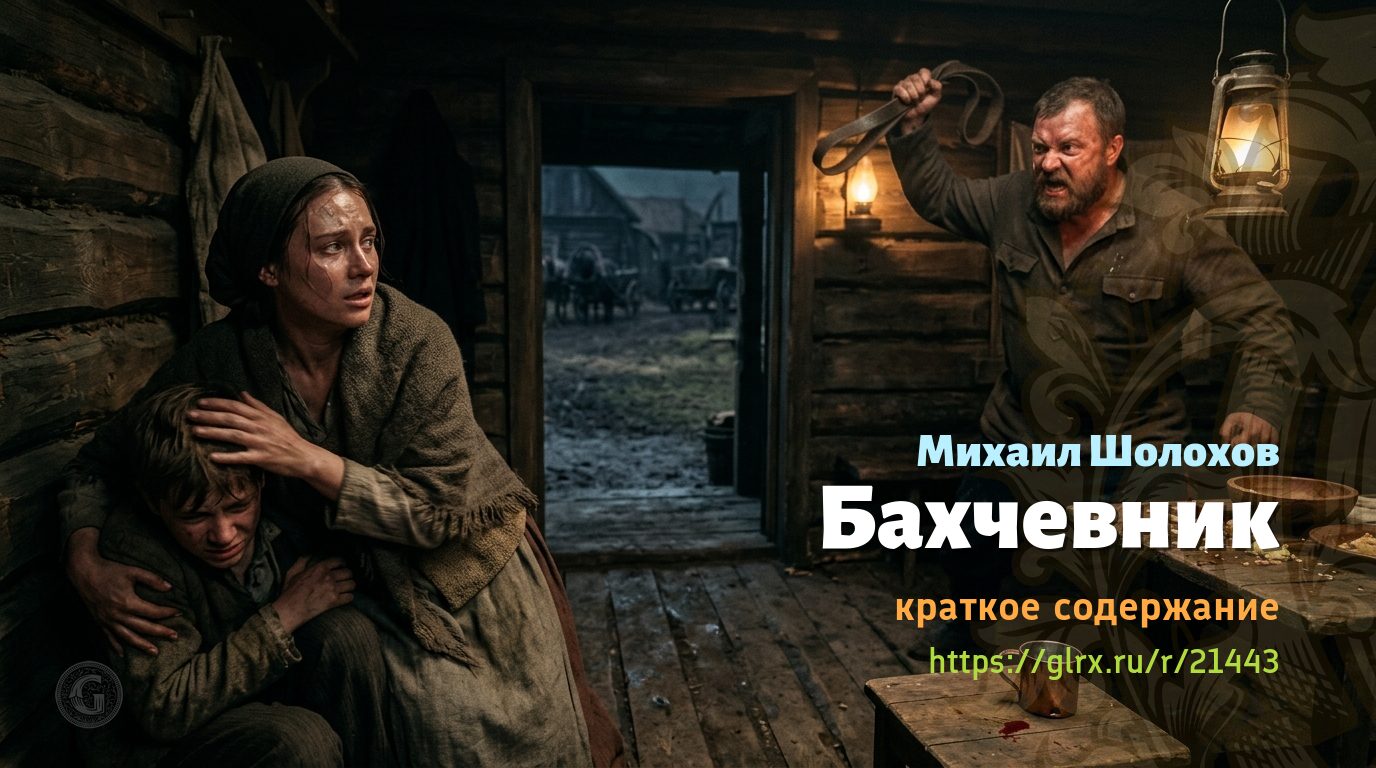
Suddenly, Anisim Petrovich’s mood changes. He turns an angry gaze on his twenty-year-old son, Fyodor. His father accuses the young man of associating with the Bolsheviks. The commandant shouts, "Speak up, you son of a bitch: are you going to the peasants?" Fyodor openly admits his connections. His father threatens to shoot Fyodor’s friends the very next day. A copper mug flies straight into the eldest son’s face. The sharp edge pierces the skin above his eye. Blood spurts. His mother rushes to protect the wounded man. Anisim Petrovich knocks over a bench with a crash and leaves the house.
The Escape of the Elder Brother
The mother fusses around the house for a long time. She collects dried fish and crackers in a bag. Then she sits down to mend linen and quietly cries. In the evening, the father returns from the office. He goes to bed fully clothed. That night, Fyodor quietly sneaks into the yard and prepares the saddle. He calls Mitka and asks for help. The older brother decides to flee across the Don River to the Red Guards. Fyodor asks his younger brother to steal the keys to the stable from under their father’s pillow. The young man wants to fight for equality and the poor.
Mitka agrees without hesitation. He cautiously enters the dark room. The heavy, gurgling snores of his drunken father can be heard in the room. The boy slips his hand under the greasy pillow. Suddenly, Anisim Petrovich grabs his son by the collar. Mitka lies about the restless horses. His father believes him and throws the ring of keys on the floor. Mitka hands the keys to his brother. Fyodor leads out the colt. Before leaving, he asks Mitka to be patient and promises to take cruel revenge on his father for any offense.
Brutal reprisal against a boy
In the morning, Mitka rides his workhorse, Gnedy, to the Don. He bathes in the cold water. The boy hears the distant rumble of artillery and thinks of his brother. His joy quickly gives way to fear of returning home. Mitka understands the inevitability of his punishment.
At home, the father immediately asks why the colt is missing. Mitka replies with a curt ignorance. Anisim Petrovich searches for the saddle and Fyodor. He enters the kitchen with a leather belt in his hands. The mother tries to shield her youngest son. She begs her husband to spare the child. The commandant roughly pushes his wife away. He throws Mitka to the floor and begins to kick him methodically. The torture continues for a long time. Soon, even the muffled groans cease to escape the boy’s throat.
Captured Red Guards
War is drawing ever closer. In the mornings, supply trains with ammunition pass through the village. They bring back crippled Cossacks. They dump them right on the square next to the village administration building. Curious chickens rake in the bloody bandages. Mitka tries to avoid his father. The boy spends his days fishing on the banks of the Don. He returns home only at dusk.
In the evening, a crowd of captured soldiers is driven into the village. They walk barefoot and in rags. Local Cossack women insult them and spit in their faces. Mitka runs after the column, peering into each exhausted face. The boy is afraid to see his brother Fyodor among them.
The prisoners are stopped near the communal barn. Anisim Petrovich comes out onto the porch. He orders everyone to take off their hats. The commandant herds the men into the black mouth of the barn. The father strikes the last wounded soldier over the bloody head with the scabbard of his saber. The man falls heavily to the ground. The crowd roars with laughter. Mitka covers his face with his hands and runs from the square.
Secret assistance to prisoners
The next day, his mother prepares donuts. Mitka asks permission to take the food to the prisoners. His mother, tearfully, agrees. She hopes for similar mercy from strangers toward Fyodor.
After waiting until darkness falls, Mitka makes his way to the barn. The guard stops the boy with a stern shout. Mitka’s origins are revealed. The old Cossack fears the commandant’s wrath. He threatens to inform on his father. The young guard intercedes on the child’s behalf, taking the bundle of food. The young guard allows Mitka to bring food on Wednesdays and Fridays during his shifts. The boy regularly brings food. He carefully climbs through the barbed wire and delivers the bundles. He returns home by secret routes.
Tragedy in the house
Every night, groups of prisoners are led out of the barn. They are driven into the steppe toward the ravines. The sounds of gunfire and volleys reach the village. If a large number of prisoners are being taken away, a machine-gun cart follows. Half an hour later, the cart returns to the commandant’s office.
One Wednesday, his father orders Mitka to drive Gnedoy into the night. Anisim Petrovich strictly forbids the horse from entering someone else’s crops. The boy manages to whisper a request to his mother. He asks her to take the food to the barn herself.
In the morning, Mitka returns home. He walks into the kitchen and sees a horrific scene. Fresh blood is smeared across the floor and walls. His mother is lying on the floor. Her face is horribly swollen. Her hair is matted with blood. The woman moans and cannot utter a word. His father’s bloody revolver lies nearby. Mitka, horrified, kisses his mother’s hands. He runs out into the street. A neighbor screams at him to save himself. His father learned about the food for the prisoners and beat his wife to death.
Working in the melon field
A month passes. Mitka is hired to guard the village’s melon fields. He lives in a hut on a mountaintop. From above, he can see the white ribbon of the Don and the village. For a long time, the Cossacks were reluctant to take the murdered woman’s son. They proposed hanging the boy from an aspen tree. The ataman persuaded the villagers. Mitka agreed to work only for a piece of bread. The direct benefit convinced the Cossacks.
The boy spends his days chasing rooks with a loud rattle. He walks dejectedly through the rows of watermelons and melons. A winding summer road snakes past the melon fields. At night, captured soldiers are driven along it to be shot. Mitka often hears screams and dogs howling.
One day, a convoy of soldiers is moving out earlier than usual. The sun is still setting over the river. Mitka watches from a hut. Suddenly, gunfire rings out. The Red Guards take off running down the road. The Cossacks fire from their knees. Two guards catch up with a fallen fugitive. A saber clangs as it cuts the man down right on the ground. Mitka’s vision darkens at the sight.
The Return of the Brother
At midnight, three horsemen ride up to the hut. They are searching for the fugitive soldiers. Mitka denies the fugitives’ presence. The Cossacks ride off to search the forest. The boy doesn’t sleep until dawn. A severe thunderstorm begins. It rains heavily.
Before dawn, a quiet groan is heard near the hut. Mitka comes outside. A man lies slumped over on the ground. The stranger begs for help and says, "Don’t give me away… don’t let me perish…" He has escaped the firing squad. His leg is shot through by the Cossacks. Mitka falls to his knees. He recognizes the exhausted, wounded man as his older brother, Fyodor.
The younger brother carries Fyodor to the hut. He hides him under a pile of dry sunflower stalks and weeds. During the day, Mitka wanders through the melon field. The brothers agree to flee at night across the Don River.
The death of the commandant and rescue
Cossack patrols ride along the road all day. Toward evening, Mitka spots a lone horseman. He warns his brother to lie still. The rider slowly approaches. It’s Anisim Petrovich. His father’s blue uniform is soaked with sweat and smells strongly of mothballs.
The father reins in his horse near the hut. He rudely asks about Fyodor. Mitka denies everything. The commandant notices traces of blood on the dry ground. Anisim Petrovich’s crimson neck fills with rage. He orders his son to go inside the hut.
Anisim Petrovich carefully examines the corners. He slowly pushes aside a pile of dry stems. The father sees his eldest son’s bare foot in a soldier’s footcloth. The commandant paws at the revolver’s holster. Mitka instantly grabs a heavy axe. The boy strikes his father in the back of the head with the sharp blade with great force.
The brothers cover the dead body with dry weeds. They descend deep ravines to the river. They must swim about eight kilometers to safety. The Don River carries the fugitives swiftly downstream. The wounded Fyodor clings tenaciously to his younger brother’s shoulder. They successfully swim across the river. They step onto hard, grainy sand and enter the dense forest. Dawn is breaking. A stunted, ruddy fringe stretches to the east.
- Exhibition project for the anniversary of Boris Grebenshchikov opened in MMOMA
- Exhibition of artists of the legendary community "Mitki"
- Exhibition "Mitki in Irkutsk"
- Moscow and Petersburg: the experience of comparative cultural studies
- "Nest" by Zhao Bandi
- "The Gentleman of Laporte" by Francis Bret Harte, summary
You cannot comment Why?