A summary of "Ruslan and Lyudmila" by Alexander Pushkin
 Automatic translate
The poem-fairytale "Ruslan and Lyudmila" was written in 1820 and was Pushkin’s first completed poem after the Lyceum. It combines a fairy tale plot with epic and song motifs. Its distinctive feature is the free tone of the narrator, who opens the action with images of Lukomorye, a scholar’s cat, and a whole world of wonders where heroes, sorcerers, and ancient Rus coexist. A Soviet film adaptation by Alexander Ptushko, based on the poem, was released in 1972, and in 1976, it won a special jury prize at the International Children’s and Youth Film Festival in Italy.
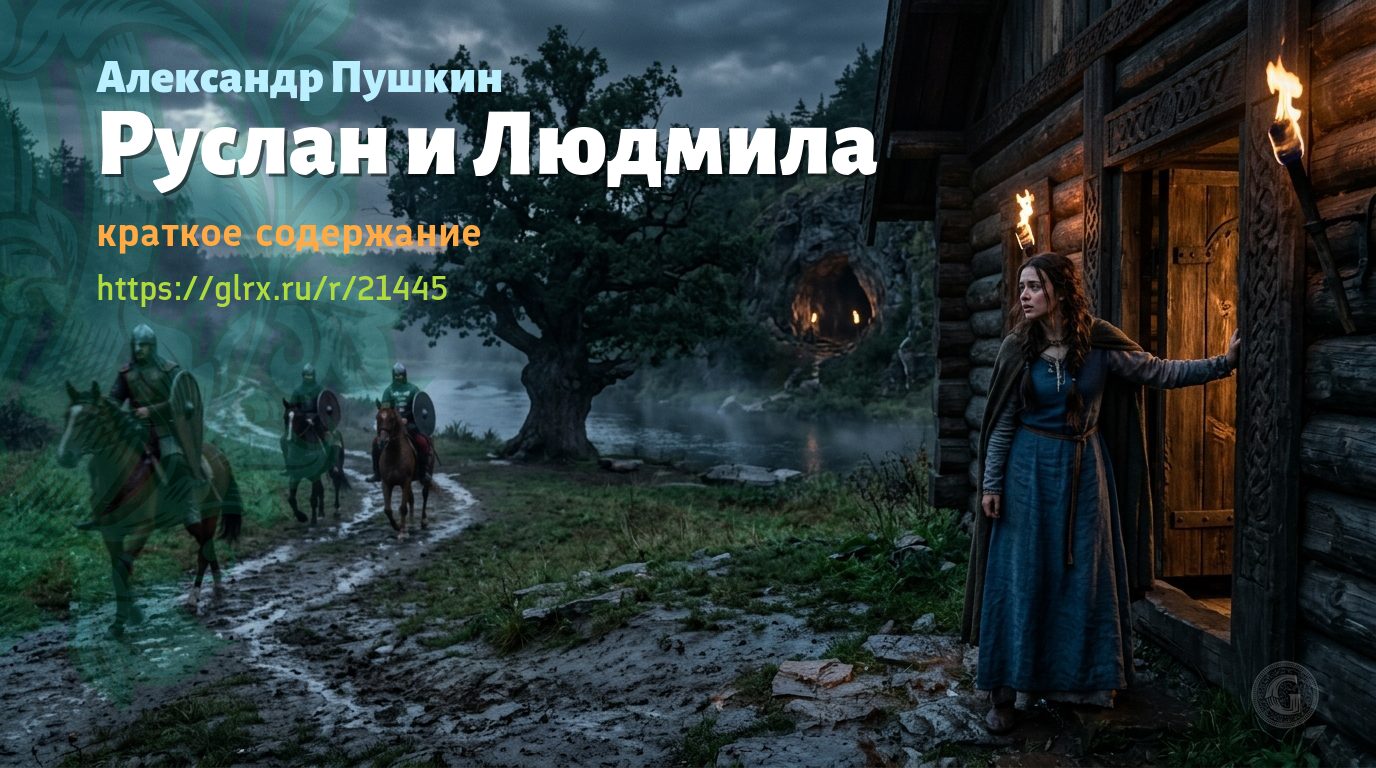
The poem "Ruslan and Lyudmila" marked the break with the classical style and became a true breakthrough for nineteenth-century Russian literature. In this work, Alexander Pushkin masterfully combined folklore with the European tradition of burlesque stories. Familiar fairytale elements are intertwined with subtle irony, light romanticism, and a profound understanding of native culture. This blend of styles allowed the young author to establish himself as an innovator, capable of transforming a simple fairytale plot into a complex literary canvas with a dual meaning.
For Pushkin studies, the poem is important as a culmination of the poet’s Lyceum and St. Petersburg career, as well as a foundation for his future works. It was in "Ruslan and Lyudmila" that the author first discovered the free and expressive narrative tone that would later form the basis of the stylistic structure of "Eugene Onegin." The work is replete with references to Russian history and mythology, including over sixty proper names and place names, making it not just an entertaining tale but also a valuable literary work.
Prologue and the abduction
The prologue begins with images of an oak tree by the seashore, a mermaid, a wood goblin, Baba Yaga, Kashchei, and thirty knights emerging from the sea — and this fairytale cycle immediately sets the tone for the entire story. After the prologue, the story shifts to Kyiv, where Prince Vladimir celebrates the wedding of his daughter Lyudmila to the brave Ruslan, and the singer Bayan sings the praises of the newlyweds and predicts their fate.
The wedding feast is noisy and solemn, but the happiness is short-lived. On their wedding night, a menacing noise erupts, everything darkens, and an unknown force abducts Lyudmila from her bedchamber. In desperation, Vladimir promises his daughter’s hand and a reward to whoever returns her, and Ruslan and three rivals — Rogdai, Farlaf, and Ratmir — immediately set out to search for her.
Ruslan’s Path
The road immediately leads the heroes in different directions, and each reveals their own character. Ruslan finds himself at the cave of the elder Finn, who explains that Lyudmila was carried off by the dwarf wizard Chernomor, lord of a distant northern castle. Finn also tells his own story: he once passionately loved the beautiful Naina, pursued her for many years, mastered secret knowledge, but in old age, instead of love, he received cruel mockery because Naina herself became a sorceress.
This interpolated story is needed not for decoration, but for a clear motive: Naina is already present in the poem’s present tense and intervenes in the heroes’ destinies. It is she who helps the cowardly Farlaf evade danger, instilling in him the idea of waiting it out and enjoying the fruits of someone else’s heroism. Rogdai, on the other hand, is consumed by envy and decides to eliminate Ruslan by force.
Rogdai pursues Ruslan, catches up with him, and engages him in battle, but is defeated and dies in the water. After meeting Naina, Farlaf completely loses his warrior spirit and rides away, content to remain alive. Ratmir, meanwhile, initially rides with everyone else, but his line will soon be diverted from the main quest.
Ruslan continues his journey alone and finds himself on an old battlefield, littered with weapons and the bodies of the fallen. There, he encounters a huge, living Head, which at first appears monstrous, but then reveals its secret: it once belonged to a giant, deceived and destroyed by his own younger brother, Chernomor. The Head guarded a sword, the only weapon capable of sapping the sorcerer’s power, and after the battle, Ruslan receives this sword along with the tale of an ancient atrocity.
Lyudmila in captivity
The story parallels Lyudmila’s fate in Chernomor’s palace. She finds herself surrounded by opulent chambers, gardens, music, and luxury, but no miracles can distract her from thoughts of Ruslan and her home. Chernomor attempts to dazzle his captive with splendor and appear before her as the ruler of a fairytale world, but he appears ridiculous and pitiful, as his formidable glory is juxtaposed with his dwarfish stature and absurd self-importance.
Lyudmila refuses to submit, defies fear, and refuses to accept the palace’s rules. Chance comes her way: she finds a cap of invisibility and begins hiding from the servants and Chernomor himself, turning his power into a futile distraction. These episodes transform Lyudmila from a passive captive into a participant in the struggle, albeit within the confines of an enchanted space.
Meanwhile, Ratmir finds himself in a magical house, where he is greeted by beautiful maidens. He forgets his former goal, remains amidst the temptations of love, and then finds quiet happiness with a young girl near a peaceful home, completely withdrawing from the competition for Lyudmila. Against this backdrop, Ruslan emerges even more clearly as the only hero who sees it through to the end.
Fight with Chernomor
Having reached Chernomor’s domain, Ruslan engages in a decisive battle. The sorcerer attempts to defeat him with magic and the power of his long beard, lifting his opponent into the air and carrying him above the clouds, hoping to exhaust him. Ruslan withstands this onslaught, clinging to his enemy’s beard and, when it weakens, cutting it off with his magic sword.
After this, Chernomor loses his power and becomes the knight’s prisoner. Lyudmila is found, but she is immersed in a magical sleep, and no embraces, words, or attempts by Ruslan can awaken her. Ruslan takes both the sleeping princess and the humiliated dwarf with him, hoping to complete the matter in Kyiv.
Betrayal and Return
On the return journey, the old feud resurfaces. Naina directs Farlaf to the sleeping Ruslan, who attacks the hero during the night, gravely wounds him, kidnaps Lyudmila, and takes her to Vladimir as the supposed victor. In Kyiv, however, the deception quickly becomes apparent: Lyudmila remains in an enchanted sleep, and Farlaf’s glory hangs in the balance.
Finn finds the murdered Ruslan and brings him back to life with the help of dead and living water. He then gives him a ring that is supposed to lift the spell on Lyudmila and sends the hero to Kyiv. While Ruslan is rushing home, the city is besieged by the Pechenegs, and the family drama suddenly merges with a military threat to the entire Russian land.
Ruslan arrives just in time, enters the battle, and helps repel the enemy attack. After victory, he approaches Lyudmila and touches her with the magic ring, causing the dream to immediately end. Lyudmila awakens, Vladimir recognizes his daughter’s true savior, and Farlaf, exposed and overcome with fear, is forced to admit his guilt.
The finale returns the action to the celebratory tone of the beginning, but this time the joy is won through trials, betrayal, and battle. Ruslan wins Lyudmila by right of loyalty and courage, Chernomor remains a humiliated captive, and the fairytale world of the poem once again merges with the world of the princely feast, where it all began.
What events does the poem begin with?
The work opens with the famous prologue about Lukomorye, where a learned cat tells tales, immersing the reader in a magical atmosphere. The main action of the poem begins in Kyiv at a wedding feast hosted by Prince Vladimir in honor of the marriage of his daughter Lyudmila to the brave knight Ruslan. The joy of the celebration is suddenly interrupted: thunder rumbles, the light dims, and an unknown force abducts Lyudmila from the bridal chamber. In a rage, Vladimir declares that he will give his daughter and half the principality to whoever can find her and return her home.
Name Ruslan’s rivals in the fight for Lyudmila’s hand.
The protagonist is joined by three knights in search of the princess, each personifying a particular human vice or weakness. The first rival is Rogdai, a stern and ruthless warrior, blinded by jealousy and a thirst for revenge. The second is Farlaf, a cowardly, boastful, and loudmouthed man accustomed to winning only at feasts but who cowers in the face of real danger. The third is the young Khazar Khan Ratmir, who seeks not so much Lyudmila herself as romantic adventure, and ultimately abandons the search for the love of another girl.
From whom did Ruslan learn that Chernomor was Lyudmila’s kidnapper?
The truth about the kidnapper is revealed to Ruslan by the wise elder Finn, whom the knight meets by chance in a secluded cave at the beginning of his journey. Finn possesses the gift of foresight and informs the hero that the princess was carried off by the powerful dwarf sorcerer Chernomor, who lives in the distant northern mountains. This elder becomes Ruslan’s main mentor: he not only reveals the enemy’s name but also predicts the knight’s ultimate victory over the evil sorcerer.
What was Chernomor’s magical power?
All of the dwarf’s supernatural power was hidden in his incredibly long gray beard. As long as his beard was intact, Chernomor could fly through the air, carry heavy objects, control the elements, and cast spells on others. Once he lost his beard, he instantly lost his magical abilities, turning into an ordinary, frail old man. Therefore, the outcome of the battle depended on Ruslan’s success in severing the source of his magical power.
What magical object did Lyudmila find in Chernomor’s palace and how did she use it?
While strolling through Chernomor’s chambers, Lyudmila accidentally discovered the sorcerer’s invisibility cap. Putting it on backwards, the princess noticed she had become invisible to everyone around her. This magical discovery allowed her to move freely through the palace and gardens, escaping Chernomor’s persistent advances and hiding from his servants. Thanks to the cap, Lyudmila gained temporary safety and the ability to defy her captor’s will until Ruslan arrived.
What did the giant Head guard, and how did Ruslan obtain this treasure?
On an abandoned battlefield, Ruslan encountered a giant living Head, which turned out to be Chernomor’s enchanted brother. Beneath it, this Head concealed a magic sword — the only weapon in the world capable of severing the dwarf’s beard. After a brief fight, Ruslan stunned the Head with a blow from his gauntlet and knocked it over. The defeated giant brother, recognizing the knight’s nobility, voluntarily surrendered the sword and asked him to avenge the treacherous Chernomor for his betrayal.
Where did the wizard Finn live, and what story of his life did he tell Ruslan?
Finn lived in a deep cave, where he spent his time in seclusion and studying magic. He told Ruslan the tragic story of his youth: as a young shepherd, he fell passionately in love with the proud, beautiful Naina, but she rejected his advances. Desperate to win her heart, Finn traveled to distant lands, became a brave warrior, and then devoted years to studying the arcane arts. When he finally cast a love spell, Naina came to him, but she transformed into a decrepit and evil old witch, whose love became his curse.
Who treacherously wounded the sleeping Ruslan on his way home?
On the way back to Kyiv, Farlaf attacked the sleeping Ruslan. Incited by the evil sorceress Naina, the cowardly rival waited until nightfall, plunged his sword three times into the unsuspecting knight’s chest, and fled. Taking the sleeping Lyudmila, Farlaf brought her to Prince Vladimir, attempting to pass himself off as the princess’s true savior. However, the deception brought him no happiness, as he was unable to awaken the girl.
How did Ruslan manage to bring Lyudmila back to life at the end of the poem?
After Finn revived the murdered Ruslan with living and dead water, the elder gave him a magic ring. Returning to Kyiv, Ruslan first took part in the battle and helped defeat the Pechenegs besieging the city. Then he entered the prince’s chambers and touched Lyudmila’s face with the gifted ring. The magic spell was broken, the girl awakened, and Farlaf’s deception was exposed, and Vladimir blessed the lovers with a long life.
- "The Knight in the Panther’s Skin" by Shota Rustaveli, summary
- The main prize of the International Slavic Forum "Golden Knight" was received by Alexander Prokhorov
- Permanent leader and founder of the theater "Near the Bridge" Sergei Fedotov celebrated his 55th anniversary
- "The Lay of the Last Minstrel" by Walter Scott, summary
- Wild field. In perpetual motion
You cannot comment Why?