A summary of Alexander Prokhanov’s "Kandahar Outpost"
 Automatic translate
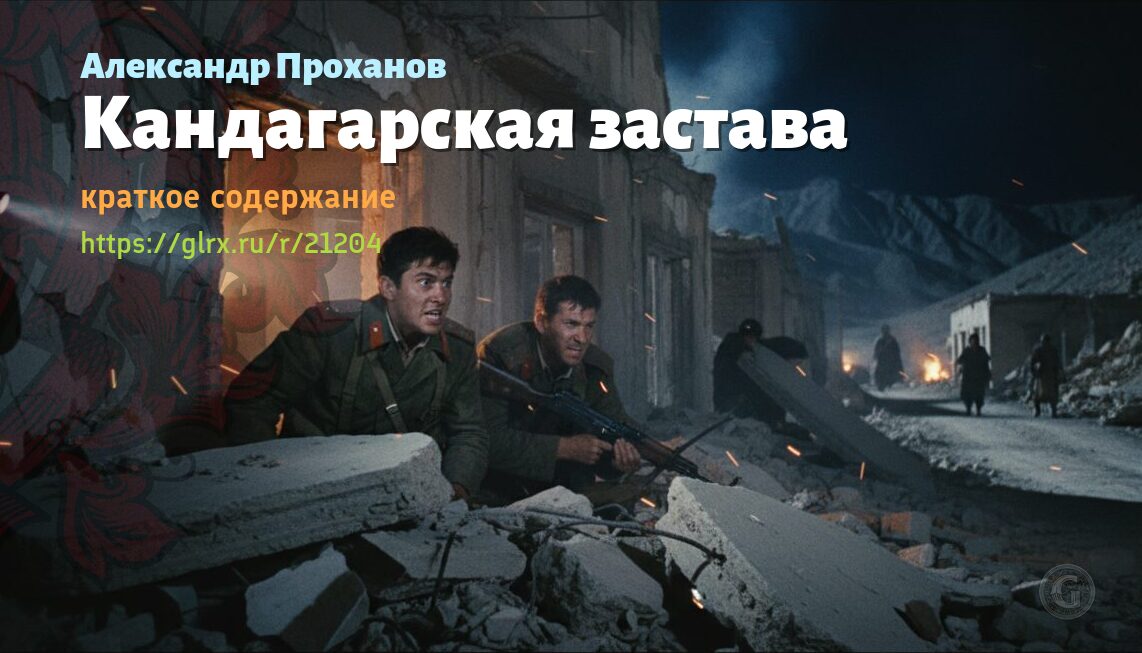
This book is a collection of stories about the war in Afghanistan, written in 1989 and united by a common setting. The work unvarnishedly captures the tragic everyday life of the Soviet contingent. The author describes the intertwining of fear, courage, and inevitable losses. The book consists of four independent stories. Each reveals the fates of people thrown into the crucible of conflict.
For the story “Muslim Wedding”, which was included in the cycle, the writer received the A.P. Chekhov literary prize.
Virgo sign
Battalion commander Major Grachev has been suspended due to his alcoholism. Wanting to regain his rank and receive a medal, he organizes a night ambush in a green area near the village of Gulyakhana. The group includes experienced warrant officers Kologrivko and Belonosov, the young lieutenant Moldovanov, Sergeant Vargin, and Private Ptenchikov. Kologrivko and Belonosov dress in Afghan national dress. The group fakes a truck breakdown on the highway to infiltrate the orchards undetected.
In the stillness of the night, the soldiers are nervous. Ptenchikov performs card tricks with a burnt handkerchief, trying to defuse the situation. The lieutenant beats him for it. When the mujahideen appear, the ambush in the ruins of an old house begins successfully. The soldiers silently capture several enemy soldiers carrying rockets. Soon, the situation spirals out of control. A large enemy force surrounds the house. A heavy firefight ensues.
Belonosov is fatally wounded in the stomach. The ensign dies in Kologrivko’s arms, remembering his native village. Private Ptenchikov, who dreamed of becoming a clown, shields Lieutenant Moldovanov from a bullet and dies. In the morning, the major orders the execution of the prisoners. Sergeant Vargin refuses to shoot the bound men. Grachev brutally kills the mujahideen with a machine gun.
Realizing the failure of the operation and his guilt for the soldiers’ deaths, the major straps himself with explosives. He goes out into the open field to meet the advancing Muslims with a white flag and blows himself up. Lieutenant Moldovanov and Vargin are killed in the firefight. Kologrivko hides in an underground kariz well. Soviet tanks flood the canals with burning diesel fuel.
The ensign engages in hand-to-hand combat with an Afghan soldier hiding there. He drowns the enemy, emerges scorched, and goes out to meet his troops. Throughout the battle, Kologrivko is haunted by a mystical drawing of a winged Virgin with a rose, seen on the wall of a ruined building.
Darling
Warrant Officer Vlasov manages the food warehouse at the military garrison. He has never seen combat and lives comfortably with his waitress, Larisa, treating her to scarce food. Vlasov prepares for his return home, dreaming of reuniting with his wife and daughter. At night, he flies by helicopter, escorting cardboard boxes of dry rations for an airborne raid.
The helicopter is shot down by an anti-aircraft missile. The pilots burn alive. Vlasov miraculously escapes with a parachute, landing right on the mountainside. Local mujahideen quickly track down the parachutist. Vlasov is brought to the opulent estate of a field commander with a blue turban. The leader, through a lisping interpreter, demands to know the routes of the Soviet convoys. The ensign refuses to talk. He responds with violence to the lashes and kicks the fat executioner.
The enemy subjected Vlasov to brutal torture. A hulking brute castrated the ensign with a sharp knife. The mutilated soldier was tied to a raft made of smashed logs and set adrift on a cold mountain river. Vlasov floated, losing copious amounts of blood. He suffered excruciating pain and delirious hallucinations. He saw familiar faces, a northern village, and familiar old women calling him tenderly, "My darling, my handsome one!"
Water and the night’s chill stop the bleeding. In the morning, the raft washes up on a concrete bridge guarded by a platoon of soldiers. One of the privates, remembering a peaceful fishing trip back home, notices the bloody body. The guards pull out the warrant officer, who is still alive but physically and mentally broken. They load him into an armored personnel carrier next to the colorful Afghan vehicles.
Muslim wedding
Intelligence chief Colonel Berezkin and military translator Lieutenant Baturin are playing a secret game. They are negotiating an alliance with Emir Seyfuddin. The goal of the deal is to secure a transport route for military convoys. Seyfuddin has long been feuding with the powerful Mullah Akram over fertile hemp fields. Berezkin is planning a large-scale military operation using artillery and air power.
During takeoff, the reconnaissance group stops a scheduled bus. Soldiers detain suspicious passengers. One of them is a limping giant with a black beard, Said Gol. During interrogation in a metal container, he brazenly admits to having previously commanded Mullah Akram’s detachment. According to the prisoner, the mullah insulted him by handing over power to the young Mahmudkhan. Said Gol proposes a plan for revenge to Berezkin. Tomorrow, Mahmudkhan’s Muslim wedding will take place, attended by the entire rebel detachment.
The Soviet command scrambles a squadron of attack helicopters. The captured giant flies with them, leading the way through the mountains. The aircraft deliver a devastating bombing strike on a festive courtyard in the village of Tora-Kotal, destroying carpets, people, and adobe buildings. Said Gol joyfully rejoices, observing the carnage from above.
That night, Fazli, Seyfuddin’s envoy and teacher, sneaks into the garrison. He is badly wounded and frightened. The teacher reveals the terrible truth. The bombed-out wedding did not belong to Mahmudkhan, but to Majid — Seyfuddin’s own son. Said Gol had cunningly deceived Soviet intelligence, tricking them into destroying their new allies. Majid is killed, Seyfuddin is wounded. The peace agreement is irrevocably broken. Baturin is acutely aware of his fatal mistake and his complete misunderstanding of the alien Eastern world.
Kandahar Outpost
Lieutenant Shchukin commands a small garrison. Outpost Alpha guards a stretch of concrete road near Kandahar. The platoon lives in a state of constant anxiety, surrounded by minefields and burned-out tanks. The soldiers create a modest living space under daily shelling. The twin brothers Blagih build a smoking room from empty shell crates. Driver Malutko steams in a makeshift banya. The lieutenant tries to maintain the morale of the frightened Muscovite Luchkov. Artist Kaftanov draws a white swan flying over a peaceful lake for a wall newspaper.
During the day, elders from a neighboring village arrive at the outpost. Through a Tajik interpreter, Saidov, they report that a Soviet anti-aircraft gun recently killed the local leader, Karim. His unit plans to exact brutal revenge that night. Shchukin prepares for a heavy defense. He methodically checks the posts, assessing possible attack directions from the can dump. In the darkness, the officer spots a rat. The commander believes it is the soul of the slain Karim, come to ask for forgiveness and an end to the war.
The night attack turns out to be a massive artillery barrage along the entire road. The garrison successfully fights back, lighting up the sky with yellow flares. In the morning, two large convoys carrying fuel and aerial bombs safely pass the dangerous section, hundreds of meters at a time. Sappers Kaftanov and Makarevich masterfully defuse a landmine before the vehicles can move.
In the afternoon, Shchukin rides in an armored personnel carrier to a nearby Afghan outpost. Lieutenant Dzhabar is stationed there. The Blagikh brothers accompany him to retrieve an asbestos pipe for the barracks stove. Shchukin and Dzhabar are having lunch, sharing bitter thoughts about the endless war. Suddenly, a burst of machine gun fire erupts from the direction of Black Square. A sniper’s bullet accurately pierces the chest of the older Blagikh brother. A medical orderly tries in vain to save the dying twin, injecting him with promedol.
A dead man is transported to a military hospital through the narrow, dusty streets of Kandahar. Local traders and farmers watch the speeding military vehicle with indifference. The doctor at the hospital pronounces him dead. The officer finds no answer to the difficult questions about the meaning of these senseless deaths.
- Александр Невский
- Александр Македонский
- Александр Бенуа: художник и сценограф
- Александра Вейхерт, современный скульптор
- Нэн Голдин: Фотограф-феминистка
- Стэнхоуп Александр Форбс, ирландский пейзажист, художник-деятель
- Александр Архипенко: русский скульптор-кубист
- Александр Колдер: американский скульптор, художник-кинетист
- Русский авангардист Александр Крюков
You cannot comment Why?