"Men Don’t Cry" by Tatyana Korsakova, summary
 Automatic translate
Tatyana Korsakova’s novel revolves around the encounter of two people who have already been broken by life in their own way: a young mother, Masha Litvinova, and the wealthy, tough, and seemingly almost unfeeling Ivan Matveyevich Serebryany. From the very beginning, the love story is linked to pain, fear, loss, and old guilt, and so the characters’ personal stories constantly coexist with a criminal secret and the memory of a past that haunts Serebryany.
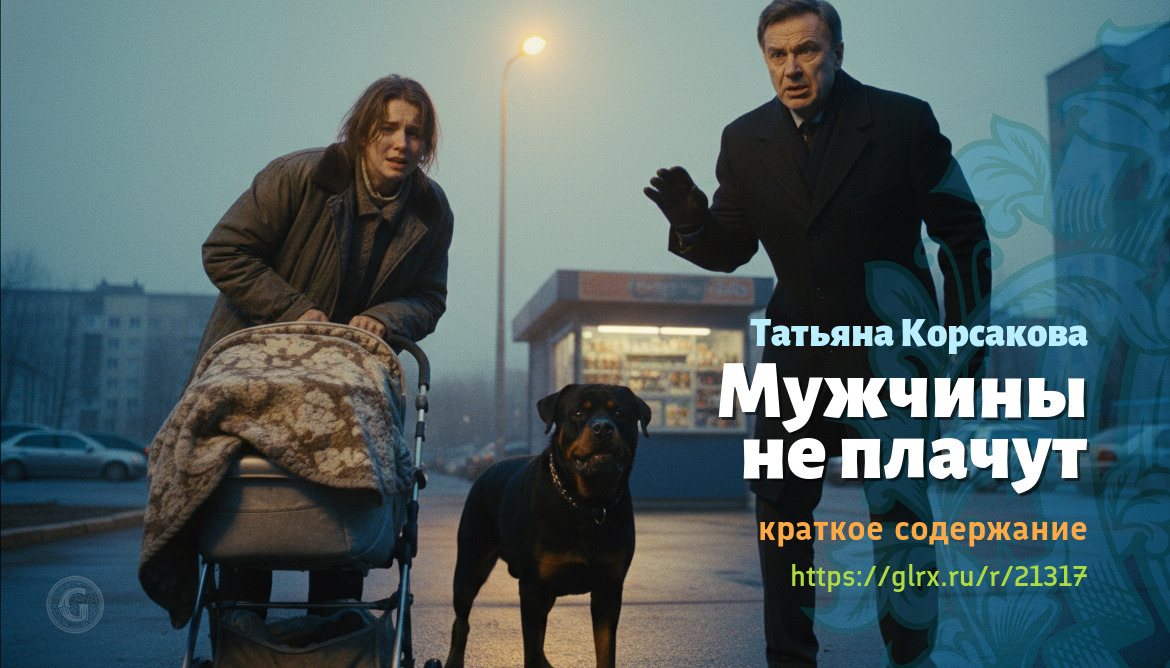
The plot unfolds casually and abruptly. Serebryany stops at a kiosk for cigarettes, notices a crying, unattended baby, and, overcoming his irritation, approaches the stroller. Almost immediately, he finds himself face to face with his long-held phobia: a huge Rottweiler appears nearby, and Serebryany, who is terrified of dogs, is ready to defend the child when it turns out that both the baby Vanka and the dog Tyson belong to the disheveled, poorly dressed Masha. The argument is silly and tense, but it is precisely where their story begins.
After this scene, Serebryany goes to the cemetery to visit the grave of Strizh, a man with whom he shared a terrible past. There, an important theme of the novel is revealed: as teenagers, they promised themselves not to cry, because "men don’t cry," and they considered themselves gladiators, taught too early by life to endure pain and await death. Strizh is already dead, his murder unsolved, and his memory remains a constant wound for Serebryany.
Masha’s story begins with her difficult motherhood. She’s poor, barely sleeps, raising a young son alone, scrimping on everything, counting the money for Vanya’s food and Tyson’s food, and at night, remembering how she got to this point. The novel then takes a long, long look back, detailing her relationship with Anton Pogorelov. Masha was once a quiet, inconspicuous student, and Anton was a handsome, charming favorite of everyone. Their relationship began on New Year’s Eve at her home, where Anton arrived late, gave her a huge stuffed bunny, stayed until the morning, and then suddenly announced he wanted to live with her.
The first years of this love seem like a fairy tale to Masha. They live together, Masha works, manages the daily grind, believes in their shared family, and tries to ignore the warning signs. Anton’s true character is revealed gradually. Without asking, he spends their shared savings on an expensive Rottweiler puppy, whom he names Tyson, but then quickly loses interest in the dog and shifts all care to Masha. Later, Anton even tries to exchange Tyson for a cell phone, and that’s when Masha openly defies him for the first time and refuses to give up the dog.
Their union finally collapses when Masha learns she’s pregnant. For her, it’s a long-awaited joy; for Anton, it’s a nuisance. During a romantic dinner she’s preparing for her big confession, Anton initially feigns calm, then demands an abortion, explaining that he doesn’t want poverty, hassle, or "the burden." When Masha refuses, he completely reveals himself: he says he lived with her for convenience, exploiting her apartment, money, care, and labor, but there was never any love in his words. Masha hits him, Tyson stops him from attacking her in return, and Anton leaves.
The pregnancy proves difficult. Masha develops preeclampsia and is rushed to the hospital, where she undergoes an emergency cesarean section. This is how their son, Ivan (Vanka), is born. At the maternity hospital, Masha’s companion is Lika, a beautiful and wealthy woman who is also expecting a child but loses it during childbirth. A strange, intense bond develops between them. Lika becomes Vanka’s godmother, and later helps Masha with things, a stroller, baby food, and simply her compassion, as Masha has little support system of her own.
Later in the novel, another important figure appears: Baba Tonya, Anton’s grandmother. At first, her visit seems almost comical: the grumpy old woman unceremoniously enters Masha’s apartment and demands to see her great-grandson. But she gradually becomes a true helpmate for Masha, becoming attached to Vanya and becoming part of their small family circle. By this time, Masha has already become convinced once again who Anton really is: he meets her by chance in the park, boasts about his new woman and his new life, but refuses to even look at his own son.
Through Lika, Masha gets a job as a secretary at a major business owner’s firm — and is horrified to discover that her new boss is the same grumpy, gray-haired stranger who once frightened Tyson near the stroller. Working for Serebryany is difficult for her. He’s demanding, abrupt, a stickler for order, a heavy smoker, exhausting his subordinates, and seemingly deliberately testing Masha’s limits. But behind his rudeness, a different nature gradually emerges: he helps his driver, Stepan, and his secretary, Annushka, when the latter is diagnosed with cancer, and increasingly views Masha as more than just a casual employee.
Serebryany’s past is simultaneously revealed. He was once Serebryany, a teenager from a world where children became criminals or victims early on, and a mysterious Master stood over them. Swift was his closest friend, and their youth was marked by humiliation, violence, and constant fear. It is from this source that Serebryany’s harshness, his habit of keeping to himself, and his painful loyalty to the memory of his friend emerge in the novel. An old crime, Swift’s death, and other dark episodes from the past gradually merge with the present, causing the love story to resemble not an office romance but a dangerous undertaking, where any mistake can have grave consequences.
Masha and Serebryany’s relationship grows slowly and with difficulty. There’s a lot of mistrust, awkwardness, and defensiveness between them, but Serebryany grows increasingly attached to both Masha and Vanya. This is especially noticeable in the way he changes around the child, and also in the fact that, for Masha’s sake, he learns to live with something he’s always feared — a dog. For the first time, he feels something other than a business deal or a casual affair, but a genuine need to care for someone without demanding payment.
The climax comes with Vanka’s disappearance. The child vanishes, and Masha almost ceases to live: she sinks into a mute, petrified melancholy, in which she no longer has the strength for tears or hope. Serebryany takes on the search. He revisits old connections, searches for clues, connects the dots, and even consults the clairvoyant Eleanor, from whom he receives a cryptic clue about a "happy place with lots of animals." The trail leads him to a traveling circus in Alexandrov, where Vanka turns up alive and well. It turns out that an elderly woman brought the boy there for money, slandering Masha and passing her off as a bad mother.
Vanka’s return home becomes the most powerful episode of the novel. Masha, almost lost touch with reality, at first can’t believe her own eyes, but then she hears her son’s voice and realizes the nightmare is over. Serebryany brings the boy himself, trying to remain firm, joking, talking about the journey, about the chocolate bar, about Vanka’s tiredness. However, behind this outward composure lies the very feeling he’s kept from emerging his entire life. He loves Masha, he loves Vanka, and he can no longer think of himself separately from them.
The epilogue brings this storyline to a clear family conclusion. Masha and Serebryany get married, and it’s he who insists on a real wedding, though she’d rather have a quiet ceremony. After the celebration, they return home, and Serebryany shows Masha and Vanka his surprise — a small puppy named Tai. For him, this is an act of great inner value: a man who once froze at the mere sight of a dog brings a new dog into the house himself, seemingly finally embracing a life with a wife, a child, the hustle and bustle of home, and an affection that’s impossible to escape.
- "Vanka", summary
- Association "Exhibition Halls of Moscow" will take part in Bibliochi
- Exhibition of the Museum of Cinema "Report from the set" in the Public Chamber of the Russian Federation
- "LoveHate" by Anna Jane, summary
- Exhibition "Heroes" of the Russian-American artist, Dmitry Strizhov
- A summary of Mikhail Bulgakov’s "Theatrical Novel"
You cannot comment Why?