Boris Akunin’s "Altyn-Tolobas," a summary
 Automatic translate
Boris Akunin’s book was published in 2000. This work opens the "Adventures of the Master" series. The writer created a separate branch of the larger Fandorin project. The narrative unfolds across two time periods. The reader is transported to the late 20th century and the pre-Petrine era. The connecting link is the history of the von Dorn-Fandorin family.
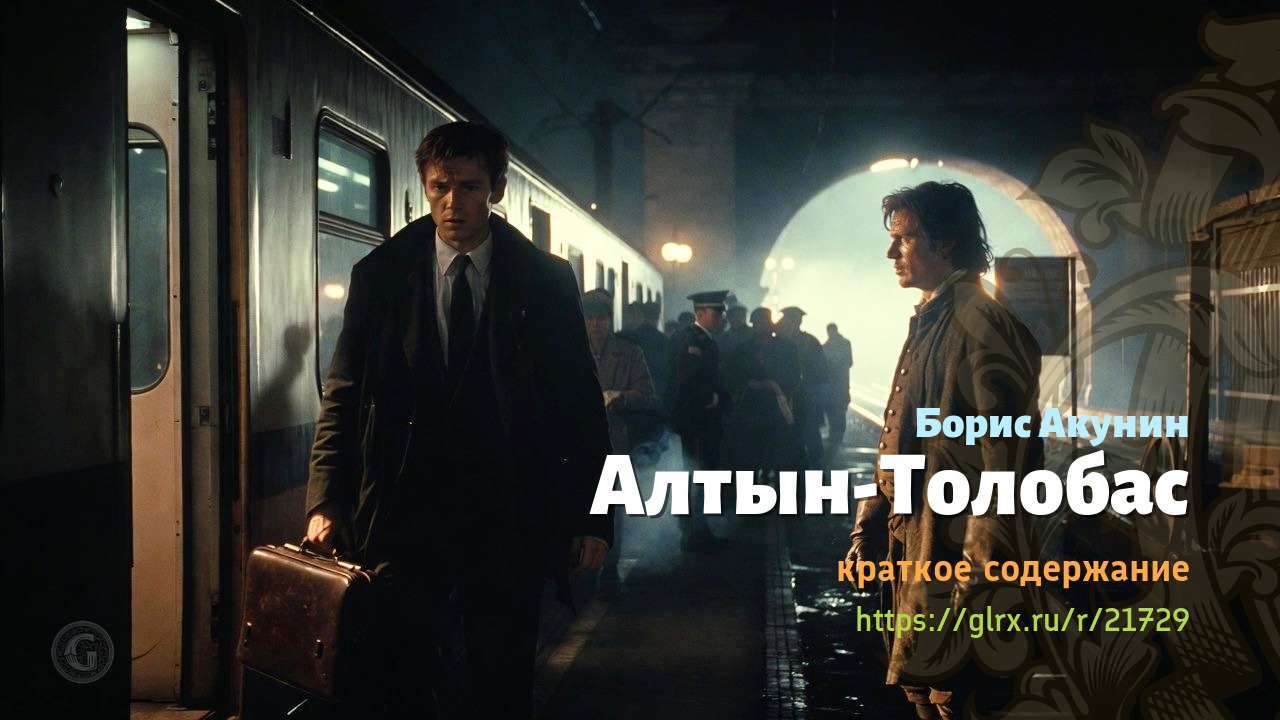
Nicholas Fandorin goes to Moscow
The protagonist of the modern storyline is Nicholas Fandorin, a British citizen of Russian descent . This history major specializes in the nineteenth century and is a descendant of the famous detective Erast Petrovich Fandorin. His lineage goes back to the Württemberg mercenary Cornelius von Dorn , who went to serve the Moscow Tsar in 1675. Nicholas’s father, Sir Alexander, dies in the sinking of the ferry Christiania. His son inherits his inheritance and sets off for the land of his ancestors. The formal reason for his trip is a fragment of Cornelius’s will. Archaeologists accidentally discovered this half of the document in the Kostroma town of Kromeshniki. An anonymous sender sent the document to the Briton by parcel post from Moscow.
Right at the border, Nicholas encounters rude border guards. On board the train, the master is drugged and robbed. The thief takes his laptop, money, and a precious relic — half of von Dorn’s charter. In Moscow, events rapidly unfold around this theft. Fandorin finds himself at the center of a criminal investigation. The Briton meets the determined journalist Altyn Mamayeva. At the same time, he is being followed by a hired killer nicknamed Shurik. This psychopath mysteriously returns the stolen diplomat to the historian. The ancient document is being hunted by seekers of Liberea — the legendary library of Ivan the Terrible. Nicholas becomes involved in a dangerous game. Here, almost no one can be trusted.
A British scholar finds himself in the post-Soviet reality of the 1990s. Local customs are very different from the image of old Russia. Nicholas drew his knowledge of his ancestral homeland from classical literature and family legends. But reality proves harsh. On the streets of Moscow, businessmen coexist with outright criminals. The foreign visitor is forced to adapt quickly. The historian must survive in a foreign, completely unfamiliar environment. He must master the local slang and rules of conduct.
The title of the novel "Altyn-Tolobas" refers to a mysterious underground vault. Translated from Turkic languages, this phrase means "golden basement" or "golden vault." According to historical myths, it is there that a priceless book collection is hidden. The Libereya was brought to Moscow by the Byzantine princess Sophia Palaiologina. The mystery of the golden basement has captivated scholars for centuries. The search for the library becomes an obsession for Moscow’s bandits.
Captain von Dorn in pre-Petrine Moscow
The second storyline takes place in 1675. Cornelius von Dorn was born into a family of impoverished Württemberg nobles. The youngest son spent ten years fighting in the mercenary armies of European powers. Prince Tulupov, the envoy, offers him a place in the service of the Russian Tsar. The terms of the contract prove quite favorable. The officer receives a generous start-up allowance, a high salary, and a captain’s commission. Cornelius takes his modest possessions with him. His travel bag contains his father’s alarm clock, a cypress cross, and a gold medallion engraved "C. v. D." The mercenary sets off via Riga directly to the Russian border.
Along the way, the captain witnesses the profound poverty of villages like Nevorotynskaya. He encounters the outright tyranny of border guards and the extortion of local officials. Courage and cunning help the German reach Moscow safely. In the capital, he serves conscientiously. The officer trains Muscovite soldiers in marksmanship and European military formations. Cornelius becomes close to the entourage of the boyar Artamon Matfeyev, tutor to the wife of Tsar Alexei Mikhailovich. Family legend has it that the mercenary married the daughter of this nobleman. The captain also finds a side income, buying red braids of girls’ hair for the Dutch wig merchant Jan van Haren. This episode explains the appearance of an antique lock of hair in the Fandorin archive. It bears the inscription "Laura 1500."
Cornelius’s fate becomes intertwined with the political intrigues of the royal court. The boyar Matveyev falls into grave disgrace. The nobleman is sent into distant exile in Kromeshniki. In May 1682, a bloody rebellion of the Streltsy (musketeers) erupts. The rebels kill Artamon and his loyal retainers. The date on the discovered document points to these tragic days. It was then that Cornelius wrote a will for his young son, Nikita. Later, unknown individuals cut this document in two. The papers from Nicholas’s archive end at this point. The subsequent biography of Captain von Dorn remains shrouded in the mists of the past.
The Search for Liberea and the Unraveling of the Mystery
Fandorin, together with Altyn, slowly deciphers the text of the fragment. The researchers discover the paper’s true purpose. The document turns out to be more than a simple will. The deed contains encrypted topographic directions. This trail leads to hidden treasure. The coordinates are directly linked to the location of the royal library. Shurik, a hired killer, is following the same trail. He is carrying out the orders of a powerful secret client. The capital’s criminal circles also show a keen interest in ancient artifacts. The scientist is constantly taking risks, balancing scientific curiosity with the instinct for self-preservation.
Place in Akunin’s work
The book marks the beginning of the "Adventures of the Master" series. This literary cycle consists of the works "Extracurricular Reading," "F.M.", and "The Falcon and the Swallow." The protagonist of these stories is Nicholas. The author skillfully weaves historical detective fiction with elements of thriller. The narrative architecture is built on strong contrasts. The grim realities of pre-Petrine times alternate with the criminal everyday life of the 1990s. Both eras are depicted through the lens of a single family.
You cannot comment Why?