"Pelageya and the White Bulldog" by Boris Akunin, summary
 Automatic translate
The detective novel was written in 2000. The narrative centers on the investigations of a clumsy, red-haired, and incredibly perceptive nun. She secretly unravels the most complex crimes that neither the police nor the provincial prosecutor’s office can solve. The novel received widespread acclaim and was successfully adapted into a film. In 2009, director Yuri Moroz released a television series of the same name, with actress Polina Kutepova brilliantly portraying Pelagia.
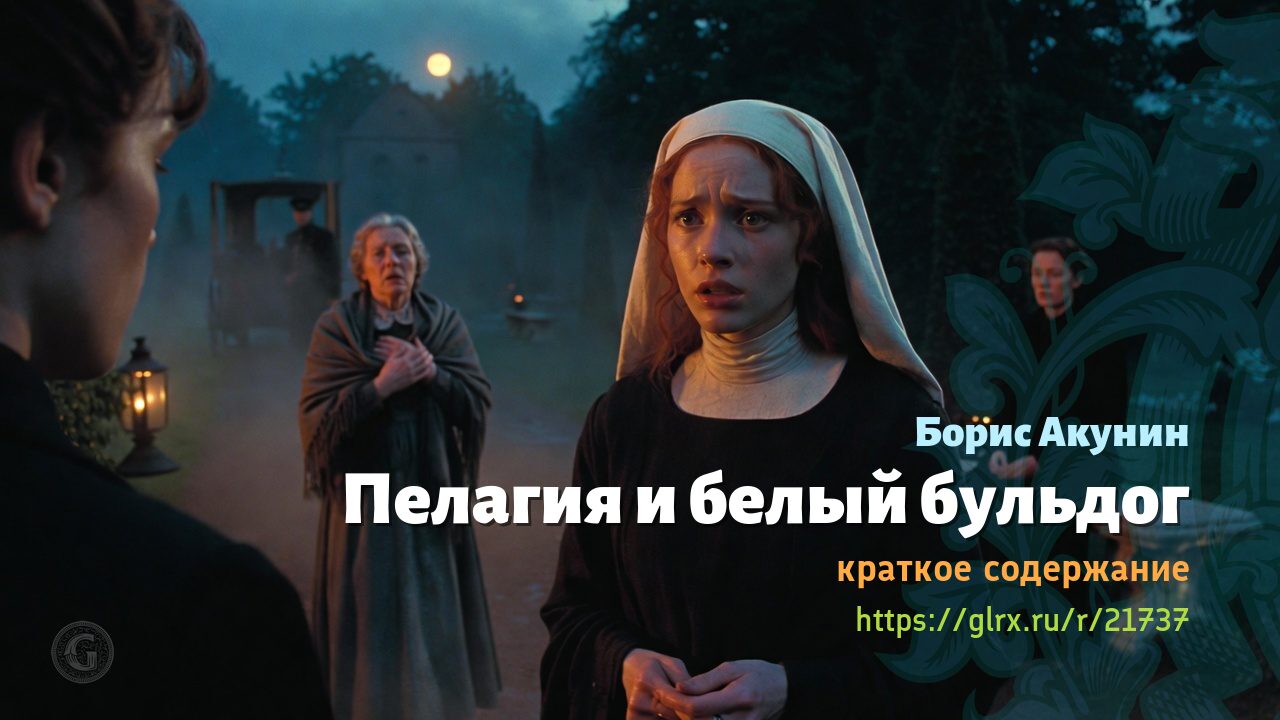
This book opens the "Provincial Detective" series of detective novels, also known to readers as "The Adventures of Pelagia." The series consists of three works. The first novel, number one, is followed by "Pelageia and the Black Monk" and "Pelageia and the Red Rooster."
The beginning of the story
The events unfold in the Trans-Volga Province. The local bishop, Bishop Mitrofaniy, suffers from insomnia due to a plague of cicadas and heavy thoughts. Synodal inspector Vladimir Bubentsov has arrived in town, ready to disrupt the peaceful provincial order for the sake of his career in the capital. At the same time, Mitrofaniy receives a desperate letter from his aunt, Maria Afanasyevna Tatishcheva. The elderly general’s wife tearfully complains about the death of her pedigree white bulldog, Zagulyai. An unknown assailant poisoned the rare dog right there on the estate. The bishop entrusts the investigation to his spiritual daughter, Sister Pelagia, who conceals a keen analytical mind behind her timid exterior.
The nun arrives at the Drozdovka estate. The house is filled with bustling relatives and guests. Among the guests are the general’s grandsons, Pyotr and Naina Telianov, the devoted manager, Stepan Shiryaev, the dry English companion, Miss Wrigley, and the Moscow photographer, Arkady Poggio. The estate is regularly visited by the neighbor, Krasnov, and the wealthy local merchant, Sytnikov. Soon, another brutal crime occurs: someone has hacked to death with an axe the second bulldog, named Zakidai. Suspicion naturally falls on all the estate’s inhabitants, anxiously awaiting the rich old woman’s generous inheritance. Pelagia begins to study the habits and conversations of her guests.
Bloody events
Naina Telianova behaves defiantly, delivering terrifying speeches about love and the sacrifices it entails. One dark evening in the park, right before the nun’s eyes, an unknown assailant kills Zakusai’s last puppy with a stone. Maria Afanasyevna, overcome with grief, nearly gives up her life and constantly rewrites her will, disinheriting her grandchildren in favor of an Englishwoman. Meanwhile, the quiet province is shaken by horrific news. Police find two decapitated male bodies on the riverbank. Inspector Bubentsov immediately declares the murder the work of local forest savages.
An official publicly claims that the Zytyak tribe made a bloody sacrifice to the ancient idol Shishiga. Bubentsov launches a large-scale investigative operation, arrests elders, provokes a peasant revolt, and ruthlessly suppresses it, killing people. Wanting to get to the bottom of this, Pelagia, with the bishop’s blessing, disguises herself as the socialite Polina Andreyevna Lisitsyna. She moves to Zavolzhsk to secretly gather information from officials. Through investigators who are infatuated with her, it is discovered that the blood on the pagan temple belongs to a slain elk, but the police strictly conceal this fact from the public.
A scandalous exhibition
Photographer Poggio is holding a private showing of his best work. The highlight of the evening is a series of photographs of a nude bather, whose perfect figure is strikingly reminiscent of Naina Telianova. The insulted manager, Shiryaev, long and hopelessly in love with the capricious young lady, brutally beats the artist. In the dead of night, an unknown assailant enters Poggio’s laboratory. The killer smashes the photographer’s chest with a copper tripod and shatters all the glass plates. Police Chief Lagrange and Prosecutor Berdichevsky immediately arrest the prime suspect, Shiryaev.
Naina saves the manager from hard labor by calmly claiming that Shiryaev spent the night in her bed. Now free, the princess returns to her city mansion. Pelagia secretly enters Naina’s house through a window and discovers the maid dead on the floor. The young lady herself lies in a dark hallway with a hole in her head. Bleeding profusely, Naina manages to confess to a nun and whispers strange words about a living aspen tree and an abandoned hoe in one of the photographs that vanished without a trace.
Night chase
The killer, patiently concealed in the darkness of the mansion, suddenly attacks the nun. Pelagia flees through the gloomy garden. In pitch darkness, under a pouring cold rain, the criminal relentlessly pursues his victim to the edge of a steep clay bank. The nun hides on the trunk of a fallen birch tree, hanging over a forty-meter abyss. The killer silently undermines the tree’s roots with a heavy stone. Falling from a great height, the nun plummets into the icy river. The powerful current sweeps the nun away and carries her far from the sleeping city.
Exhausted and battered by the waves, Pelagia struggles to reach a sandbank just below the cliff of Drozdov Park. Waiting for the saving dawn, the nun recalls Naina’s deathbed delirium and discovers loose, dug-up earth beneath a withered aspen tree. Armed with a garden hoe, the fugitive digs into a deep hole and discovers two rotting human heads, as well as a hand with a severed finger. This horrific discovery completely knocks the sister unconscious. She regains consciousness only in the safe quarters of the local bishop.
Arrest and trial
The identity of the decapitated victims is quickly established. They are the missing timber merchant Vonifatyev and his young son. The merchant received thirty-five thousand rubles for a lucrative deal, after which he vanished into the woods without a trace. Prosecutor Berdichevsky goes to the hotel to arrest Bubentsov, but encounters fierce resistance. The inspector’s wild servant, Murad, opens fire on the police. In the ensuing shootout, the rebellious Caucasian is killed, and Bubentsov himself, along with his personal secretary, Tikhon Spasyonny, is thrown into prison.
A brutal legal battle unfolds in the spacious new courtroom. Prosecutor Berdichevsky directly accuses Bubentsov of all the bloody crimes. Moscow attorney Lomeiko brilliantly demolishes the prosecution’s weak arguments. The defense eloquently proves that the savage Murad slaughtered the Vonifatyevs for money, and that he dealt with the photographer and the impudent young lady because of the insult to the honor of his revered master. The audience is fully prepared to acquit the inspector, but Bishop Mitrofaniy imperiously intervenes. The pastor delivers a stern, accusatory speech, naming Bubentsov as the true source of the spilled blood.
An unexpected ending
Secretary Spasennyi suddenly falls into hysterics and loudly repents before the courtroom. He calls his arrogant boss a cold-blooded murderer of a merchant and two defenseless girls. Enraged, Bubentsov nearly bites the traitor’s throat right there in the dock. However, the final word in the case comes from Pelagia, who appears before the jury disguised as the elegant socialite Lisitsyna. With flawless logic, the nun proves to the court Bubentsov’s complete physical innocence of the mechanical murders themselves. The inspector simply couldn’t have delivered the fatal blow with a copper tripod due to the small size of his hands.
Pelagia exposes the true perpetrator of the crimes — the quiet secretary of the Spasennyi. It was he who stabbed the merchant to death for a huge sum of money and then buried the heads in the park, wearing Bubentsov’s general’s cloak for cover. Naina Georgievna accidentally witnessed this horrific masquerade but mistook the killer for her beloved inspector. Trying to protect his bloody secret, the deceived princess poisoned the dogs digging the earth. An observant photographer accidentally captured a forgotten hoe in a photograph, which ultimately cost him, Naina, and the poor maid their lives.
The court justly sentences Spasennyi to life in prison. Acquitted by law, Bubentsov hastily leaves the province in indelible disgrace. Goodness triumphs, and the governor’s administrative authority is once again strengthened. The bishop fervently asks Pelagia for forgiveness for having exposed her life to mortal danger. The bishop pronounces: "Forgive me, Pelagia, for Christ’s sake, for sending you to such a passion." The pacified nun and the pastor are peacefully conversing by the open window when a dusty carriage rushes out into the square. The battered, bloodied monk desperately calls for the bishop, heralding the beginning of entirely new, terrible events.
You cannot comment Why?