A summary of Boris Akunin’s "Three-Eyed Week"
 Automatic translate
This book is a coming-of-age story about the long career of Moscow detective Markel the Three-Eyed. This 2017 work spans the seventeenth century. The hero’s life is told through seven distinct episodes, named after the days of the week, followed by a play. Each day reveals new aspects of the political life of Muscovite Rus. Markel begins life as a humble orphan, then becomes a high-ranking clerk, and ends his days as a humble monk. The text is rich in historical realities, palace intrigues, and detective mysteries.
This publication is part of the literary series "History of the Russian State in Stories and Novels." This volume is the fifth in the cycle. In addition to Markel’s story, the series includes such books as "The Fiery Finger," "Bokh and the Rogue," "The Widow’s Cloak," "The Star," "The Nut Buddha," "The Good Adventures and Reflections of Lucius Catinus," "Peace and War," "Honey," and "A Dog’s Death."
Mondays
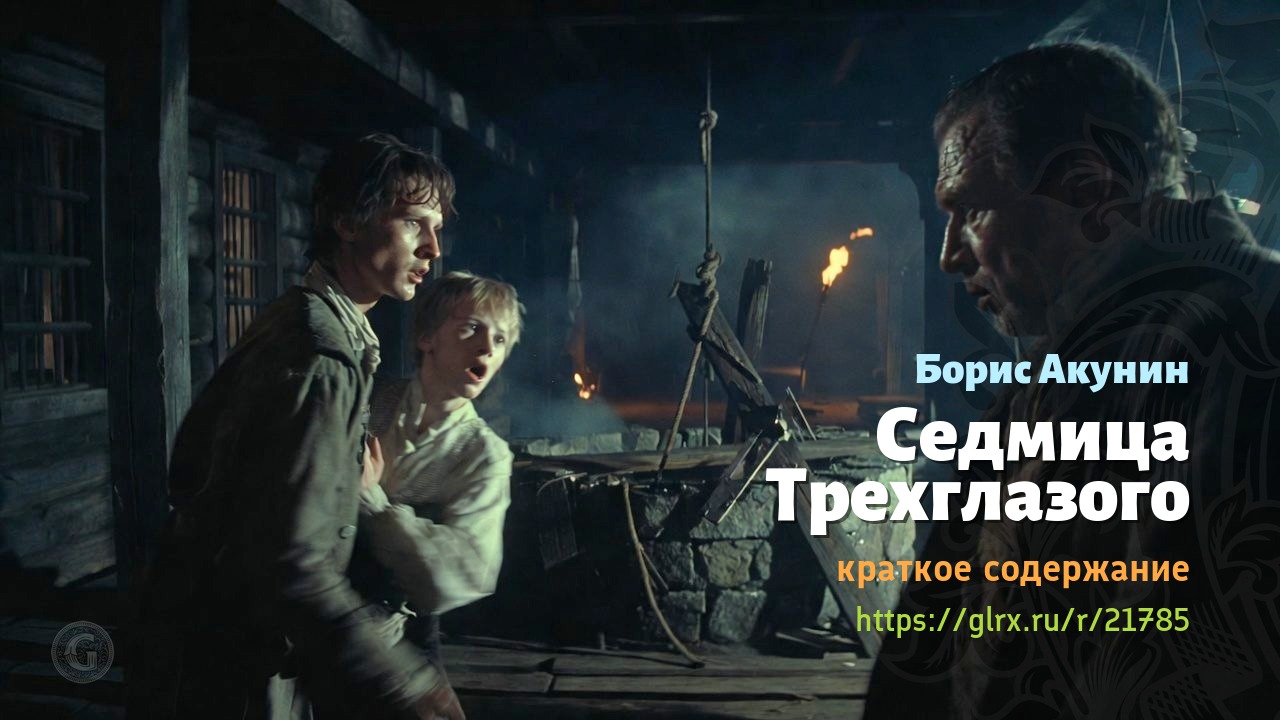
The action begins in the Neopalimovsky Monastery, devastated by the Lithuanians. Twelve-year-old orphan Markel and the timid nobleman’s son Istoma are learning to read and write from the surviving old monk Gervasy. Markel’s grandmother, a wise forest hermit nicknamed Butterfly, brings them food. Suddenly, a detachment of Polish cavalry appears at the monastery. Young Lieutenant Wilczek cold-bloodedly murders Gervasy and then his commander, Pan Sapieha, in order to gain possession of the unique royal scepter with a huge ruby.
Wilczek kills Sapieha’s beautiful lover, Marishka, and mercilessly stabs Istoma. Butterfly bravely defends her grandson, throwing a hunting knife, but the lieutenant pins her to the wall with his saber. Before she dies, she manages to hide the scepter in a crack under the dried-out oak floor and sinks her teeth into the killer’s leg. Markel breaks free and escapes through a narrow window into the darkness.
Tuesday
The events shift to 1620. Twenty-year-old Markel serves as a simple yaryshko in the Zemsky Prikaz (Province) in Moscow. The old clerk, Kuzma Shubin, takes the young man as his assistant to investigate the murder of Princess Lukerya Lychkina. The girl was found dead in someone else’s wedding dress. Shubin rushes to blame the crime on a random street robber. Markel carefully examines the courtyard, finds the stolen pearl kokoshnik in a deep well, and notices the nails of the door bolt pulled out from inside.
Yaryzhka interrogates the inhabitants of the tower without false modesty. A terrible truth emerges: the elder sister, Kharitha, driven mad by unrequited love for her fiancé, Prince Vasily Cherkassky, mixed up her sisters in the dark and killed Lukerya. Markel pities Kharitha and her younger sister, Aglaya, with whom he falls in love at first sight. Cherkassky breaks off his engagement to Marfa and proposes to Aglaya. Judge Stepan Proestev notices Yaryzhka’s keen intellect and takes him into his service, nicknamed him "Three-Eyed" because of the cherry-colored birthmark on his forehead.
Wednesday
The year is 1632. Judge Proestev sends Three-Eyed to Riga, Sweden. Markel travels disguised as a simple guard for the messenger Dmitry Lopatin. The messenger has a forged letter hidden in his tuesk (box), while Markel has memorized the real state letter. At an inn near the city, Polish spies attack Russian travelers. Markel recognizes the leader of the enemy spies as Wilczek, now known as Korshun. Three-Eyed allows the enemy to take the forged document.
In Riga, Markel delivers a secret verbal message to Governor Johan Schütte. The local interpreter, Jacob Kruger, helps track down Korshun in the ruins of the abandoned Kopfturm tower. Markel pursues the killer of Butterfly. In a fierce horse battle, Three-Eyed’s saber breaks, but he manages to fire a flintlock pistol straight into Korshun’s face. The bullet knocks out the enemy’s light eye. Markel takes the trophies, leaving the villain for dead. The blow of the enemy’s blade lops off the hair on the crown of Three-Eyed’s head, leaving him permanently bald.
Thursday
His service proceeded as usual, and Three-Eyed lived comfortably, acquiring a sturdy house and garden. He had a kind wife, Katerina, and a son, Anikey. One day, Proestev urgently took Markel to the Kremlin, directly to Tsar Mikhail Feodorovich. The heir, Alexei Mikhailovich, had lost his beloved Persian cat, Otrada. The impressionable boy refused food and fell unconscious. Doctors were helpless, and the Tsar wept in despair.
The Three-Eyed One meticulously examines the children’s quarters and identifies the thief: the palace dwarf, Orinka, hid the animal under the stairs. The girl squeezed through the narrow door of the toy tower, wanting to cuddle the furry creature. Markel returns the cat to the lucky heir. The grateful sovereign grants the talented detective a noble rank, an estate, and a luxurious sable coat. Proestev predicts a great future for Markel under the new young monarch.
Friday
Markel is fifty-three years old. He serves as the attorney for secret affairs under the all-powerful Patriarch Nikon. On the bishop’s orders, Markel secretly arrives in Kyiv to meet with the general judge, Ivan Kabanenko, to deliver gold and a secret document to the Cossack. At the appointed location, a deadly ambush awaits Three-Eyed. The false Kabanenko turns out to be a loyal servant of Colonel Krichevsky.
Krichevsky himself is the miraculously surviving Korshun, hiding his disfigured face under a bandage embroidered with an eye. Ogneglazy breaks Markel’s knee with an iron poleaxe, forcing him to write a forged letter to Hetman Khmelnytsky. Three-Eyed agrees, asking for a bast made from pieces of lard to be applied to his leg. Seizing the moment, Markel kills two haiduks with well-aimed knife throws. The lights go out. In pitch darkness, the wounded Three-Eyed strikes Krichevsky in the leg with a saber, then hacks his sworn enemy to death.
Saturday
Deacon Markel is grieving over the recent death of his wife, Katerina. The aging detective wanders through Moscow, observing the poverty of the common people and the disastrous consequences of the introduction of copper coins. Guards kill a thief who stole one hundred and twenty brand-new copper rubles. Three-Eyed and his nimble young assistant, Vanka Repey, uncover the truth. It turns out that the rubles were manufactured by counterfeiter Frol Ryaboy right in his home, using government-issued coinage.
Kirill Poluyektov, the head of the coinage, hastily goes to see his high-ranking patron, the courtier Fyodor Kuryatev. Upon returning, Poluyektov dies from poisoned wine. Frol Ryaboy is found with his throat slit in Zaryadye. Three-Eyed interrogates Kuryatev and discovers that the illegal minting is being run by the boyar Ilya Miloslavsky, the Tsar’s father-in-law. Miloslavsky offers Markel a share in the thieves’ scheme and easily lures Vanka Repya away. The old clerk refuses to sully his honor, slaps Miloslavsky across the face, and proudly marches off to prison.
Sunday
After eight long years, the old monk Martyrius — formerly Markel the Three-Eyed — returns to the Neopalimovsky Monastery, having miraculously escaped the stake. The monastery has long since become a women’s monastery. Here, Martyrius unexpectedly encounters the widowed Aglaya. At night, the monk sneaks into the Oak Chamber, yearning to reminisce about his distant childhood. A young man, the spitting image of Korshun, quietly creeps in behind him.
It’s the son of the murdered villain, who has come looking for the missing scepter. Vilchenok recognizes Three-Eyed and raises his sharp saber. Aglaya, who had followed the monk, kills the criminal with a blow of a heavy axe. The old couple find the royal scepter hidden by Butterfly, admire the scarlet sapphire, and calmly replace the relic in the crevice. They decide to live out their remaining years together, joyfully greeting the dawn every day.
Kill the snake
The play takes place in 1689. Prince Vasily Golitsyn, a favorite of Empress Sophia, dreams of enlightenment and European prosperity for Russia. On a dark street, the prince is attacked by unknown knife-wielding assassins. Siberian artelnik Anikey Trekhglazov saves Golitsyn in time and becomes his personal bodyguard. Vasily’s cousin, Boris Golitsyn, guards the young Peter Alekseevich in the village of Preobrazhenskoye near Moscow. Boris teaches the young tsar to rule the harsh people with a firm hand in order to create an invincible, great empire. Fyodor Shaklovity, the leader of the Moscow Streltsy, suggests that Sophia physically eliminate the grown Peter. The faithful Anikey volunteers to carry out the deed personally. The play offers the audience two possible endings.
In the first scenario, Trekhglazov cold-bloodedly shoots Peter in the head on the shore of a pond. Boris Golitsyn weeps bitterly over his imperial plans forever shattered. In the second scenario, Anikey warns Peter of the rapidly approaching armed streltsy. The future emperor panics and flees to the Trinity Lavra of St. Sergius. Vasily Golitsyn nobly refuses to surrender Sophia to the enemy and remains with her until the very end. Tsar Peter joyfully celebrates his victory and foresees the immense grandeur of a future Russia.
- "The Flying Ship" by Andrei Belyanin, summary
- Sailor, artist, man. Vladimir Golitsyn
- Exhibition of paintings and graphics "Adam’s Ribs"
- Exhibition of graphics and paintings by Illarion Golitsyn at the Tretyakov Gallery
- Exhibition of Catherine and Sergei Golitsyn "Nature and the City"
- Klara Golitsyna. Now and here. Anniversary exhibition dedicated to the 90th anniversary of the artist
- Exhibition of Sergei and Catherine Golitsyn "Moscow Land"
- Shrovetide at the estate: Salon of the Golitsyn Princes
You cannot comment Why?