"The Raphael Gene" by Katya Kachur, summary
 Automatic translate
"The Raphael Gene" is the third novel by journalist and writer Katya Kachur, published by Eksmo in 2024. The action takes place in the tiny Volga settlement of Ostrov Raphael — formerly Bolshiye Gryazi-2 — on the other side of the Volga from the city. The village was named by escaped convict Raf Bailov, who hid in the surrounding forests and caves for five years, and this name became official after a referendum held three years ago by visiting officials. The novel is based on the author’s personal experience observing foxes in the Volga forests, and a zoological motif becomes a recurring theme: Spanish zoologist Juan formulates the concept of "THE RAPHAEL GENE" — a mutation that contradicts the instinct for self-preservation and compels foxes to turn to humans, who kill them.
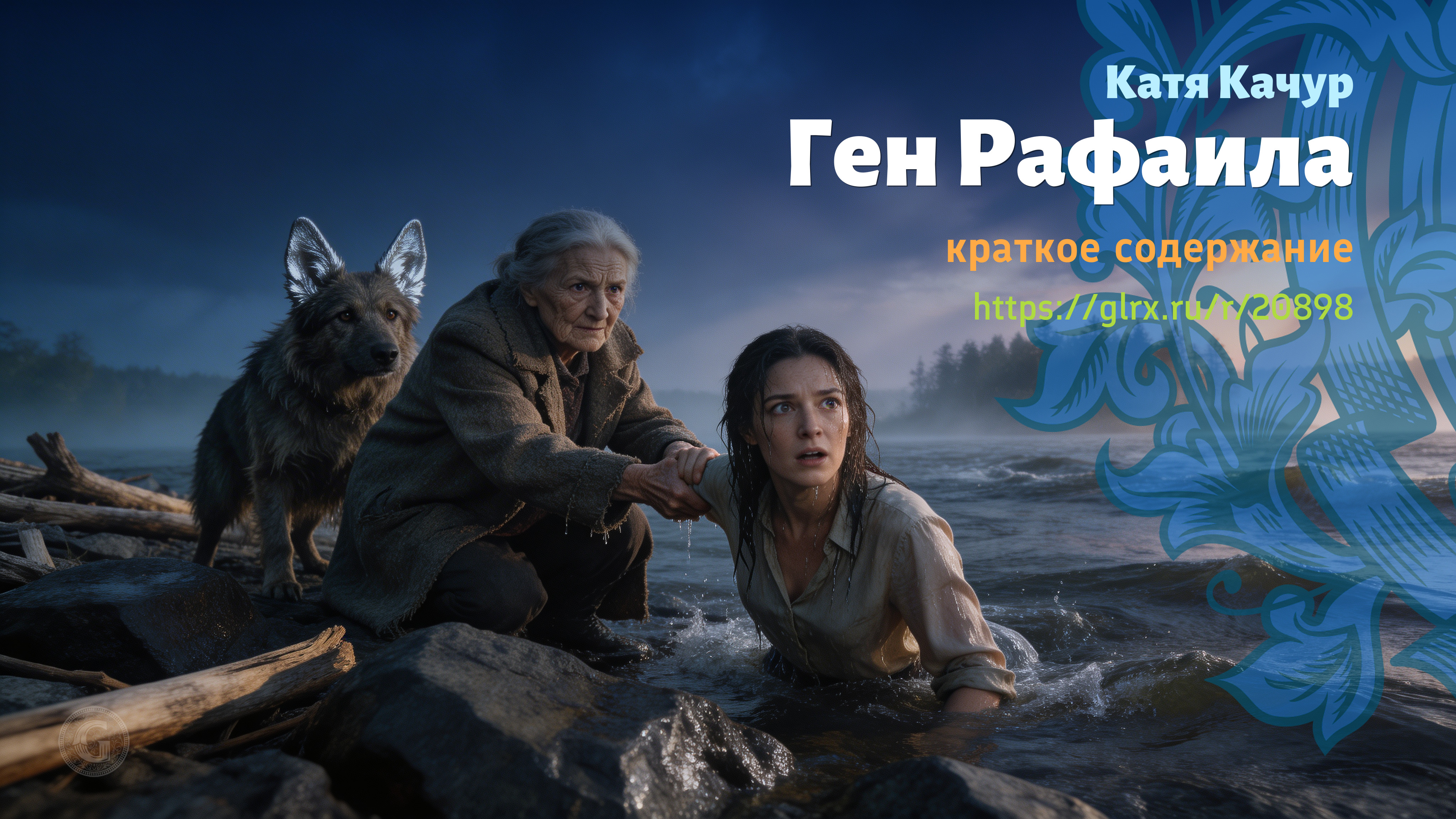
The story opens with a short introduction from the narrator, a Moscow writer and journalist. Lured by the exotic name, she boards the steamship "Omik" — a rusty vessel built in the 1970s — and sails across the Volga. Disembarking at the wrong pier — in Zapozdye — the narrator walks along the shore for two hours, her feet scraped on the rocks, until a huge dog, Jose, with silver ears covered in protective gel, pounces on her in the darkness. The dog’s owner, eighty-year-old Batutovna, lifts the writer from the water and takes her home. Batutovna’s son-in-law, Anatoly Ivanovich Krasavtsev, treats his guest to "Parisianka" and "Muscat Novoshakhtinsky" grapes, and the narrator listens intently to the story of this unusual family. The next morning, she returns to Moscow and begins writing her novel.
War in the kitchen
Anatole and Batutovna have lived on the Island for several years now, and their daily life is a chronicle of endless "battles." The mother-in-law collects glass jars from the trash and hides them under sofas and beds. The son-in-law scrapes them out at night and scatters them across a trash heap within a five-hundred-meter radius. At every face-to-face encounter, they resort to bladed weapons — knives, skewers, frying pans.
One of the "battles" ends with Batutovna stubbed her toe on a broken can, and Anatole suffers a hypertensive crisis. They end up on the same couch while Juan, a Spaniard and zoologist who lives next door, stitches the wound with a surgical needle from his belt pouch and slips nitroglycerin under Anatole’s tongue.
Nickname and legends
Batutovna — Pelageya Potapovna Obolenskaya in her passport — got the nickname in her youth, when a circus came to the village of Oboltovo. A teacher and Komsomol activist, she persuaded the acrobats to let her take a ride on a trampoline. The gymnasts launched her skyward, the tent’s dome burst at the seam, and Palashka flew straight into a sheep manger, breaking her leg. Second-grader Dotoshkin, giving a welcoming speech at the hospital, confused her patronymic and called her "Pelageya Batutovna." The nickname stuck, and the story spread to ten surrounding villages and a neighboring military unit.
Since childhood, Krasavtsev had heard the family legend about his descent from the famous Russian tenor Fyodor Komissarzhevsky, father of the actress Vera Komissarzhevskaya. However, even as a child, he calculated the dates and realized that the chronology didn’t add up; "Baba Olya" was merely a namesake. He didn’t dispel the legend and passed it on.
The General and his father
The true family story was the biography of his father, Ivan Mikhailovich Krasavtsev. In February 1944, near Voronezh, Ivan, a reconnaissance company commander, was in a dugout with six of his comrades when a direct shell hit killed everyone else. Krasavtsev was only dug out the next day: the snow on his face was melting. Five fragments remained in his leg forever — as a child, Tolya would probe them with his fingers, imagining malachite, emeralds, and amethysts.
Anatole grew up with a gift for rescue: his unerring inner "sensor" detected the impending death of others. While still a cadet, he pulled a suicide off a railway bridge and received a punch in the teeth for it. He rose through the ranks from a district police officer to a major general in the Ministry of Internal Affairs. At forty, he fell in love with twenty-eight-year-old Olesya Obolenskaya — a curvy woman who was captivated by all his tales of noble origins. His first wife, an intelligent woman of émigré descent, was too preoccupied with everyday life to be surprised.
Collapse of plans
His son, Andrei, a spitting image of his grandfather Ivan, down to the birthmark on the instep, said from his first words, "I want to go to war." In tenth grade, he fell into a gang where his classmate, Fedya Grushev, was killed in a fight. No one was specifically at fault, but Krasavtsev’s enemy, the new city police chief, Sergei Burko, took advantage of the situation to settle a score. All the general’s savings were spent trying to hush up the matter. The family moved to a remote house beyond the Volga, Olesya went on antidepressants, and Anatole took up grape growing — so absorbedly that he missed the moment when his mother-in-law moved in with them "for the summer" and stayed permanently.
A Spaniard in the Woods
Juan, a young zoologist, came to the Island with the sole purpose of studying foxes. Instead, he discovered the corpses of strangled and skinned animals: no one had shot them; they had walked of their own accord toward the person who killed them. It was these observations that led him to the concept of the "RAPHAEL GENE." The locals explained that this was the work of Raf Bailov, the very same escaped convict.
Anatole and Juan met when a village thief stole a zoologist’s expensive microscope. The retired general grabbed a pistol and kicked down the door. The microscope was found in the cellar of a dealer named Vovchik, the eyepieces intact. From then on, the two lonely souls became inseparable: one conducted observations, the other guarded the camera traps in the trees, threatening to "cut off the fingers of the local men" if even one camera was touched. Later, Juan brought Anatole a puppy — it had been thrown from a boat with a stone tied to its neck, but the stone came loose and the zoologist pulled the dog out of the water. That’s how Krasavtsev got Jose.
Summer and Raphael
When Olesya arrived on the Island — with her son Andrey and his fiancée Natasha — life in the house changed. Olesya cleaned the entire house, even bathing the cats. Juan fell in love, even against his will. In the forest, where they would go together, he lectured her on sixty-million-year-old strawberry fossils, while Olesya listened with the same delight she once felt when listening to Krasavtsev’s stories.
In the strawberry patch where they found themselves, along with their tamed fox, Rafik, Rafael Bailov emerged from the bushes. He unfastened the fox’s collar and snapped his neck with a flick of his fingers. He stunned Juan with a blow to the neck with the edge of his palm. Sitting down next to Olesya, Bailov reminded her of her father’s long-ago request, which she had once conveyed, called her a monster and himself a saint, and then left. Olesya packed her suitcase and left the Island on a private boat, not looking back at the howling of Juan, who had regained consciousness.
Losses
Andrei called his father and told him he’d signed up for a military contract: Grandfather Ivan had appeared to him in a dream and told him to go. Anatole recited lines from Psalm 91 and burst into tears. Olesya, haggard and silent, took over Batutovna’s care after her stroke — massages, diapers, spoon-feeding, deciphering her wishes from her silent lips.
Anatole is heading back to the Island to sell the house and take the animals. The Omik is half empty, the river is leaden, the forest is bare. He looks out the window and remembers how two weeks ago he was driving Batutovna down this same river — her head resting on his lap. Next to him, in the cabin, a chow chow with a purple tongue looks at him disapprovingly. The pier on Raphael Island draws closer — a dreary gray building with a blue roof, swaying with the waves.
You cannot comment Why?