"Walk Fearlessly:
Between Literature and Life" by Evgeny Vodolazkin, summary
 Automatic translate
A book of essays and autobiographical prose by Yevgeny Vodolazkin, a medievalist and author of the novels "Lavr" and "Aviator," was published in 2021. These are not memoirs in the strict sense: recollections of childhood, student years, and academic work at the Pushkin House are intertwined with literary essays on the nature of words, the prophetic role of Solzhenitsyn, and the boundaries between fiction and reality.
Kindergarten despair
The book opens with a story about two Leningrad kindergartens, merged into one in my memory. The boy, destined to become a scientist, felt a persistent aversion to communal living: not to other children, not to the teachers, but to the very fact of being forced into a confined space. He always postponed his tantrums until the last moment, at the front door, patiently stretching the morning minutes to an eternity — past the pharmacy, past the bronze horseman, past the thorny bushes.
When asked about the cause of his tears, he answered honestly: the fluorescent lights were too bright. This answer didn’t convince the adults. Nevertheless, it was precisely the piercing, merciless lighting that illuminated what would have remained in the shadows under normal household lighting.
By the age of five and a half, the suffering had subsided. In the late, "happy" days of kindergarten, operatic duels emerged: little Eugene invariably played Onegin, while his plump friend, presumably Vladimir, played Lensky. The first shot was fired accurately; the second, clumsily choosing his landing spot, slapped his thigh, and fell sideways with a crash of branches.
Collective farm, hops and Tatiana’s Day
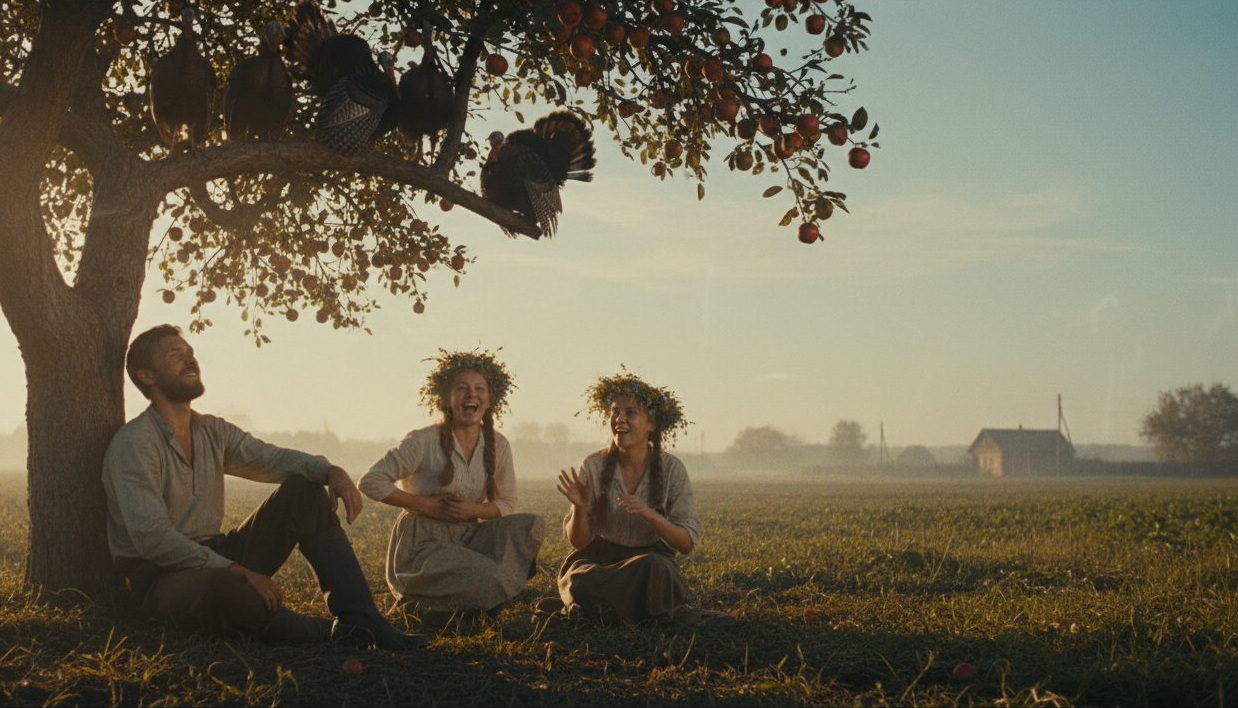
His student years are described through two episodes separated by time and space. The future medievalist found himself harvesting hops on a collective farm, where he spent evenings with girls wearing wreaths under an apple tree covered with turkeys — the birds roosted in the branches, not participating in the general conversation and not complaining about anything, as befits folklore characters.
The folklore tradition took place at the junction of Russia, Ukraine, and Belarus — where a groom named Kolya, abandoned by his bride on his wedding day, went to a village club and asked the onlookers who would marry him. A short girl stood up. Kolya’s resolution was brief and devoid of lyrics, but the marriage was a happy one. Vodolazkin wrote down this story from Kolya himself, noting the beauty of the Slavic language.
Her own love story unfolds differently. Tatyana joined the author in graduate school at the Pushkin House, and the Evgeny-Tatyana couple was understandably intriguing as an alternative development to the plot of the immortal verse novel. Pushkin’s characters, Vodolazkin notes, had never been to a collective farm, and so they managed to complicate a difficult situation to the extreme.
Musin and his co-authors
A separate chapter is dedicated to a cat named Musin, the offspring of Musya, a kindergarten cat, adopted under circumstances more reminiscent of a television game show than a conscious choice. Cross-eyed, flea-ridden, and refusing a scratching post, he methodically destroyed a chair, wallpaper, shoes, and finally destroyed a printer and laptop: the repairman explained that saline solution was a strong conductor and wouldn’t help the equipment.
After this, an extra chair was placed next to the computer. Musin sat on it and monitored the accuracy of the translations of ancient Russian chronographs. The scientist Yuri Knorozov, who deciphered the Mayan script, co-signed articles with his cat, Asya. Musin did not insist on official co-authorship: discrimination against cats in publishing circles, in his observations, is still common.
He lived for sixteen years. His final months were spent with failing kidneys, receiving injections and IVs administered by his owner, who had no medical experience whatsoever. The cat’s eyes showed an understanding of the futility of these procedures: he allowed his duty to be carried out to the end, caring more for people than for himself.
Zhdanovskaya Embankment, Building 11
For over ten years, the Vodolazkin family lived in a monumental Stalin-era building on Zhdanovskaya Embankment. Pompous on the outside, it had no elevators, and the walls between apartments were vanishingly thin: the neighbor’s melancholy piano exercises in the evenings would turn into "Moonlight Sonata" amid family squabbles.
One day, Catherine, a Sorbonne student whom the Vodolazkins were teaching Russian, read aloud a passage from Alexei Tolstoy’s "Aelita" — and, beautifully softening the consonants, recounted the current address of the owners: 11 Zhdanovskaya Embankment. It was in the courtyard of this building that Tolstoy located the workshop of engineer Los, whose prototype was Yusef Los, a teacher at the neighboring aviation school who was captured by the NKVD in 1937 and never returned.
In the 1990s, the author discovered a cake tied with a ribbon in the front door, which he dared not ignore. Four minutes later, men in spacesuits arrived, held a device on a rod to the box, and discovered that it contained a confection. They ate it themselves, thanking him for his vigilance.
Two funeral services
The chapter on funerals is built on the contrast between two scenes. The first is the death of the author’s father, born in Nalchik, raised in Baku, and settled in Kyiv. He was buried in a rural cemetery in the Ukrainian hinterland, where his coffin was transported on the trailer of an old Zhiguli car along a bumpy dirt road. With each jolt, his father’s unbound hand rose above the coffin — it seemed as if he were casually conversing with the heavens.
Before the funeral service, the arm refused to bend. Then, bent over, old woman Tonya hobbled up to the coffin on two crutches, rested them against the lid, and pressed the arm down with no visible effort. The priest concluded the ceremony with the words, "Well, then, let’s go with God!" — and the procession moved through the village.
The second scene is Père Lachaise that same evening, where a coffin slowly floats through the crematorium doors to the accompaniment of jazz. The cemetery turned out to be a functioning one: one could easily lie down — or crumble to ashes — to the wonderful music next to Sarah Bernhardt and Chopin.
Solzhenitsyn and repentance
A lengthy essay on Solzhenitsyn returns to the biblical meaning of the word "prophet" — not a predictor, but an accuser, speaking not from a pulpit but from the midst of humanity, having endured similar, and often incomparably greater, trials. Vodolazkin explores Solzhenitsyn’s concept of repentance as the initial stage of correction — not a collective march into the public square, but a purely personal effort that changes the social atmosphere even when reaching a small number of people.
A word between fiction and reality
The concluding essays address the nature of contemporary literature. Vodolazkin traces how postmodernism — having destroyed the conventional reality of the New Age — gradually moves toward the creation of a new reality, while simultaneously drawing closer to the poetics of the Middle Ages. The boundary between fiction and nonfiction becomes blurred; Svetlana Alexievich’s Nobel Prize, the "Lives of Remarkable People" series, and biographical projects on major writers — all are symptoms of a single cultural demand. The medieval world was read as a text written by God; the postmodern world, as a collection of quotations. The emergence of both states gives birth to a new sensation: the world as a text, co-created with existence, right now.
You cannot comment Why?