Contact by Carl Sagan, summary
 Automatic translate
Contact is a science fiction novel by Carl Sagan, published in 1985. Sagan, an astrophysicist and one of the founders of the SETI program, wrote the book based on a screenplay that had been elusive for years. Unlike most novels about extraterrestrial intelligence, Contact is built not on fear of aliens but on an attempt to understand and accept them, with science, not weapons, being the primary tool.
In 1997, the novel was adapted for the screen by Robert Zemeckis: the film, starring Jodie Foster, won the Hugo Award for Best Dramatic Feature of the Year.
Ellie’s childhood
Eleanor Arroway is born with a look of wonder on her face — a look that never leaves her. As a child in Wisconsin, she fixes a broken Motorola radio by herself, straightening a bent vacuum tube pin. Her beloved father — he affectionately calls her "Tinka" — dies when she’s still a schoolgirl; her mother soon marries John Staughton, an associate professor of physics who believes science is not for women.
Staughton systematically ridicules her electronics studies and forbids her from interacting with students from the nearby college. Ellie responds with stubbornness: she builds encryption machines, independently deciphers transcendental numbers in seventh grade, and at Sunday school, asks the pastor questions about contradictions in the Book of Genesis that no one dares answer. The only way out of this house is Harvard.
Years of study and the beginning of a career
At Harvard, Ellie masters the professional voice of a physicist — loud and clear, the only way to be heard in male-dominated discussions. Meanwhile, she begins an affair with guitarist Jesse, who plays R&B in bars near Kenmore Square. When he offers her a child instead of continuing his studies, the relationship quietly ends.
At the California Institute of Technology, Ellie works under two polar opposite mentors: the brilliant and arrogant David Drumlin and the gentle radio astronomer Peter Valerian, obsessed with the search for extraterrestrial civilizations. It was Valerian who inspired her to take the idea seriously. She chose the topic of her dissertation on the sensitive elements of radio telescopes — ruby masers cooled by liquid helium — and almost immediately discovered the three-degree background radiation, a remnant of the Big Bang, in a previously inaccessible frequency range.
Project Argus and the signal from Vega
After Puerto Rico, where Ellie spent several years working at the giant Arecibo radio telescope and listening to dozens of nearby stars without success, she headed the Argus project in New Mexico — an array of 131 radio telescopes. In October, a received signal from Vega, a star 26 light-years away, turned out to be more than just noise: a sequence of 261 prime numbers. The signal could only come from an intelligent being.
Next, a second layer is discovered in the received stream: a broadcast of the 1936 Olympic Games from Berlin, featuring Hitler’s speech — the first television signal to ever leave Earth’s ionosphere. The Vegans simply reflected it back, signaling: "We hear you." The third, most voluminous layer consists of thirty thousand pages of technical schematics. These are the plans for a machine whose purpose remains unknown.
The Machine and International Disagreements
A consortium of powers begins deciphering the blueprints, while tough political negotiations are underway over who will build the Machine and who will be on the crew. Presidential adviser Ken der Heer, with whom Ellie develops a relationship, becomes the intermediary between Washington and Argus. Drumlin, who had previously scoffed at SETI, now seeks a place among the five pilots.
The key to deciphering the "introductory section" of the schematics is revealed by the eccentric billionaire S.R. Hadden: the signal’s phase modulation must be checked. When this fourth layer is unlocked, it becomes clear: the Machine is a dodecahedron with five cabins, one per person. The crew consists of Elli, Soviet astrophysicist Vaigai Lunacharsky, a Japanese scientist, an Indian scientist, and — in place of Valerian, who died in the sabotage — Drumlin.
Journey
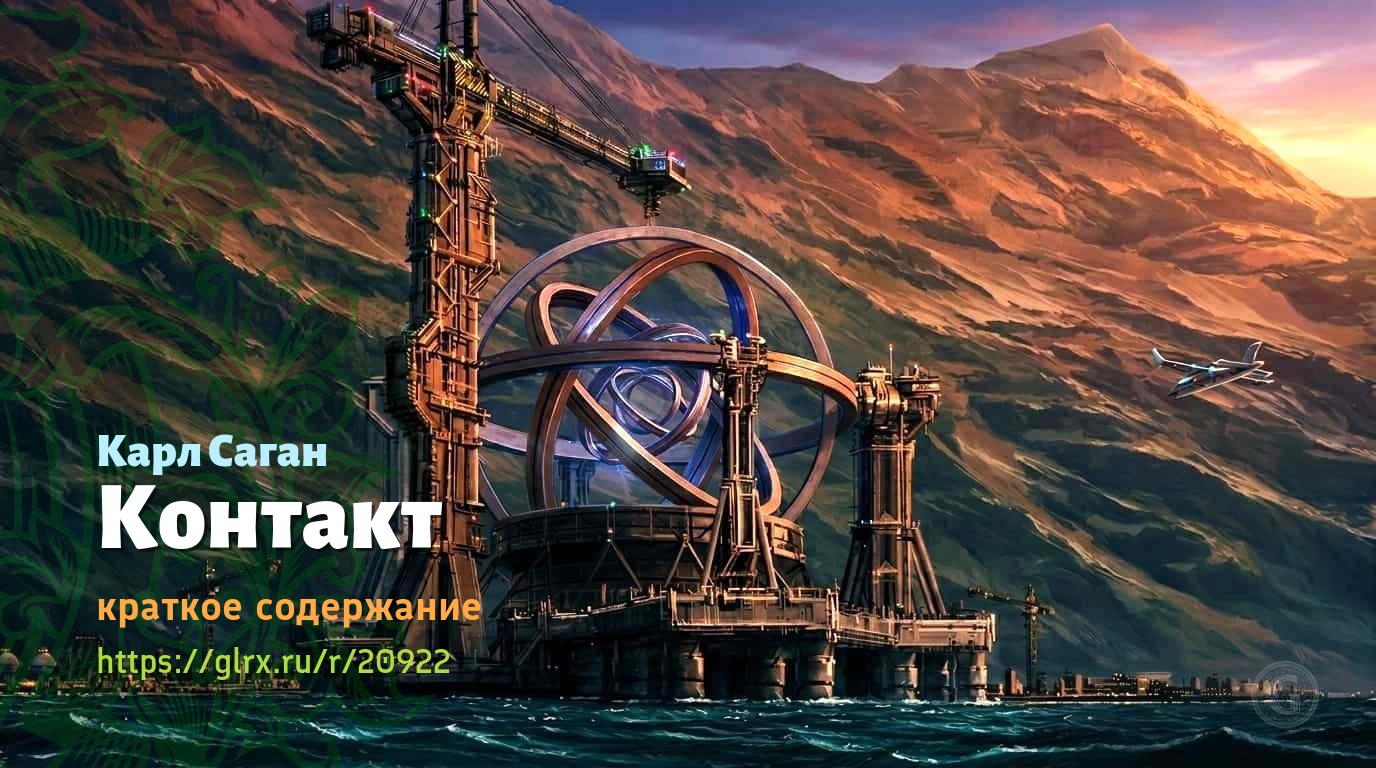
In the last days of December 1999, the Machine is activated. It immediately carries the five through a wormhole system to the center of the Milky Way. There, at a station in the middle of a star cluster, each of the travelers encounters a being in the form of a loved one. Ellie sees her father before her — exactly as she remembered him.
The being speaking to her in her father’s voice explains: the tunnel network was built by an even more ancient race, traces of which have disappeared; the Vegans themselves are just one of its users. The civilization that sent the Message is busy reorganizing the physics of the Universe using matter in the Cygnus A region. The encounter is brief. The travelers record everything on video and return to their capsules.
Return and Silence
On Earth, almost no time passed: in the eyes of observers, the capsule fell straight into the water, never going anywhere. The video recordings were erased, presumably by the wormhole’s magnetic fields. Hadden, who had independent copies of the data, faked his own death and secretly entered orbit, taking his secrets with him.
Government commissions classify the incident as a possible prank or a collective hallucination. Ellie and her four companions remain silent under pressure. The only one who believes Ellie implicitly is the priest and public intellectual Palmer Joss, whom she met at the height of the Message negotiations. Lacking proof, for the first time in her life, she relies on faith, as she once did on calculation.
Message in "pi"
The novel’s ending takes place several years later. Following a hint received during a meeting, Ellie writes a program to analyze the digits of pi in the base-11 number system. At the colossal depths of decimal expansion, a regular figure emerges from the random noise: a long sequence of ones and zeros forms a circle. The message exists not in radio waves or in blueprints — it is inscribed in the very mathematics of the universe, in the place Ellie has been able to look ever since she learned in seventh grade that pi is transcendental.
- Carl Sagan’s "Cosmos" Summary
- "The Demon-Haunted World: Science as a Candle in the Dark" by Carl Sagan, summary
- A summary of "Science and the Search for God" by Carl Sagan
- A summary of "Broca’s Brain: On Science, Space, and Man" by Carl Sagan
- New Aelita Andre show in New York
- The project "Theater evenings" as part of the "Seasons of Culture Russia - Austria"
- “See You in the Cosmos” by Jack Cheng
You cannot comment Why?