Carl Sagan’s "Cosmos" Summary
 Automatic translate
"Cosmos: The Evolution of the Universe, Life, and Civilization" is a book by astrophysicist and science writer Carl Sagan, published in 1980 simultaneously with a thirteen-part television series of the same name on PBS. The book is written not as a textbook, but as a personal journey through time, space, and the history of science — from the first observations of the ancient Greeks to the interplanetary probes of the 20th century. Each of the thirteen chapters corresponds to an episode of the television series, but is developed much more deeply within the text.
In 1981, the book won the Hugo Award for Best Non-Fiction Book. It spent 70 weeks on the New York Times bestseller list and became the best-selling non-fiction book of its time.
Opening up the scale
The first chapter sets the tone for the entire book: Sagan describes a journey from the edge of the observable universe — eight billion light-years from Earth — to the surface of our planet. Hundreds of billions of galaxies, each containing an average of one hundred billion stars; the Local Group, including the galaxy M31 in the constellation Andromeda; the spiral arms of the Milky Way — Sagan describes all of this as a living space, not an abstract set of numbers.
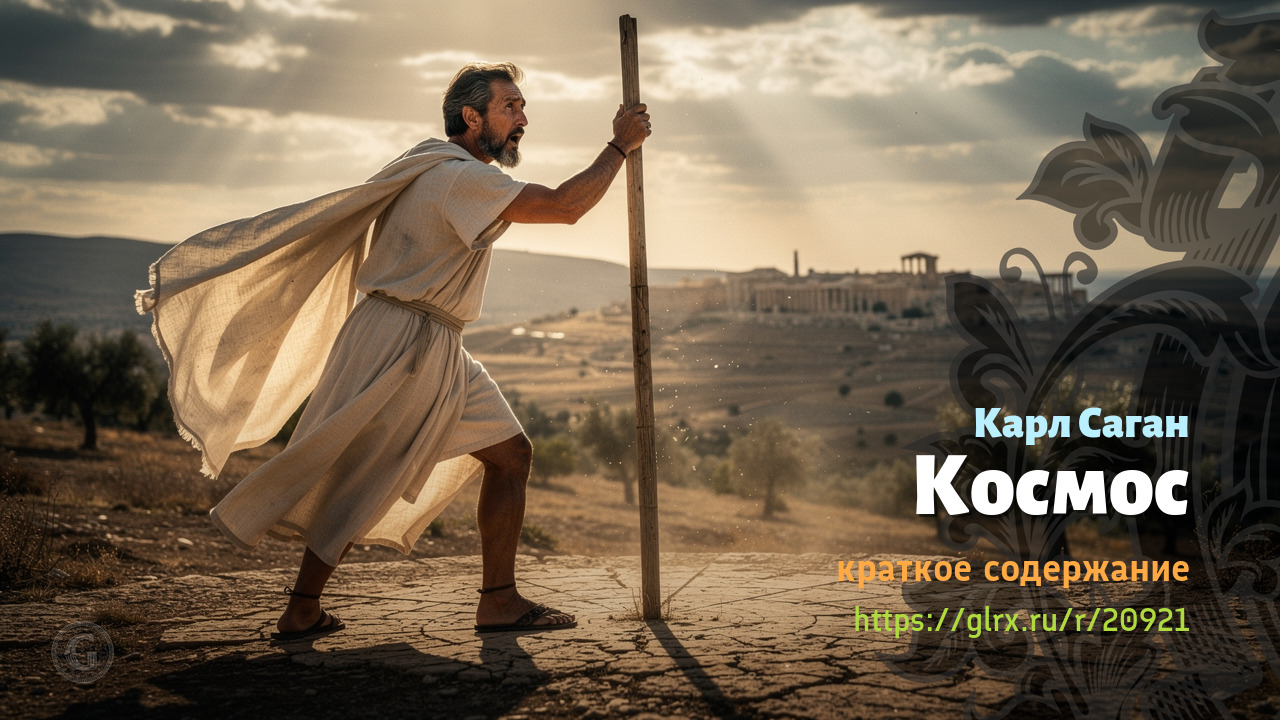
Here we also encounter the story of Eratosthenes, an Alexandrian scholar of the 3rd century BC who, by comparing the length of shadows cast by poles in Alexandria and Syene on the summer solstice, calculated the circumference of the Earth with an error of a few percent. His only instruments were poles, his eyes, and his feet. The result — approximately 40,000 kilometers — proved correct. Sagan compares this experiment with Columbus’s expedition: Columbus deliberately underestimated Eratosthenes’s figures to convince his crew to embark on a westward voyage, and only the chance discovery of America saved the expedition from failure.
The Library of Alexandria and the Death of Knowledge
For Sagan, Alexandria is not just a geographical location, but a symbol of the flourishing of science possible with freedom of thought. Euclid, Archimedes, Hipparchus, Heron, and Apollonius of Perga all worked there. Around half a million papyrus scrolls were kept in the library. It was in Alexandria that Aristarchus of Samos proved that the Earth revolves around the Sun — but his work was lost, and humanity had to wait almost two thousand years for this truth to be restored. Sagan views the destruction of the library and the execution of the mathematician Hypatia in 415 AD as a catastrophe for civilization, a direct consequence of intellectual intolerance.
The origin of life
The second chapter describes the evolution of life — from the first organic molecules in a primordial soup to complex multicellular organisms. Sagan examines Stanley Miller’s experiments, which showed that amino acids can form from simple inorganic compounds when exposed to electrical discharges. The DNA molecule — the universal archive of hereditary information — links all life on Earth: humans, fungi, and bacteria. In this same chapter, Sagan describes Japanese fishermen who, over the course of centuries, deliberately selected carp with the "faces" of samurai — a clear example of artificial selection, paralleling what happens in nature, randomly and slowly.
Kepler and the Harmony of the Spheres
The third chapter is a biography of Johannes Kepler, the astronomer who sought mathematical order in the motions of the planets. Sagan recounts his difficult life — poverty, epidemics, his mother’s trial for witchcraft — and his collaboration with Tycho Brahe. It was Tycho’s meticulous observations, which Kepler was able to process mathematically after his teacher’s death, that led to the discovery of the three laws of planetary motion.
Venus, Comets, and Criticism of Velikovsky
In the fourth chapter, Sagan examines Venus, a planet hidden beneath dense clouds of sulfuric acid. It was Sagan’s participation in the research that helped explain the extremely high temperature on its surface: it is maintained by a runaway greenhouse effect. He also examines the theory of Immanuel Velikovsky, who claimed that Venus was ejected from Jupiter as a comet and nearly collided with Earth. Sagan consistently refutes this concept, point by point, but only after acknowledging that any theory deserves an honest examination on its merits.
Mars: Dreams and Reality
Chapter five is devoted to Mars. Sagan describes how, in the late 19th century, American astronomer Percival Lowell interpreted dark lines on the planet’s surface, designated by the Italian word canali , as artificial irrigation canals of a Martian civilization. The reality turned out to be different: in 1976, two Viking landers — a project Sagan himself helped develop — found no convincing evidence of life. The Martian sky turned out to be pinkish-yellow, not blue. Nevertheless, Sagan leaves the question of the existence of simple life forms open.
Voyager and the outer planets
Chapter Six tells the story of the Voyager 1 and 2 probes, launched in 1977. Flying past Jupiter and Saturn, they transmitted images that overturned many previous ideas: Jupiter’s moon Io turned out to be a volcanically active world, and Saturn’s rings were far more complex than previously thought. Both probes carried a "Golden Record" containing greetings in fifty-four languages, music, and encoded images of Earth.
Ionian Revolution
Chapter seven takes the reader back to the sixth century BC, to the Ionian philosophers. Thales, Anaximander, and Democritus proposed that the world could be explained without the involvement of the gods: atoms exist, matter is infinitely divisible, and diseases have natural causes. Sagan calls this an awakening — the first mass movement in history toward a rational understanding of nature. It was interrupted and did not fully resume for about two thousand years.
The life of stars and the origin of the elements
Chapter 9 describes the life cycle of stars: from clouds of hydrogen and helium, through thermonuclear fusion in the core, to supernova explosions that scatter heavy elements into space. The atoms of carbon, oxygen, and iron that make up the human body were synthesized in the depths of stars that died long before the birth of the Solar System. "We are made of star stuff" is one of the key ideas of the book.
The Big Bang and the Edge of the Universe
Chapter ten examines cosmology: the expansion of the universe, the cosmic microwave background, and the Big Bang approximately fifteen to twenty billion years ago. Sagan draws a parallel with Hindu cosmology, which measures the birth and death of the universe in hundreds of billions of years — the only religious tradition whose timescales are even remotely comparable to those of science.
Search for extraterrestrial intelligence
Chapters eleven and twelve are devoted to the SETI program. Sagan describes the Drake equation, which is used to estimate the probable number of technological civilizations in the Galaxy. He considers a hypothetical "Encyclopedia of the Galaxy" — an archive of knowledge that advanced civilizations could exchange via radio signals. He also analyzes possible civilization types according to the scale of Soviet astrophysicist Nikolai Kardashev — from planetary to galactic energy consumption.
Who speaks on behalf of the Earth?
Chapter thirteen is the most disturbing. Sagan returns to the image of the Library of Alexandria and the death of Hypatia as a metaphor for what happens when knowledge gives way to fear. He views nuclear weapons as capable not only of destroying cities but also of causing a "nuclear winter" — a global drop in temperature resulting from a smokescreen that would render the very idea of victory in a nuclear war meaningless. Intelligence, emerging from the cosmos, is responsible to it — and therefore must survive.
- Карл Готтхард Лангханс: немецкий архитектор
- Портрет Карла VII, Жан Фуке
- Пьяный господин, Карло Карра
- Карл Шмидт-Роттлуфф: немецкий экспрессионист и мастер гравюр по дереву
- Антонис Ван Дейк: Фламандский барочный портретист короля Карла I
- Карл Андре: скульптор-минималист
- Шинкель, Карл Фридрих: биография неоклассического архитектора
- Карл Шпицвег: немецкий художник жанрово-бытовой живописи, стиль бидермейер
- Карло Маратта (Маратти): Итальянский художник эпохи барокко
You cannot comment Why?