A summary of "Justification of the Island" by Evgeny Vodolazkin
 Automatic translate
"Justification of the Island" is a novel by Yevgeny Vodolazkin, published in late 2020 by Elena Shubina Publishing House. Written during the COVID-19 pandemic, it covers the history of the nameless Island — from the first chronicle and the baptism of the people to the revolution, totalitarian regime, and present-day environmental catastrophe. The main text is a chronicle kept by successive monks of the Spaso-Ostrovny Monastery; the chronicle is read and commented on by Their Serene Highnesses Parthenius and Xenia — the ruling couple, who lived to be 347 years old — whose entries are published as a kind of living footnote to the chronicle.
The Beginning of the Chronicle: Baptism and the First Chroniclers
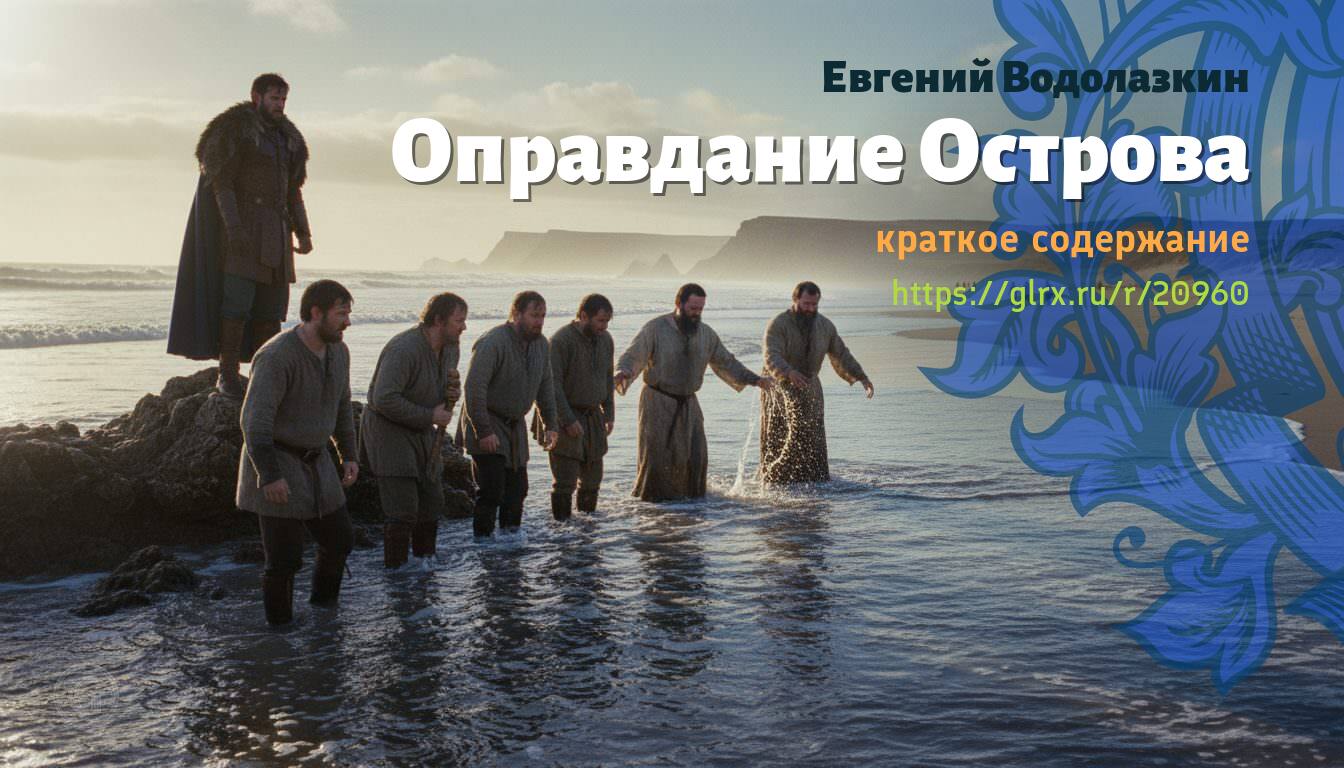
Before baptism, the islanders had no written history. Memory retained only what was repeated — and all hurricanes merged into one great hurricane, all wars into one endless one. Everything changed under Prince Alexander, who conquered the entire island and accepted baptism under the name Theodore. He ordered the inhabitants to come to Sandy Shoal and be baptized, adding that anyone who refused baptism "was not his friend." Everyone, or almost everyone, accepted baptism, knowing the risk they were taking.
With the arrival of books and writing, the monk Nikon the Historian began keeping a chronicle. At the same time, the prophet Agathon the Lookout lived on the Island, giving "prophecies for a long time" — including one that the feud would end when "the two princely branches unite." Having lived to be 120 years old, Agathon dictated his main prophecy to the chronicler Procopius the Gugniv — the same one whose tongue had once been cut out for swearing. The demand to "keep your tongue quiet" sounded like a bitter joke from the centenarian. However, Procopius acted unexpectedly: he unraveled the manuscript of the chronicle, removed the prophecy, and, according to rumors, secretly smuggled it to the mainland. The text was lost. No one knew what Agathon had predicted for the fate of the Island.
War of the Bloodlines
During the reign of Theodore’s son, Prince Constantine, a dispute broke out between the North and the South. The conflict arose over competing "true genealogies": the southern prince Euthymius claimed descent from Emperor Augustus, having found a scroll in a hollow oak tree indicated by a talking stag. Then Constantine himself discovered his own genealogy in the same hollow, according to which Augustus spent his second night on the Island with another princess, Hilaria, and her descendants were born two weeks before Euthymius’s. Euthymius had already died in a monastery by this time. His son Proclus came to Constantine with a crowd, but died of "fainting" after three days of sharing a meal.
Proclus’ brother, Phrolus, accused Constantine of poisoning and roused the South to war. Armed farmers and fishermen flocked to his banner. In the Forest, Constantine’s troops were ambushed and then stranded in a swamp, losing most of their army. The island split in two.
The siege and death of both princes
Constantine began his second campaign during a lean year, deliberately destroying crops along the route to Frolova Fortress to deprive the enemy of food supplies. The siege lasted eight months. Horses, dogs, rats, saddles, and leather belts were eaten in the Fortress, and in the eighth month, cannibalism escalated; dead bodies lay in the streets, from which chunks of flesh were cut off at night. All this time, Bishop Athanasius sought peace, but none of the princes listened.
Frol capitulated only when the riots spread to his own army. Constantine swore on the cross to release his captive. Entering the Fortress and removing Frol’s guard, he fulfilled his oath to the letter — and the mob, maddened by hunger, tore Frol to pieces on the spot. A moment later, a spear from the same crowd struck Constantine himself. Both princes died on the same day.
Parthenius and Xenia
Michael, Constantine’s son, reached a new compromise with Andronicus, Phrolus’s son, regarding the lineages: Augustus lived on the Island for exactly two days, fathering an ancestor for each of the warring branches. The reconciliation was reinforced by the prophet Agathon, who prophesied that Michael’s son, Parthenius, would marry Andronicus’s daughter, Xenia, and that a lasting peace would reign on the Island. And so it came to pass. The young couple married, and the two lines were united.
They were granted an unusually long life — over three centuries. It is precisely this circumstance that gives their voice in the novel its distinctiveness: 347-year-old Parthenius and Xenia read the chronicle as if it were their own personal biography, recalling details, debating with the chroniclers, and adding what they did not know.
In the twenty-seventh year of Parthenius’ reign, ambassadors from the Apagonian Emperor Nicephorus arrived with an offer to join his empire. Parthenius refused, pointing out that the island was "surrounded by water on all sides" — a sign of a special route. The ambassadors’ second visit was openly threatening. Nicephorus’s response was a fleet — so many ships that the sea "resembled a pond strewn with autumn leaves." Parthenius sailed out to meet him with a small number of vessels.
Revolution, the Monastery and the Return of the Cathedral
The novel doesn’t stop at the Middle Ages. The island traverses the Great Revolution, a totalitarian regime, and repression. Former rulers Parthenius and Ksenia find themselves in a communal apartment: they share a kitchen with several families, battle rats and cockroaches, and listen to the radio in the evenings. Power rests with Chairwoman Melissa.
After the earthquake, all the revolutionary frescoes crumble in the Cathedral of the Transfiguration, which had been converted into the Temple of the Bright Future, revealing the former images. Melissa spends three hours alone in the Cathedral, emerges "enlightened," and announces the return of the Temple to the Church. House churches open across the Island, and the monastery fills with monks who had served secretly in the world. Father George, 119 years old and still reminiscent of his former monastic life, becomes the abbot.
The film and the fulfillment of prophecy
Parallel to this story, a contemporary plot unfolds: French director Jean-Marie Leclair is filming "Justification of the Island," with Parfeny and Ksenia serving as consultants. Over dinner, they tell Leclair about communal living, the revolution, and what it’s like to move from the Palace to a roommate’s flat. The film is a huge success.
The chronicle’s publisher states in the preface that "the events of the last year have altered the original plans for the publication" — "we have lived to see the time when ancient prophecies have begun to come true." The reader is given the answer in the epigraph — Agathon’s prophecy: "And the earth will shake, and black waters will ignite in the North, and flaming waters will flow in the South. And ashes will fall from the sky, and your hearts will turn to ashes." The Southern Mountain, silent for centuries, awakens — and the Island faces the threat foretold by the prophet whose central word was never heard by its people.
You cannot comment Why?