Banksy Exposed? Reuters Investigation and the Man Behind the Mask
 Automatic translate
In March 2026, Reuters published a major investigation claiming to have identified the artist Banksy. According to the journalists, the pseudonym was actually Robin Gunningham, a Bristol native born in 1973 who later changed his name to David Jones. The artist himself has made no public comment.
What exactly did Reuters journalists find?
The investigation, published on March 12, 2026, was several years in the making. The agency’s journalists reviewed company registration documents, witness statements, residential addresses, and the graffiti’s chronology. They concluded that Gunningham grew up in Bristol, attended a private school in Bristol, and subsequently settled in London.
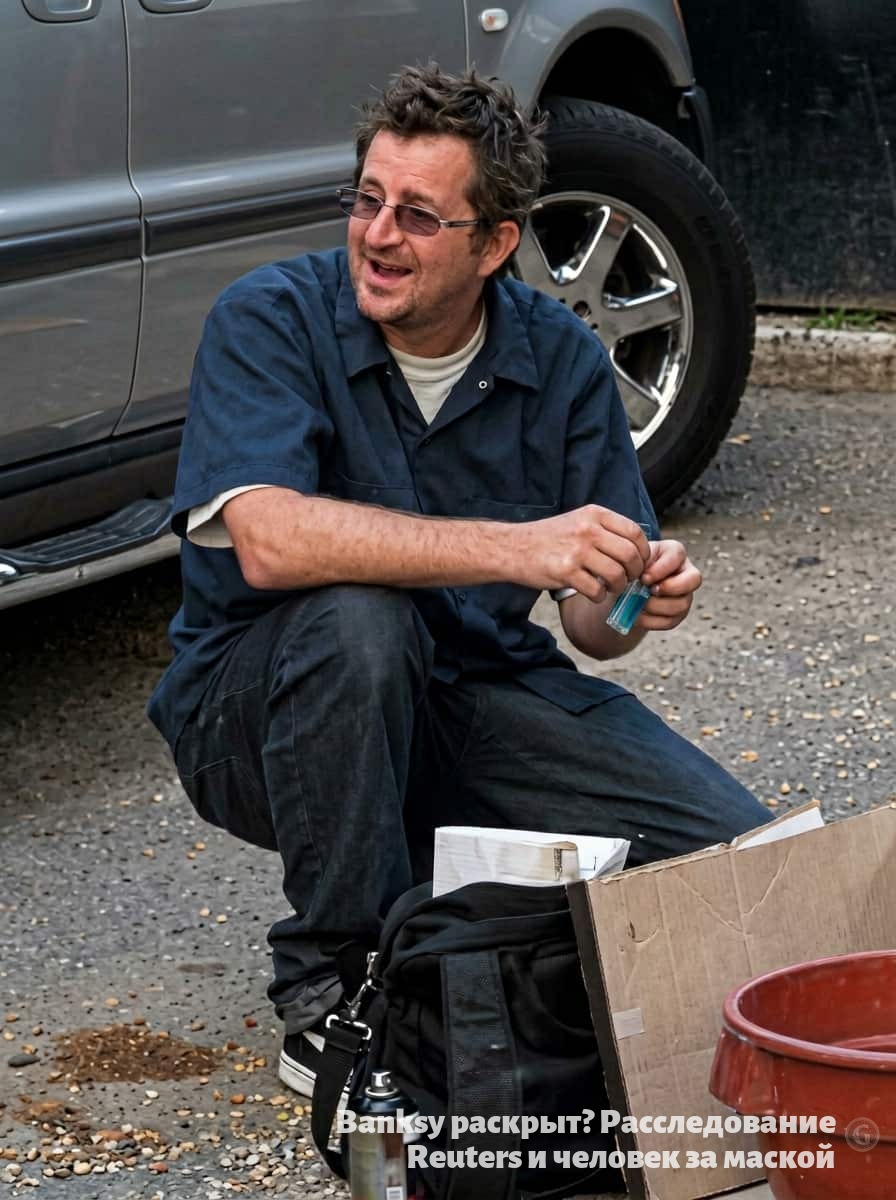
A key element of the evidence was the alleged name change. According to Reuters, Robin Gunningham legally changed his name to David Jones — a circumstance the journalists interpreted as an attempt to deliberately obscure his identity. Furthermore, the agency cited witnesses who allegedly knew the artist personally under both names.
The investigation was based not on a single source, but on a combination of circumstantial and direct evidence. Reuters claimed to have "compelling evidence" of a connection between Gunningham and Banksy’s work — specifically, the geographical coincidence of the graffiti’s appearance with the alleged artist’s residences at various points in his life.
This is not the first time
Robin Gunningham’s name had been floated as a possible Banksy prototype long before the Reuters report. Back in 2008, the British newspaper Mail on Sunday was the first to report the name, citing sources in Bristol’s artistic community. At the same time, a photograph of a young man near a graffitied wall was published, which the editors claimed was indeed Gunningham.
In 2016, a team of researchers from Queen’s Mary University in London used geographic profiling — a method originally developed for forensics — and concluded that the pattern of Banksy artworks appearing in Bristol and London corresponded to Gunningham’s residential addresses. The study’s authors emphasized that this was a statistical correlation, not direct evidence. Nevertheless, the publication received widespread media coverage.
Reuters, therefore, did not reveal a new name; the agency built a new array of documentary evidence around it.
Reaction from the art community and lawyers
The publication provoked a mixed reaction. Commenting on the investigation in British media, media lawyer Mark Stevens pointed out that disclosing a person’s identity against their will could violate privacy laws in the UK, even for public figures in the broadest sense. He argued that anonymity is not just an artistic device, but a right protected by law.
Some critics and journalists raised a fundamental question: why reveal the artist’s identity at all, when anonymity is seamlessly integrated into their message? The Guardian published a piece with the subheading "But does this tell us anything new?" — and this skepticism was shared by many. CNN, for its part, focused not on the artist’s identity, but on a broader question: what does anonymity mean for an artist in the age of digital surveillance?
Meanwhile, the art market reacted to the news with undisguised interest. Banksy’s works sell at auction for prices exceeding millions of pounds, and any information about the artist potentially influences the attribution and valuation of the works.
Who is Banksy and where did he come from?
Banksy emerged on the Bristol street art scene in the early 1990s, a period when graffiti was beginning to transform from a subcultural phenomenon into something noticed by gallery owners and collectors. The artist’s early work was focused on Bristol, a city that gave birth to bands like Massive Attack and shaped the distinctive cultural atmosphere of the time.
By the late 1990s, Banksy had moved to London and began working on the walls of East End — the Shoreditch and Brixton districts, which were then undergoing gentrification and served as the perfect backdrop for political statements. The artist’s signature stencil technique allowed him to work quickly — applying the image and disappearing before the police arrived.
In the 2000s, Banksy achieved international fame. His works appeared on the West Bank barrier, in New York, Los Angeles, Paris, and Vienna. Each performance was accompanied by a media blitz — the artist skillfully exploited the media without providing them with a single clue to identify him.
Self-destructing painting and other provocations
Banksy’s most famous performance took place in October 2018 at Sotheby’s in London. His painting "Girl with a Balloon" sold for £1.04 million — and at the moment the hammer fell, it began to slowly crawl through the frame, being cut by a built-in shredder. Both the auction house and the buyer were shocked. It was later revealed that the shredder had been hidden in the frame, and the artist himself had been watching the event via video link.
However, the mechanism didn’t work completely — the painting was only cut in half. This circumstance subsequently became part of the concept: the renamed work, "Love in the Bin," sold at Sotheby’s in 2021 for £18.58 million — eighteen times its original price. The market, which the artist had attempted to mock, responded by raising prices.
Anonymity as a political gesture
Banksy’s secrecy isn’t just a marketing ploy. The artist has repeatedly spoken out on sensitive political issues: war, corporate greed, consumerism, and the refugee crisis.
When an artist takes on political statements of this nature, anonymity ceases to be a personal preference. It becomes a defense mechanism — against legal prosecution, pressure from the authorities of countries whose policies the artist criticizes, and threats to their physical safety. This is why revealing Banksy’s identity — even if based on factual evidence — is perceived by some in the professional community as ethically questionable.
How convincing is Reuters’ evidence?
The Guardian directly questioned whether the Reuters investigation revealed anything fundamentally new. The editorial team noted that Gunningham’s name had long been publicly known, and the agency’s new documents add details but do not provide irrefutable visual or biometric evidence.
In its report, NPR emphasized that Reuters deliberately refrained from publishing photographs of the alleged artist and did not cite his direct statements — which in itself indicates certain gaps in the evidence base. The agency claims confidence in its conclusions, but does not provide readers with the opportunity to independently verify key pieces of evidence.
The Banksy fan community on Reddit reacted skeptically: some users pointed out that Reuters had essentially recycled existing data and added the agency’s corporate credentials, without achieving any real journalistic breakthrough. Others, on the contrary, praised the systematic approach: for the first time, the agency had compiled documentary evidence from company registers, address databases, and eyewitness accounts into a single text.
The artist’s own silence
Banksy did not respond to the publication. This is consistent with his long-standing practice: the artist rarely gives interviews, never confirms or denies rumors about his identity, and communicates with the outside world exclusively through his official website and representatives.
His press office reportedly declined to comment on Reuters’ investigation. Lawyers representing the artist limited themselves to general statements about his right to privacy, without confirming or denying the agency’s specific findings.
This silence is eloquent in itself — but it proves nothing. Over the decades of the Banksy myth, a variety of journalists, researchers, and bloggers have published "exposés" that the artist has consistently ignored. Reuters’ current publication, for all its volume and methodicalness, is no exception to this rule.
You cannot comment Why?