Visa to France:
Documents, Application, and Travel to the Main Museums of Paris
 Automatic translate
A visa is the first step to a trip to Paris. We’ll explore the required documents, the application process, and why, after the visa process, it’s worth heading to the Louvre, Orsay, and the Pompidou Centre.
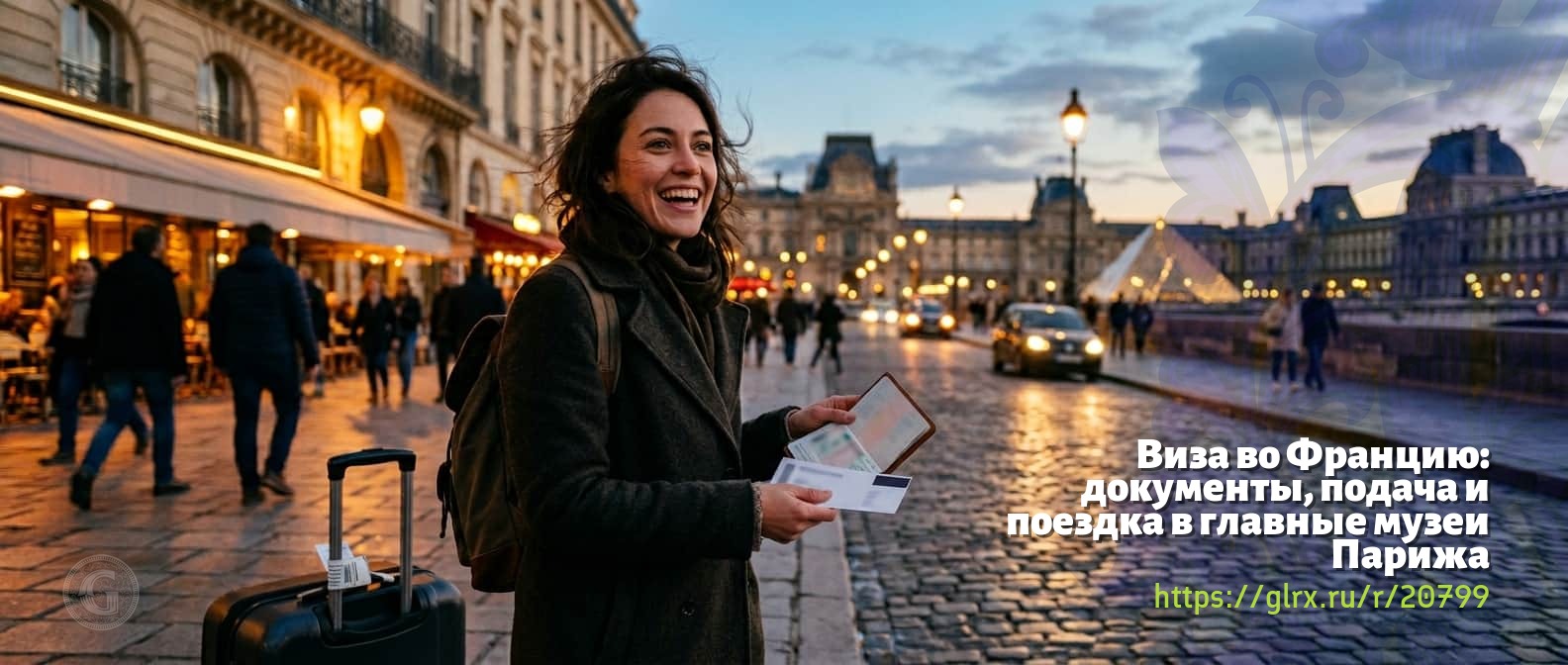
A trip to France almost always begins not with the Louvre, the Orsay, or a stroll along the banks of the Seine, but with a more prosaic but essential step: obtaining a visa. For Russians, a visa to France remains the first step toward their future journey: to Paris, its old boulevards, museum collections, architecture, exhibitions, and that special atmosphere that keeps people coming back. Therefore, it’s important to start by discussing not paintings and exhibition halls, but the practical aspects of the trip: where to submit documents, what to prepare in advance, how long to wait for a decision, and what to pay special attention to.
Applying for a visa to France requires precision, patience, and meticulous attention to detail. Applicants typically begin by filling out an application form, then gather documents, make an appointment at the visa center, and then submit their application. While this process seems standard at first glance, it’s precisely here that errors often occur: some underestimate the importance of financial documents, others submit an overly formal reservation, and others gather documents without a clear itinerary. Meanwhile, the French authorities typically look not only at the documents themselves but also at how convincingly they fit together to form a coherent travel narrative.
2 What documents are usually needed?
3 Deadlines, filing and waiting for a decision
4 Why the visa block is more important than it seems
5 Museums of France: Why Paris is Worth a Visit
6 The Louvre: A Museum You Can’t Exhaust
7 Orsay: 19th-Century Paris and the Language of Impressionism
8 Centre Pompidou: art that debates and provokes
9 The Museum Route as a Way to See France Deeper
How to begin the process of applying for a visa to France
Preparation for application usually begins with filling out an application and scheduling an appointment at the visa center. Applicants should determine their travel dates, approximate itinerary, accommodation, and duration of stay in advance. Even if the travel plan isn’t yet planned out day by day, it should be realistic and coherent. A French visa doesn’t tolerate paperwork chaos: when a person has clear dates, confirmed accommodation, tickets, and a logical explanation of the purpose of their trip, their application is significantly stronger.
Typically, a standard set of documents is required to apply for a French visa. This includes a valid passport, an application form, a standard photograph, proof of employment, financial documents, accommodation reservations, travel documents, and health insurance. In practice, applicants are usually particularly attentive to two sections: financial information and the purpose of their trip. If these sections are clear, the entire package is accepted much more confidently.
Financial documents are needed not for formality, but to confirm that the trip is truly funded. A bank statement should be clear and understandable: regular income, a reasonable balance, and no random one-time transfers just before the application. A certificate of employment, if available, enhances the overall impression by demonstrating stability of employment and income. If the applicant owns their own business, freelances, or is otherwise employed, it’s especially important that the documents explain their situation as clearly as a standard employer statement.
The travel itinerary is no less important. France is a country where tourism is perceived as a clear and natural purpose of travel, but even a tourist trip must be substantiated. Hotel reservations, approximate dates, tickets, and a general plan for travel create a sense of thoughtfulness. If someone writes that they’re going to Paris for museums, walks, and a few days in the city, and the application includes Paris reservations and tickets for these dates, the purpose of the trip appears convincing. However, if the documents are collected pro forma and disjointed, this always weakens the application.
What documents are usually needed?
The top section of such a text should indeed be as calm and practical as possible. The most important thing here is for the reader to understand what exactly is required of them. Typically, for a French visa, the following is prepared:
- a valid international passport;
- a completed and printed application form;
- photograph;
- confirmation of financial resources;
- a certificate from work or other documents confirming income;
- accommodation reservation;
- transport confirmation;
- health insurance;
- copies of internal documents, if they are required for the package;
- additional documents confirming the connection with Russia.
Ties to Russia are typically understood to include work, studies, business, property, family, and other circumstances that indicate the trip is temporary. This isn’t a separate formality, but rather part of the overall impression of the applicant. The more stable their situation appears, the more relaxed the trip is perceived.
The way the package is assembled is also important. A good dossier isn’t just a folder with random pages, but documents that coordinate with each other. The dates on the tickets and reservations match, the financial documents appear clear, the itinerary is understandable, and the purpose of the trip is self-explanatory. That’s why applying for a French visa requires more attention to detail and order than just a few odd documents.
Deadlines, filing and waiting for a decision
Another important section at the beginning of the text is the deadline. It’s best to plan your trip to France in advance, rather than waiting until the last minute. Even if the average application processing time seems reasonable, peak season, holidays, and visa center workloads can significantly impact the wait. Therefore, a smart application always means submitting with ample time.
After the appointment, the applicant brings the documents to the visa center, submits biometrics if required, pays the fees, and waits for a decision. At this point, nothing can be corrected, so all work must be done in advance: check the application form, dates, spelling of the last name, document numbers, insurance policy, reservations, and financial documents. It’s these small details that often determine whether the application will look flawless or whether the package will contain weaknesses.
The visa section of the text shouldn’t intimidate the reader, but rather encourage careful preparation. A visa to France isn’t something exotically complex, but it’s also not a formality that can be rushed through. The winners here aren’t the bravest, but the most focused: those who understand the route in advance, calmly prepare their documents, and clearly state the purpose of their trip.
Why the visa block is more important than it seems
When reading a text about France, people often want to skip straight to Paris, its museums, and impressions. But it’s the visa section that makes the entire future itinerary a reality. Without it, the Louvre remains a beautiful idea, the Orsay a dream, and the Pompidou a point on the map yet to be reached. Therefore, the top section of the article should provide a sense of support: here’s where to start, here’s what to prepare, here’s how to approach the presentation without rushing or fussing.
And only then does it make sense to move on to the main event — the trip itself. Because once the visa issue is resolved, France reveals itself not as a list of documents, but as a space of art, memory, architecture, and cultural richness. It’s here that the text can shift gears: from practical and restrained to more atmospheric and meaningful.
Museums of France: Why Paris is Worth a Visit
Once a visa is obtained, a French itinerary becomes more than just an abstract plan, but a real journey. And if it’s a first trip, Paris is almost always the center of that itinerary. It’s home to museums that draw not only tourists to France, but also art historians, students, curators, collectors, and simply those for whom painting and architecture are an important part of their personal experience.
Paris is convenient because you can experience several cultural eras at once. One day can be devoted to antiquity and the Renaissance, another to the French 19th century, a third to the avant-garde and contemporary art. In this sense, French museums don’t just complement the trip; they become its true essence.
The Louvre: A Museum You Can’t Exhaust
The Louvre is almost always the first stop. And it’s not just because of its fame, but because it truly sets the tone for the entire Parisian museum program. It’s hard to think of the Louvre as a simple museum you can simply "see in a couple of hours." It’s a space where ancient sculpture, ancient Eastern art, Egyptian collections, Renaissance painting, French classicism, and a vast swath of European history come together in a single itinerary.
People come here, of course, for the most famous works — the Mona Lisa, the Venus de Milo, and the Nike of Samothrace. But the Louvre’s true power lies beyond these symbols. It lies in the sense of cultural continuity, as one passes through several civilizations in a single day and sees how ideas about beauty, power, the body, faith, and the human form have evolved.
Therefore, it’s best not to turn the Louvre into a race through a list of must-see masterpieces. It’s far wiser to choose one or two broad itineraries. For example, focus on Italian painting and ancient sculpture, or combine the Egyptian section with French art. This approach allows you to not simply tick off the sights but truly experience the museum as an experience.
Another unique feature of the Louvre is its architectural drama. The former royal palace itself creates the impression that visitors are moving not just through halls, but through layers of European history. And this sensation resonates even with those unfamiliar with art history. At the Louvre, visitors find themselves within a grand cultural narrative, where each hall continues the previous one.
Orsay: 19th-Century Paris and the Language of Impressionism
While the Louvre offers a sense of vertical historical perspective, the Musée d’Orsay operates differently. It’s far more emotional and relatable to contemporary viewers. It’s less a celebration of museum monumentality than a vibrant dialogue with the 19th century — with a Paris that was changing, debating, accelerating, and simultaneously learning to appreciate the beauty of the everyday.
The Orsay is especially important for those who want to experience how art emerged from academic rigor and embraced light, air, movement, and urban life. It is here that one can see most clearly why the Impressionists became not just an artistic movement, but an entire shift in perspective. Monet, Renoir, Degas, Pissarro, Sisley, Manet, Van Gogh — at the Orsay, they are perceived not as names from a textbook, but as participants in a larger conversation about how one can see the world.
Another benefit of this museum is its unobtrusive scale. It’s easier to experience it attentively. Here you can linger over individual paintings, return to them, compare moods, and notice how differently the artists depicted light, water, the street, a face, dance, or silence. At Orsay, the viewer experiences not so much the effect of grandeur as a profound emotional engagement.
The former train station building itself plays a special role. It’s the perfect fit for this museum: a space of movement, anticipation, and time has been transformed into a place that showcases the art of a time of change. This makes the Orsay a favorite museum, even for those who originally came to Paris solely for the Louvre.
Centre Pompidou: art that debates and provokes
After the Louvre and Orsay, the route logically continues to the 20th century — and here it’s almost impossible to miss the Centre Pompidou. This museum always feels different: it doesn’t calm, but rather shakes. Its architecture, its exposed communications, its openness to the urban environment, and the very principle of the exhibition create a completely different rhythm of perception.
The Pompidou is important because it presents art not as a consummate beauty, but as a search, an experiment, a questioning, and a challenge. Here, the usual expectations of a classical museum no longer apply. Instead, the viewer encounters the avant-garde, abstraction, conceptual gestures, and artistic forms that provoke thought, debate, agreement, or irritation. And this is precisely its value.
For Russian-speaking travelers, the Pompidou holds another special layer of interest. The works of Kandinsky, Malevich, and other avant-garde masters appear here not as something alien, but as part of a shared European history of art, in which the Russian artistic tradition occupies a significant place. This makes a visit to the museum not only aesthetically pleasing but also culturally personal.
After Pompidou, Paris began to be perceived more broadly. It was no longer just a city of classicism and impressionism, but also a space for artistic experimentation, where different eras didn’t supplant one another, but coexisted and continued to debate.
The Museum Route as a Way to See France Deeper
The strength of a trip to France is that the museums don’t exist separately from the city. After the Louvre, the historic center of Paris feels different. After the Orsay, there are embankments, bridges, cafes, boulevards, and the very idea of a city stroll. After the Pompidou, there’s modern Paris, with its shop windows, galleries, bookstores, and street life.
That’s why a museum tour of France isn’t just about paintings and collections. It’s a way to see the country more deeply: to understand its historical memory, its relationship with art, its habit of preserving the past while simultaneously creating something new. France has a knack for transforming culture not into museum dust, but into a part of everyday life. This is precisely its appeal.
If you’re short on time in Paris, it’s smarter not to try to cover everything. It’s enough to focus on a few key points: the Louvre as a grand historical panorama, the Orsay as 19th-century art and Impressionism, and the Pompidou as a contemporary space. This itinerary alone provides the feeling of a full-fledged cultural journey.
A trip to France really does begin with a visa, and that’s perfectly normal. A French visa isn’t an unnecessary formality, but the practical step that turns the idea of traveling into reality. If you approach the application calmly, gather a clear set of documents, plan your route in advance, and leave yourself plenty of time, the visa process stops seeming daunting and becomes simply part of your preparation.
And then comes the real point: the museums of France, the streets of Paris, the Louvre, the Orsay, the Pompidou, a conversation with art from different eras, and the feeling that the trip was not only beautiful but also meaningful. This text works best in this order: first, the documents, deadlines, and application, then France as a cultural space, the very reason one wants to go through the entire visa process.
- Museums of the world - a large archive of museum collections of paintings
- TripAdvisor compiled a hit parade of world museums. Hermitage - 6th
- Tickets to the Louvre for rubles: where to buy without risk and overpayments
- Mona Lisa could be moved to a separate underground room
- Louvre Abu Dhabi
- From the Louvre to the Hermitage: a journey through the world’s museums