The wedding ring in world art:
how artists of different eras depicted love and marriage
 Automatic translate
Love is one of the eternal themes of world art. Over the centuries, artists have returned to it again and again, finding new ways to express feelings, family, fidelity, and hope. One of the most expressive symbols of these values is the wedding ring . Despite its simple form, it carries profound meaning: a closed circle without beginning or end symbolizes the eternity of union, trust, and the promise of togetherness.

The history of this symbolism goes back thousands of years. However, it was European painting that transformed the ring from mere jewelry into a significant artistic image, helping to tell the viewer an entire story without a single word.
Art values detail. Sometimes a single small ring on a hero’s finger can convey more about love, loyalty, and hope than dozens of pages of text.
2 Renaissance: Marriage as Ideal Harmony
3 Northern Renaissance: The Language of Detail
4 Baroque: Emotions become the protagonist
5 19th Century: Love Becomes a Personal History
6 When painting inspires contemporary design
7 Why the ring image remains relevant
8 Art that stays with a person
From symbol to artistic image
In painting, a ring is almost never the main object of a composition. More often, artists use it as a semantic accent that completes the narrative. A single gesture — the placing of a ring or the joining of hands — instantly communicates to the viewer that what they are witnessing is not simply a meeting of two people, but the birth of a new family.
This is why artists of different eras paid special attention to the hands of their subjects. In a classical composition, the viewer’s gaze naturally moves to the palms of the subjects, where rings are exchanged or the couple’s hands are joined. This technique makes the scene emotionally charged and relatable, regardless of language, culture, or time.
A small detail becomes the key to the entire plot.
Renaissance: Marriage as Ideal Harmony
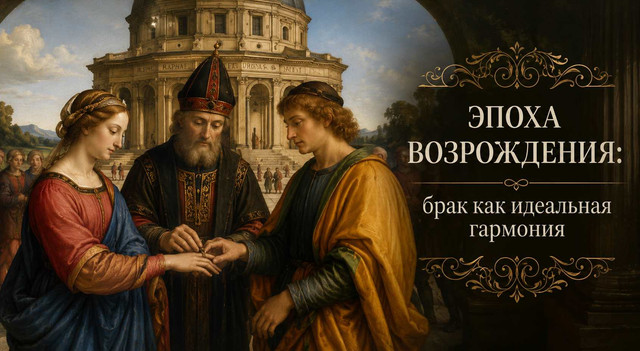
During the Renaissance, the theme of marriage acquired particular significance. Artists sought to convey not only the religious meaning of the union of a man and a woman but also the harmony of human relationships.
One of Raphael’s most famous works is considered to be "The Marriage of the Virgin ." At the center of the composition, the high priest joins the hands of Mary and Joseph, while the groom places a ring on the finger of his beloved. The ring itself takes up very little space on the canvas, yet it is this gesture that shapes the entire composition.
The architecture, perspective lines and arrangement of figures seem to emphasize that marriage marks the beginning of a new life story.
For Renaissance masters, it was important to show that love is harmony , and the ring is the material embodiment of this ideal.
Northern Renaissance: The Language of Detail

While Italian artists sought ideal proportions, Northern European masters became famous for their incredible attention to detail.
A striking example is Jan van Eyck’s famous "Arnolfini Portrait." Here, the family unit is revealed through a multitude of symbols:
- the joined hands of the spouses;
- mirror as an image of truth;
- a single burning candle;
- dog as a symbol of fidelity;
- carefully painted interior of the house.
Even if the ring is not the main compositional element, it becomes part of the overall narrative about marriage, responsibility and mutual trust.
Such paintings allow the modern viewer to literally “read” the work, like a historical document, in which every detail has its own significance.
Baroque: Emotions become the protagonist

In the 17th century, art became significantly more emotional. Baroque artists sought to convey not so much ideal composition as human experience.
Wedding scenes are filled with movement, glances, smiles, and excitement. The ring ceases to be merely a symbol of a contract , becoming a sign of sincere love.
The artists pay special attention to the play of light. The gold metal reflects the sun’s rays, emphasizing the solemnity of the moment. This allows even the smallest jewelry element to play a significant role in the painting’s emotional impact.
19th Century: Love Becomes a Personal History

With the development of Romanticism, the theme of love gradually ceased to be a purely social event. Artists began to be interested in the feelings of specific individuals.
Scenes of marriage proposals, home portraits of young spouses, family interiors, and quiet moments of happiness appear in 19th-century paintings. The ring becomes a symbol of personal choice , not just adherence to tradition.
It was during this period that painting began to actively influence the development of jewelry art. Artists, architects, and designers inspired artisans to create jewelry that incorporated motifs such as:
- Gothic;
- classicism;
- modernism;
- Art Nouveau;
- Art Deco.
Jewelry art is gradually becoming a continuation of artistic culture.
When painting inspires contemporary design
Even today, the connection between painting and jewelry remains remarkably strong. Many contemporary designers study the works of great artists, paying attention to composition, color combinations, play of light, and proportion .
It’s no surprise, then, that many couples choose gold wedding rings , inspired not only by fashion trends but also by the aesthetics of classical art. Simple forms, noble materials, and attention to detail make such jewelry truly timeless — just like the finest works of art.
Why the ring image remains relevant
The change of artistic eras has not changed the main thing: the ring continues to be one of the most understandable symbols of love.
There are several reasons for this:
- the circle shape is associated with eternity;
- the precious metal symbolizes the strength of the union;
- The exchange of rings has become a universal wedding ritual in many countries;
- This image is equally understandable to people of different cultures.
This is why artists continue to turn to it today, albeit in a modern interpretation.
Art that stays with a person
Great paintings remind us that love is rarely expressed in grand words. It most often manifests itself in gestures, glances, and small details, which the artist skillfully transforms into the central meaning of the work.
The wedding ring is one of the most recognizable symbols of world culture. Over the centuries, it has united art, history, and human emotion, evolving from a small adornment into an icon understood by everyone without translation.
That’s why, when we look at paintings by Raphael, Jan van Eyck, or the 19th-century masters, we see more than just a jewel on a hero’s finger. We see a promise made to another person, the beginning of a shared story, and a symbol of love that has survived the passage of time, artistic movements, and generations, retaining its significance to this day.
You cannot comment Why?