"Frozen Wanderers" by Dina Rubina, summary
 Automatic translate
This book is an autobiographical collection of short stories and novellas, published in 2005. The text captures the author’s personal experiences amidst shifting cultural and geographical coordinates, combining travel notes with insights into Jewish history. The writer describes her own experience of adapting to a new country, interspersed with everyday anecdotes and philosophical reflections on memory, loss, and the continuity of generations.
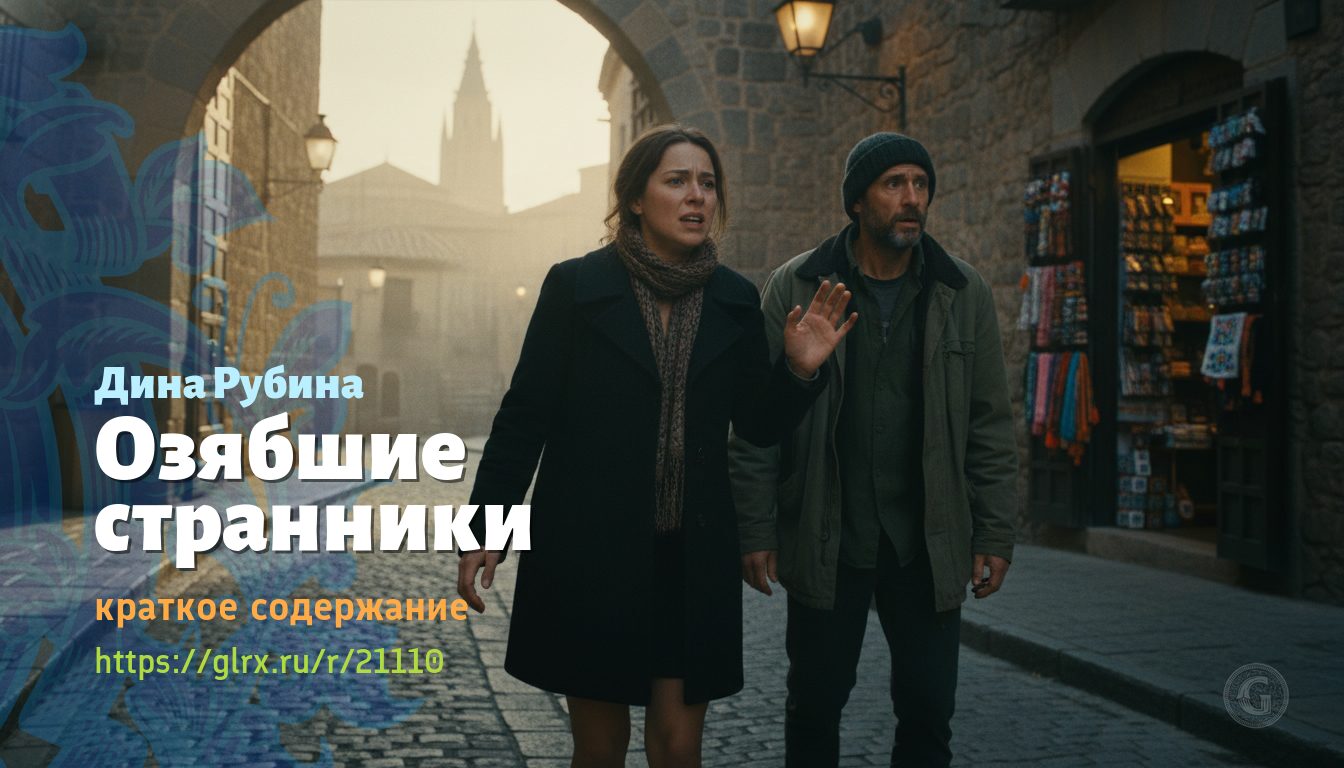
Sunday Mass in Toledo
The narrator and her husband, Boris, travel across Spain. They visit Barcelona, Seville, Cordoba, Granada, and Madrid. The heroine searches for traces of her ancestors — Sephardic Jews expelled during the Inquisition. She has long been haunted by a recurring dream in which she walks barefoot along a ribbed pavement. In Toledo, the couple finds a souvenir shop selling kosher wine. The Catholic owner confesses to her secret Jewish origins. They then visit the workshop of an artisan named Espinosa, who carves a Star of David. In the final scene, the heroine attends mass in a cathedral built on the site of a Jewish market and takes a photo barefoot at the old ghetto gate, closing the gestalt of her long-ago dream.
Villa "Consolation"
The friends arrive in Sorrento and stay in a villa carved into a high cliff overlooking the sea. The building is managed by an Italian woman named Maria. The history of the place is revealed: a Russian merchant fled the 1917 revolution. His wife died in childbirth on board ship. The merchant hired a local wet nurse, Lucia, built a villa for her, and lived with her for twenty years. However, he left his entire inheritance to his only son. Insulted, Lucia hanged herself, cursing the female line of the family. Maria, a descendant of the family, rebuilt the abandoned house, hoping to reverse her fate, and now patiently awaits brief visits from her Israeli lover.
Cold spring in Provence
A journey through the south of France is accompanied by a continuous cold rain. The characters visit Nice, Antibes, Vence, and Arles. At a flea market, the narrator purchases a volume of Vincent van Gogh’s letters. The text of the letters weaves into the narrative, reflecting the artist’s loneliness, bouts of madness, and despair. The couple wanders through the artist’s works and visits the mental hospital in Saint-Rémy, where he was treated. Leaving Provence on an old commuter train, the heroine reads in a newspaper found on the floor about the recent brutal murder of Dutch filmmaker Theo van Gogh, a descendant of the artist’s brother, linking the tragedy of the past with the cruelty of modern society.
Migratory viola
The family receives a large sum of money from the sale of Boris’s paintings. The narrator’s sister, Vera, persuades them to invest in a rare, hand-crafted viola. The instrument was created by the Almaty master Shub specifically for a gigantic musician who later died in the mountains. Vera emigrates to Israel and takes the viola with her. Attempts to sell the instrument fail due to its unusual dimensions. The viola is later sent to New Zealand, then to Boston, but no buyers are found. Ultimately, the instrument returns to Israel and takes its permanent place on the wall as a monument to the family’s commercial failures.
School of Light
Their March trip to the Netherlands begins in Amsterdam and continues in The Hague. At the Mauritshuis Museum, the heroes admire the paintings of the Dutch Minorities and Jan Vermeer’s "View of Delft." They spend the night in Delft, at an inn where the rooms are named after artists. A faded copy of Vermeer’s masterpiece hangs in the café. It turns out that the copy was painted by candlelight by a young Jewish artist named Samuel. During the war, the mother of the current innkeeper hid him and five others in the basement. The artist died there of illness, leaving behind only this painting. The innkeeper declines any honors, considering saving people a personal destiny.
Nightingale Time
The story depicts the everyday life of a small town in the Judean Desert. Early in the morning, the silence is broken by the call of the muezzin from a neighboring Arab village, the singing of birds, and the cries of a peacock. Sultry khamsins give way to parching winds. Local life is filled with colorful characters: Bedouin women search trash bins for usable items, Arab teenagers sweep the streets, and security guards check bags at the entrance to shopping malls. This measured routine contrasts sharply with the terrifying news of the bombings in Jerusalem. The narrator experiences anger and impotence in the face of terror, retreating into her computer work and attempting to comprehend the fragility of human existence.
At the end of August
Exhausted by three years of office work, the heroine suffers from physical exhaustion. She goes to Tel Aviv to see a homeopath, then to a pharmacy for medication. The pharmacist, Gabi, whose face and hands are horribly disfigured after the war in Lebanon, shows genuine concern for her. In a café, over a bowl of shawarma, she hears on the radio about the terrorist attack on a Jerusalem bus. To calm down, the narrator descends to the Mediterranean Sea. She wades into the water, observing bathers, a huge black dog, and fishermen on a raft. A long walk along the beach and contemplation of the crimson sunset bring temporary relief.
Our Chinese business
The heroine and Boris are trying to make money with their own microscopic publishing house. They receive a commission to update an old newsletter for immigrants from China — Russian Jews who spent their youth in Harbin and Shanghai. Negotiations with the community’s leadership, Yakov Moiseevich and the dictator Maurice Lurye, reach a dead end. The elders cling to the past and refuse to fire their editor, Alik — a disabled man and the product of a long-standing love affair. Boris behaves provocatively, quoting Chinese poetry and provoking scandals. Ultimately, the collaboration fails, leaving behind only memories of others’ broken lives and lost illusions.
Jerusalem bus
Short vignettes of Israeli public transportation demonstrate the unique characteristics of local communication. The bus driver is the absolute master of the vehicle. Passengers sing songs, argue loudly, offer advice to one another, and even engage in heated arguments with the driver. In one scene, a religious passenger begs the driver to drive more carefully on an icy road, to which the driver responds in Russian, recalling his experience driving heavy trucks in the Siberian taiga. The bus serves as a microcosm of Israeli society — noisy, conflicted, lacking social distance, yet tightly knit into a single social organism.
I’m a bastard
The writer reflects on her touring career. She compares herself to an ofenya — a traveling salesman selling his own books in different countries. The constant travel, the monotonous notes from the audience reproaching her for using informal language, and the need to entertain audiences are exhausting. The heroine’s son secretly sells her books on buses, signing them with horrific spelling errors. Despite fatigue and the panicky fear of being late for performances, the narrator discovers new plots, aptly grotesque details, and treasures the rare moments of sincere audience appreciation in these travels.
Under the sign of carnival
Life in Israel is depicted through a prism of the grotesque. Tragedies blend with the absurd. A former dissident, imprisoned in a Soviet prison for burning a red flag, burns it in Tel Aviv and is jailed again. Tourists wander Jerusalem in outlandish costumes. Russian-speaking children forget their native language, retelling classics with distorted criminal meanings. Islamic terrorists dress up to commit murders in cafes. A typo causes a newspaper ad featuring a certain Cain offering circumcision services, underscoring the surrealism of everyday life.
“…Ikh bin nervoso!”
The couple arrives in Italy. Within minutes of arriving in Rome, Boris’s bag containing documents, money, and religious paraphernalia is skillfully stolen. The locals react to the theft with a flourish and emotion. The couple continues their journey, admiring the architecture of Rome, the austere beauty of Florence, and the mosaics of Ravenna. Throughout their travels, they communicate in a strange mixture of Russian, Italian, and English. Italy amazes them with its theatricality. Boris purchases new prayer utensils at a Florentine synagogue, where he is honorably called before the Torah by the local congregation.
"Can’t you just not walk here?!"
The heroine embarks on an official trip to Russia and Ukraine with Klara, the director of the Russian library. Before their departure, they are subjected to absurd security instructions. In Odessa and Moscow, the narrator feels a sharp alienation from her former homeland, noting the dilapidated buildings and the changed language of the city’s inhabitants. During a performance of the ballet "Giselle" at the Mariinsky Theater in St. Petersburg, she unexpectedly spots Ariel Sharon in the box. In Moscow, at a meeting with readers, Sharon also appears, delivers a short speech, and provokes a storm of emotion among the local Jewish audience.
At your gates
The heroine gets a job as an editor at a Jerusalem publishing firm. The owners publish religious literature, brochures, and tabloids. The Gulf War begins. Sirens wail at night, and residents hide in sealed rooms and don gas masks. The office is ablaze with intrigue: editor-in-chief Yasha bullies his subordinates, secretaries lose documents, and hack writers submit insane manuscripts. The firm suffers financial ruin due to the founder’s machinations. Amid the scandal and sirens wailing, investors fight with the editors. Left without a job and money, the heroine looks out from her balcony at the hills and passionately asks God for a chance to earn some money.
You cannot comment Why?