Mikhail Lermontov’s "Masquerade," a summary
 Automatic translate
This verse drama tells the story of a former professional gambler who, blinded by jealousy, murders his innocent wife. The play was written in 1835. During the author’s lifetime, state censorship repeatedly banned its publication due to its harsh denunciations of high society vices and the lack of proper punishment for the protagonist. A famous stage production was staged by director Vsevolod Meyerhold at the Alexandrinsky Theatre. The premiere took place in 1917. Later, in 1941, Sergei Gerasimov directed a successful film of the same name, starring Nikolai Mordvinov.
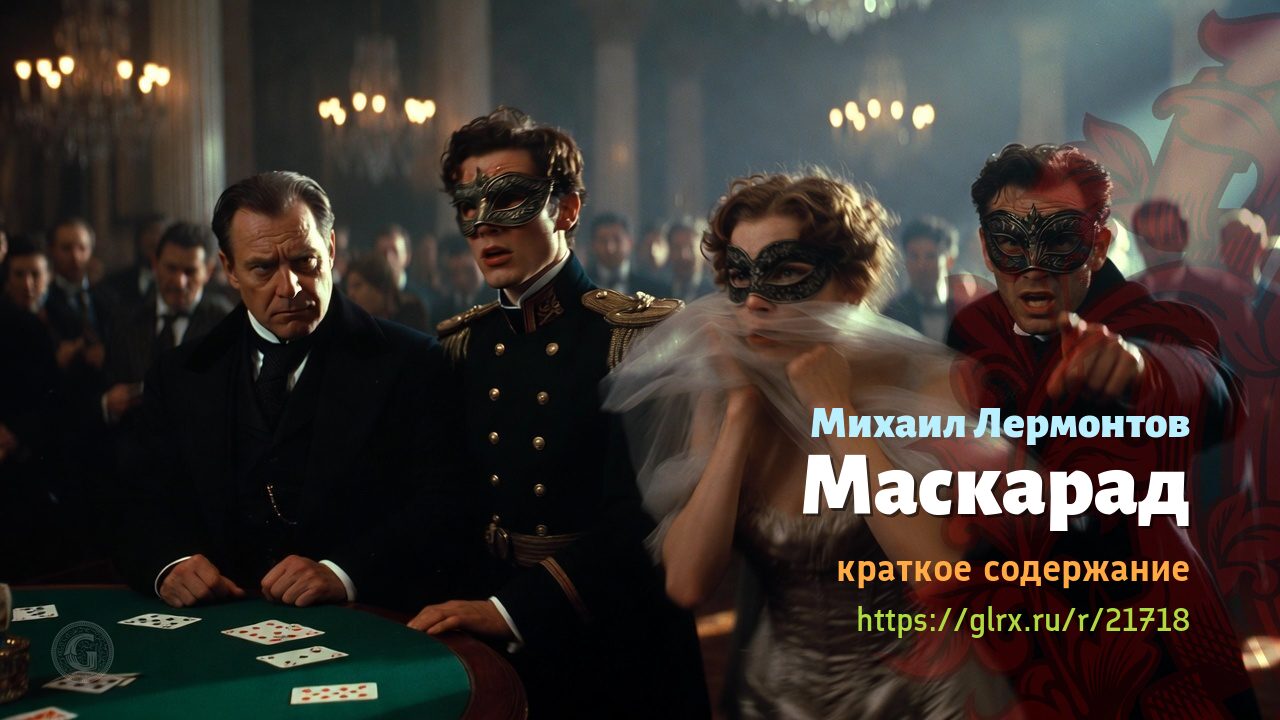
A card game and a fateful meeting
The action begins at the green baize table. Young Prince Zvezdich bets all-in and loses everything. The players mock the army officer’s ardor. Yevgeny Alexandrovich Arbenin approaches the table. He himself was once known as a ruthless gambler, but has now settled down and become a wealthy family man. Arbenin observes the prince’s despair. He recalls his own wild youth and decides to intervene. Yevgeny Alexandrovich asks Zvezdich to give him a seat at the table. His skill prevails — Arbenin quickly wins back his lost banknotes and drily returns them to the prince. The officer sincerely thanks his savior. Arbenin rejects the gratitude, cynically declaring that he has always been guided solely by personal gain and cold calculation.
The friends set off to Engelhardt’s ball in search of new entertainment. Zvezdich openly complains of boredom. Arbenin advises him to take a closer look at the dancing women. Behind a thick mask, women often conceal their true desires and are easily approached. Soon, an unknown woman emerges from the motley crowd. She approaches the prince and bluntly confesses her sincere affection. Intrigued, Zvezdich tries to rip the stranger’s mask off. The woman resolutely breaks away. She fears public exposure and social ridicule. To distract her ardent suitor, the mask tosses a gold and enamel bracelet that someone had dropped onto the floor. The prince picks up the find, and the woman quickly disappears into the crowd.
Meanwhile, a man’s mask blocks Arbenin’s path. The stranger calls the former gambler a dishonest man. Arbenin imperiously demands to see his face, but the stranger predicts imminent disaster and disappears.
The Lost Bracelet
Zvezdich boasts of his newly acquired trophy to Arbenin. The bracelet seems strangely familiar to Arbenin. He returns home in a gloomy mood. His wife, Nina, arrives too late. Arbenin hotly reproaches his wife for her social carelessness and excessive love of balls. Suddenly, he notices the missing pair of jewelry from her wrist. Nina casually admits to the loss of the bracelet.
Arbenin pales at the terrible realization. The servants carefully search the carriage but find nothing. It turns out that Nina also attended the ill-fated masquerade. Her husband’s suspicions grow into firm conviction. Nina dismisses his accusations as empty nonsense and trivialities. Arbenin flies into an uncontrollable rage. He promises to tear their lives apart without the slightest regret. Nina swears by heaven of her absolute purity. Her husband categorically refuses to believe her tears.
The development of social intrigue
The true owner of the mask is Baroness Strahl. In the morning, she visits Nina. The Baroness is strenuously concealing the secret of her nocturnal adventure. Zvezdich enters the living room. The officer sees Nina and openly alludes to their recent masquerade encounter. Nina is genuinely perplexed. Zvezdich mistakes her resistance for feminine cunning and refuses to back down from his intended goal.
Baroness Shtral is terrified of losing her social reputation. She decides to direct the meddlesome prince’s suspicions toward Nina. The nosy gossip Shprikh appears in the house. The Baroness indirectly confirms the rumor of Zvezdich’s secret affair with Nina. Shprikh immediately passes the news on to the gambler Kazarin, and through him, the dirty gossip reaches Arbenin.
At the same time, Shprikh actively helps Zvezdich compose a love letter. The note falls directly into Arbenin’s hands. The letter’s text dispels the last doubts of the betrayed husband. His old friend Kazarin adds fuel to the fire with his musings on universal deception. He compares life to a deck of cards, ruled only by blind fate. Arbenin heads to Zvezdich’s home, determined to stab his sleeping rival. The former card sharper stands over the prince, but the blade falls from his weakened hands. Arbenin chooses a more sophisticated method of execution. He spares the officer’s life and graciously invites him to a card dinner.
Baroness Strahl realizes the gravity of her intrigues. She secretly approaches Zvezdich and confesses that she was the one hiding behind the mask. The officer refuses to take the impending danger seriously.
That evening, the rivals meet at the gaming table. Arbenin tells those present a story about an unfaithful wife and a vile friend. Then he loudly accuses Zvezdich of brazen cheating. Arbenin forcefully throws a deck of cards right in the prince’s face. Zvezdich demands an immediate duel. Arbenin coldly refuses his satisfaction, leaving the army officer with the indelible stigma of a coward and a scoundrel.
Poisoning
At yet another lavish ball, society acquaintances disdainfully avoid the disgraced Zvezdich. The prince approaches Nina. He announces his imminent forced departure to the Caucasus. As they part, Zvezdich warns her of her husband’s incredible treachery. Nina considers the officer mad and refuses to listen to his ravings.
Arbenin watches his wife’s conversation from afar. He has prepared a powerful poison in advance. Evgeny has kept this deadly powder since his wild youth, when he himself intended to take his own life after losing heavily. Nina complains of intense heat. She asks her husband for a scoop of cool ice cream. Arbenin discreetly slips the poison into the dessert. Nina calmly eats the delicacy. Her husband claims sudden illness and takes his wife home. An unknown person from the masquerade secretly observes the poisoning but decides not to interfere.
Nina’s Death
In the bedroom, Nina becomes physically ill. She begs her husband to send for a doctor immediately. Arbenin calmly observes his young wife’s suffering. He discourses at length on the emptiness of human existence and the frailty of life. Nina begs for salvation and complains of a searing pain in her chest. Her husband openly admits to poisoning her. Nina is overcome with indescribable horror.
Arbenin cruelly demands a sincere confession of infidelity. Nina weakly cries for help, but the bedroom doors are firmly locked. Dying, the woman betrays her husband to heavenly judgment. She utters with difficulty: "I am dying, but I am innocent… you are a villain…" Arbenin stubbornly calls her dying vow a pathetic lie. Nina closes her eyes forever.
Pay
Arbenin is devastated. He sits motionless beside his dead wife. His attending physician and an elderly relative appear, drily discussing the material details of the upcoming funeral. Suddenly, two uninvited guests arrive at the house — Zvezdich and the Unknown. The Unknown finally reveals his true identity. Seven years ago, Arbenin mercilessly cheated him at cards, depriving him of a large fortune and any hopes for a happy future. All these years, the deceived man secretly followed Arbenin, patiently awaiting the opportune moment for a crushing blow.
The guests bring a written confession from Baroness Strahl. The text completely exonerates Nina. Zvezdich confirms the absurd accident with the gifted bracelet. The prince explains his tragic mistake in detail. Arbenin clearly understands the full gravity of his actions. With his own hands, he poisoned an absolutely pure, infinitely devoted woman.
Yevgeny Alexandrovich’s proud mind can’t withstand such a monstrous shock. He begs God for forgiveness, falls heavily to his knees, and then rushes toward the dead body with a wild cry. Arbenin loses his mind forever. The unknown man triumphs maliciously, having achieved his long-desired revenge. Zvezdich survives, but is doomed to suffer forever from his irrevocably lost reputation.
- The Theater of Satire announced "Spring Premier"
- The magic of Plisetskaya. Notes for the anniversary of the great ballerina
- A summary of Mikhail Lermontov’s "A Strange Man"
- 400 works of art can leave the walls of the Thyssen-Bornemisza Museum
- Baroness Thyssen sells the pearl of her art collection
- "Pushkin Festival"
You cannot comment Why?