A summary of "The Pit" by Alexander Kuprin
 Automatic translate
"The Pit" is a socially charged novella by Alexander Kuprin, published in 1915. This book lays bare the quotidian routine of legalized prostitution in pre-revolutionary Russia, starkly revealing the tragedy of women thrown overboard. In 1990, the novella served as the basis for a feature film of the same name. It was later successfully adapted into a popular Russian television series.
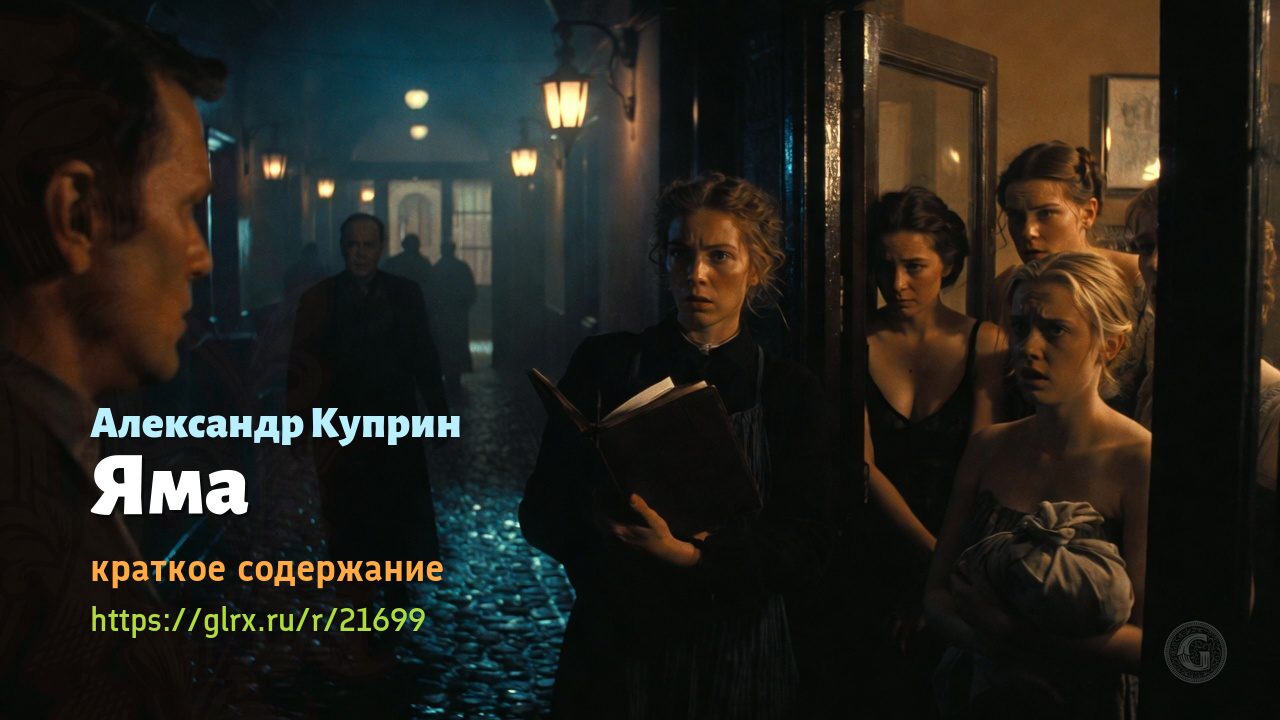
Everyday life in Yamskaya Sloboda
The action takes place in Yamskaya Sloboda, the outskirts of a southern city densely populated with brothels. The establishments differ only in price and outward luxury. One of the middling establishments belongs to Anna Markovna Shaibes. The house is sternly governed by the cruel housekeeper, Emma Eduardovna. She is assisted by the junior housekeeper, Zosya, and the bouncer, Simeon. The corrupt police officer, Kerbesh, reliably provides cover from the law. The establishment’s residents are shackled by debts for clothing and are completely subservient to the will of their superiors.
The girls wake up in the afternoon, drink coffee, and lazily prepare for their night’s work. Several distinctive faces stand out among them. Zhenya is a proud, independent, and well-read brunette with sparkling eyes. Tamara is a former novice at a monastery, reserved, intelligent, and fluent in foreign languages. Manka Belenkaya is a naive blonde who often causes violent scenes after drinking liqueur. Pasha is a woman with a nervous breakdown, ready to give herself to any guest. Lyubka is a simple, illiterate peasant woman with a freckled face. Nina is a village girl recently sold into a house.
In the evening, visitors flock to the hall. They include officials, merchants, clerks, artisans, and students. They are entertained by the old drunkard Vanka-Vstanka, who recites absurd poems and performs magic tricks. Pianist Isaak Davidovich and violinist Isai Savvich, the hostess’s husband, provide music for the dancing. The men arrive, pay their dues, choose their women, and depart. The women feign passion with indifferent submissiveness, strictly adhering to the established price list.
Student revelry and Lyubka’s rescue
Late at night, a noisy group of students arrives at the establishment. They are accompanied by journalist Sergei Ivanovich Platonov and assistant professor Yarchenko. The guests rent a private room, drink cognac, and chat with the girls. Platonov is well acquainted with the local customs: he had a long lunch here while preparing the owner’s daughter for her high school exams. The journalist discusses societal indifference and the monstrous prosaic nature of prostitute love. He sees in this institutionalized vice the naked and terrible truth.
A conflict erupts between Platonov and the student Sobashnikov. The brazen youth attempts to insult the reporter, but retreats before his calm strength. Student Likhonin, inflamed by wine and lofty philosophical conversations, decides to commit a noble act. He wants to break one of the girls out of their vicious cycle and return her to an honest life. His choice falls on Lyubka, who is sleeping in a chair. Likhonin takes her home in a cab.
Meanwhile, Semyon Yakovlevich Gorizon, a human trafficker, arrives in town. Disguised as a traveling salesman, he transports huge quantities of defrauded girls across the country. This time, he’s bringing his new wife, Sarah, with him. Gorizon, without a shadow of a doubt, sells his wife to Madame Barsukova’s expensive brothel for a thousand rubles. He also cynically transfers the unattractive Jewish woman, Sonya Rul, from Anna Markovna’s home to a cheap soldiers’ establishment, earning a commission.
A celebrity visit
During the summer fair, the town is overflowing with people and easy money. The famous singer Elena Viktorovna Rovinskaya arrives in Yamskaya Sloboda with her socialite friends — the composer Chaplinsky and the lawyer Ryazanov. Rovinskaya is looking for a thrill, having grown tired of the capital’s luxury. First, the group visits Treppel’s opulent establishment. There, they chat with a wealthy German woman, Elsa, who is pragmatically saving up for her own pub and intends to marry well.
The guests then visit Anna Markovna. The Baroness, Rovinskaya’s companion, arrogantly declares that she is collecting information for a shelter for fallen women. A proud Zhenya abruptly cuts her off. Tamara also puts the aristocrat in her place, reminding the Baroness of her own dubious past in a provincial choir.
Rovinskaya, touched by the somber atmosphere, sits down at the piano and performs a heartfelt rendition of Dargomyzhsky’s romance. The music brings genuine tears to the women in the building. Zhenya falls to her knees before the singer. She confesses that she is infected with syphilis and is deliberately taking revenge on men by concealing her illness. The singer tenderly kisses the girl on the forehead and advises her not to give up. Lawyer Ryazanov, as he says goodbye, leaves Tamara his business card.
Revenge and repentance
Zhenya continues to carry out her plan of cruel revenge. She selects the richest, oldest, and seemingly healthy clients to transmit the infection to. She despises men for their lust and hypocrisy. However, her resolve unexpectedly falters.
Cadet Kolya Gladyshev comes to see her. The boy has been sincerely and naively attached to Zhenya since last winter. The girl takes pity on the pure and trusting youth. She lights a match, shows him the sores in her throat, refuses sex, and forces Kolya to leave immediately. The shocked cadet weeps with sympathy and horror, realizing the full depth of the woman’s tragedy. Zhenya gives the cadet to Manya Belenkaya, and she remains alone.
That same evening, a tragicomic event occurs in the hall. Old Vanka-Vstanka, entertaining the girls, asks them riddles. Suddenly, he collapses to the floor. He dies of a heart attack, writhing, his face blue. The bouncers coldly carry the body outside to avoid publicity.
Likhonin’s experiment
Lyubka lives in Likhonin’s modest rented room. The student earnestly tries to teach her literacy, history, and geography. He is assisted by his faithful friends, Solovyov and Nizhedreidze. Solovyov reads touching novels to the girl, and the Georgian Nizhedreidze sings songs to the guitar. Lyubka becomes attached to Likhonin with all her womanly heart. She takes charge of the household and learns to make artificial flowers for sale.
But Likhonin’s noble impulse quickly fades. The student is burdened by living with an uneducated woman who doesn’t understand his lofty ideals. He is irritated by her jealousy and dog-like devotion. Another student, the self-assured Simanovsky, offers to lecture Lyubka, but in reality, he is trying to crudely seduce her. Likhonin uses this scene as a convenient pretext. He creates a feigned scandal, leaves the girl fifty rubles, and cowardly flees, feeling an inner relief.
Left alone, Lyubka tries to find work as an honest servant. Without any recommendations, she suffers failure after failure. Hunger drives her to the street, where she is subjected to brutal beatings, ridicule, and deception by passersby. Driven to utter despair, Lyubka returns to Anna Markovna’s house. The housekeeper coldly beats her in the face for running away. Zhenya, with the fury of a wildcat, stands up for her friend, provoking a mass hysteria and a brawl involving the doorman, Simeon.
The Death of Yama
Saturday arrives — the day of the mandatory medical examination. The town doctor, Klimenko, routinely checks the girls, mechanically marking their yellow tickets. Zhenya’s turn comes, but she disappears. Simeon breaks down the toilet door, which is locked from the inside. The girls find Zhenya hanged with a corset cord. In a short suicide note, she asks for no one to blame, complains of people’s meanness, and leaves her modest belongings to Tamara.
Tamara decides to bury her friend according to Christian rites, despite strict prohibitions against burying suicides on consecrated ground. She turns to the actress Rovinskaya and the lawyer Ryazanov for help. Ryazanov bribes the police and arranges the necessary permits from the clergy. Tamara, using her own funds, organizes a dignified funeral with a church choir and a priest. Returning from the cemetery, Lyubka meets the student Solovyov. He sincerely proposes marriage. Lyubka, with a furious hatred, slaps him in the face and sends him away, completely disillusioned with all men.
After Zhenya’s death, the aging Anna Markovna hastily sells the establishment to Emma Eduardovna and retires. The new owner imposes strict Prussian rules. She offers the clever Tamara the position of senior housekeeper. Tamara pretends to accept. Together with her lover, the notorious Moscow thief Senka, she drugs a wealthy notary. The accomplices rob his fireproof safe and leave the city forever with false passports.
The series of terrible tragedies continues. The feeble-minded Pasha, completely driven mad by exhausting work, is taken to a psychiatric hospital. There, she soon dies of blood poisoning. Naive Verka is killed by a bullet from her official lover — a cowardly embezzler who decided to commit a spectacular double suicide. Manka Belenkaya is killed by a blow to the head with a heavy bottle during a drunken nighttime brawl.
The final chord is a massive soldier pogrom. Embittered soldiers, cheated and beaten by bouncers the day before, storm into the Yamskaya Sloboda. The rioters smash houses, smash furniture, kill doormen, and force naked women out onto the pavement. Petty thieves take advantage of the confusion to ransack rooms. The authorities, with great difficulty, suppress the bloody riots with the help of fire hoses and army units.
The Governor-General issues a strict decree ordering the immediate closure of all legal brothels. The inhabitants of the destroyed buildings, deprived of shelter and protection, disappear into the vast city, forever joining the ranks of cheap street prostitutes.
You cannot comment Why?