A summary of Alexander Fadeev’s "Young Guard"
 Automatic translate
This book is a grim chronicle of the Krasnodon underground during the Great Patriotic War, written in 1946. Based on actual documents, interrogation reports, and testimonies of the surviving participants of the tragedy, it meticulously documents the unparalleled courage of these schoolchildren in the face of the enemy.
For the novel, the author was awarded the first-degree Stalin Prize in 1946. Two years later, director Sergei Gerasimov made a feature film of the same name, which became the undisputed leader of the Soviet box office and brought national fame to the young actors who starred in it.
Evacuation and the arrival of the occupiers
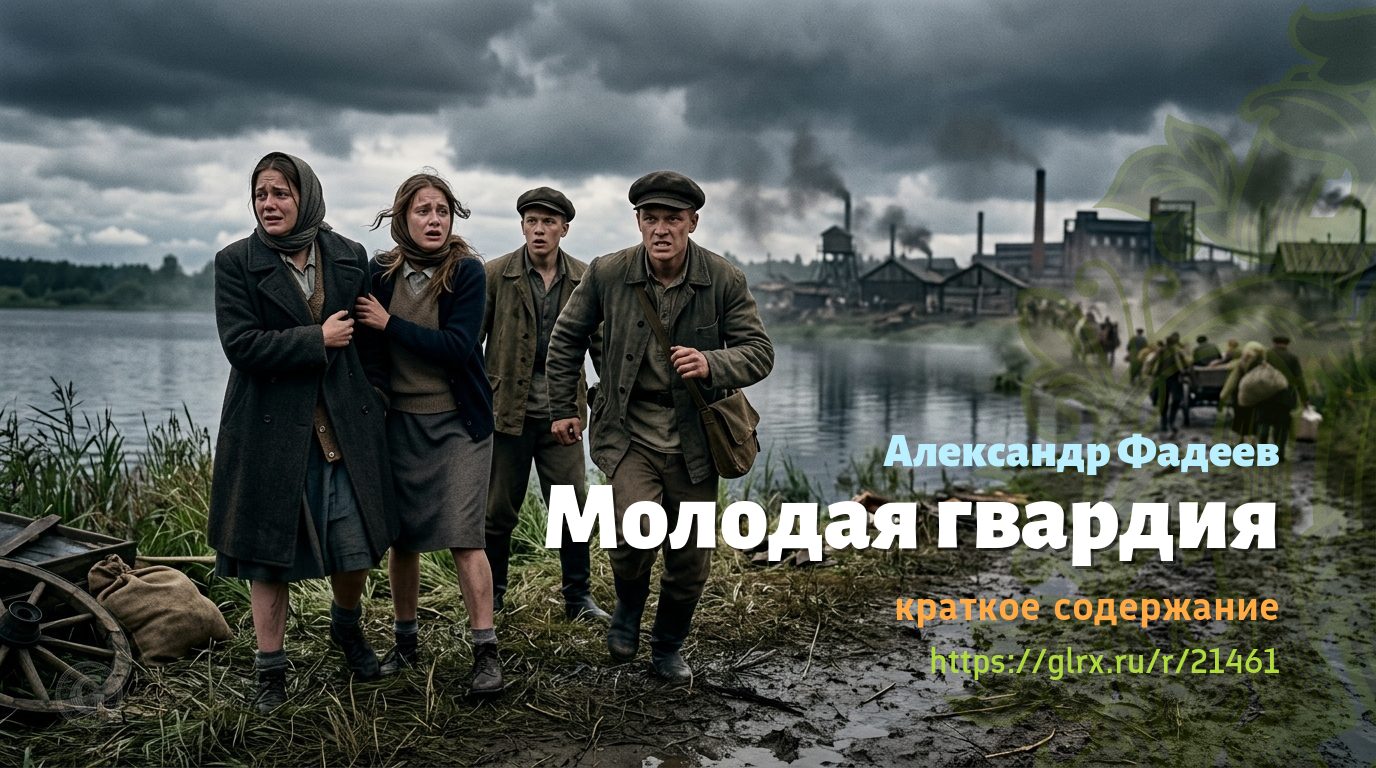
July 1942. The front line is rapidly approaching the mining town of Krasnodon. Ulyana Gromova, Valya Filatova, and Sasha Bondareva are relaxing by the river, savoring the last moments of peace. The girls hear the increasing rumble of gunfire. Mass panic sets in. The roads are clogged with carts, herds of cattle, and thousands of retreating soldiers and refugees.
Mine No. 1-bis director Andrey Valko and miner Grigory Ilyich Shevtsov personally blow up their enterprise. The massive reinforced concrete headframe collapses. People try to escape east. Oleg Koshevoy, Ivan Zemnukhov, Zhora Arutyunyants, and Ulyana Gromova join the dense stream of refugees. Huge traffic jams form at the Northern Donets River crossing.
Enemy dive bombers mercilessly bomb the crowd. The explosion kills the orphanage’s director, and Ulyana witnesses the loss of a little boy’s sight. The enemy’s tank wedges cut off their routes. The Krasnodon residents are forced to trudge back to the captured city.
The first victims of the new regime
Krasnodon is occupied. Officers are quartered in the townspeople’s cozy stone houses. General Baron von Wenzel and his long-legged adjutant are staying in the Koshevoys’ house. Oleg, his mother Elena Nikolaevna, and his grandmother Vera are driven into a cramped barn. The invaders take away food, slaughter chickens, tear down fences, and trample flowerbeds. A systematic reign of terror begins.
Andrei Valko and Matvey Shulga, left to coordinate the underground, are separated. Shulga, betrayed by the self-serving traitor Ignat Fomin, ends up in gendarmerie custody. Valko, who tried to warn the old communist Lyutikov, is also captured by the police. Master Chief Bruckner, Master Chief Balder, and Chief of Police Solikovsky subject the miners to horrific torture.
The communists don’t give up. During a confrontation in the investigator’s office, the beaten Valko and Shulga attack the guards. They beat the gendarmes with heavy chairs and inkwells. They are thrown alive into a deep pit in the city park. As they are covered with earth, the men loudly sing the proletarian anthem.
Creation of a secret organization
The youth of Krasnodon refuse to submit to the enemy. Young men and women begin to fight independently. Oleg Koshevoy, Vanya Zemnukhov, Sergei Tyulenin, and Ivan Turkenich organize a secret society. They name it "Young Guard." Turkenich becomes its commander, and Koshevoy assumes the duties of commissar under the pseudonym Kashuk. By the light of oil lamps, the young men swear an oath to avenge the fascists to the last drop of blood.
In Pervomaika, the group is led by Anatoly Popov and Ulyana Gromova. In the village of Krasnodon, Kolya Sumskoy leads. The underground fighters are collecting weapons abandoned in the steppe. Zhora Arutyunyants, with the help of his father, is building a wooden printing press. Volodya Osmukhin brings back the remains of a printing press dug up in the park.
The boys listen to reports from Moscow on a hidden radio. Every night, fresh handwritten and printed appeals appear on fences and walls. Vanya Zemnukhov writes patriotic poems. Leaflets are even pasted onto the backs of unwary policemen in the market square.
Active sabotage by the Young Guards
The daring and elusive Sergei Tyulenin personally sets fire to the trust building and a former bathhouse, now converted into barracks. Later, he, along with Lyuba Shevtsova and Vitya Lukyanchenko, raids the German labor exchange. Lyuba smears the glass with honey to prevent it from rattling when cut. Seryozha hurls Molotov cocktails into the building. Lists of thousands of young city residents, destined for forced labor in Germany, are destroyed.
Lyubov Shevtsova occupies a special place in the underground. Retained by headquarters as a radio operator, she disguises herself as the daughter of a repressed factory owner. A flamboyant actress, she easily makes friends with enemy officials. She extracts strategic data, steals medications, and pilfers alcohol from an ambulance van. She passes information to her contacts, skillfully concealing her hatred.
Combat squads attack enemy vehicles on the highways. They kill soldiers and drain fuel tanks into the ground. Anatoly Popov’s group silently eliminates a sentry at the Pogorely farmstead. The underground fighters free several dozen Soviet prisoners of war employed in logging operations. Among them is Lieutenant Yevgeny Moshkov. On the steppe roads, the boys recapture a gigantic herd of cattle from the Germans, scattering the animals across the surrounding area.
The death sentence is passed on the traitor Ignat Fomin. Turkenich and Tyulenin hang the policeman from the arch of the city park at night. A plaque listing his heinous deeds is pinned to his chest. On the eve of the October celebrations, red flags fly over the administration building, schools, and mines. Signs reading "Mined" serve as a long-term deterrent to the occupiers.
Fatal mistake and betrayal
To create a diversion, the Young Guards obtain permission from the drunken burgomaster Stetsenko to open a club. Master of ceremonies Yevgeny Stakhovich announces the acts, and Lyubka tap dances. Stakhovich had previously shown weakness and deserted from the partisan detachment during a battle. Headquarters stripped him of his leadership position. The club serves as a convenient cover for secret meetings of the activists.
At the end of December, underground members rob a car carrying New Year’s gifts. Some of the cigarettes are given to boys at the market to sell. The police catch one teenager. Under brutal lashes, he names the club’s leaders. Moshkov, Zemnukhov, and Stakhovich are thrown into ice-cold cells. Zemnukhov and Moshkov stoically endure being whipped with electric cables. But Stakhovich breaks down. Under torture, he begins to betray his comrades.
The police intercept former schoolgirls Vyrikova and Lyadskaya. Fearing for their lives, the girls compile long lists of untrustworthy peers. The punitive force is immediately activated. Police raids are carried out every night.
Arrests and torture
Headquarters orders everyone to leave Krasnodon immediately. Koshevoy, Tyulenin, Valya Borts, and the Ivantsov sisters trudge across the steppe, sinking into the snow. Severe frosts and dense patrols hinder the front’s progress. Oleg goes deeper into the territory but is ambushed. During a search, they find a sewn-in Komsomol card on him. Oleg is taken to Rovenki.
Sergei Tyulenin reaches the front lines. He joins the battle as part of an attacking rifle division. After sustaining a through-and-through wound to his arm, the skinny young man returns to Krasnodon. That night, police break into the Tyulenins’ house. Before the wounded young man’s eyes, the police brutally beat his mother, trying to break his will.
Ulyana Gromova refuses to escape without her friends. Soon, the prison is packed with dozens of young people. Investigator Kuleshov and SS officer Fenbong resort to savage torture. The girls’ hair is torn out, and their bodies are burned with hot irons. A bloody star is carved into Ulyana’s back. Viktor Petrov’s eyes are gouged out. Volodya Osmukhin’s hand is chopped off.
The Komsomol members sing songs in their cells. Ulyana encourages her tortured friends by reciting the poem "Demon." Lyubka Shevtsova calls Master Bruckner an executioner to his face and tap dances in the prison corridor. Their spirit is unwavering.
Execution and immortality
In mid-January, the mutilated prisoners are loaded into trucks. They are taken to the destroyed headframe of shaft number five. Young men and women loudly sing revolutionary songs. Along the way, Anatoly Kovalev manages to untie the bonds. He jumps out of the truck and runs into the darkness.
The rest are led to an ice pit. Many are thrown down alive. A groan from underground can be heard for several days. The Nazis drop heavy mine carts after the bodies.
Oleg Koshevoy and Lyubov Shevtsova are later executed in the forest near Rovenki. As their guns point, Oleg proudly tells his executioners, "It’s not you who are terrible, but what gave birth to you." Gray-haired at sixteen, he dies undefeated. Lyubka Shevtsova sings a Moscow song and takes a bullet point-blank.
In mid-February 1943, Soviet tank units liberated Krasnodon. The surviving resistance fighters — Ivan Turkenich, Valya Borts, Zhora Arutyunyants, the Ivantsov sisters, and Radik Yurkin — stand alongside city residents at the icy mine shaft. Rescuers spend several days recovering their mutilated bodies. The heroes are buried in a mass grave in the center of the city park. A temporary wooden obelisk is erected over the hill with a list of the fallen young men and women. The survivors take a solemn oath to continue the struggle to victory.
- "We Are from the Future 2" by Alexander Shevtsov, summary
- A summary of "The Humanist" by Alexander Shevtsov
- "Art of the East" - a series of lectures from the "Cultural Project" has started in Kiev
- “Eugene Onegin” sounded at the finish of the “Music in the Estates” marathon
- Exhibition of one painting by Jan van Goyen (1596 - 1656) "Fishing boat at the mouth of the river"
- "In Search of Treasure" by Asya Lavrinovich, summary
You cannot comment Why?