A summary of "The Recluses of Altona" by Jean-Paul Sartre
 Automatic translate
This book is Jean-Paul Sartre’s last completed philosophical drama, bringing the heavy burden of the Nazi past and the colonial violence of the 1950s to the locked chambers of a Hamburg mansion. The fate of a shipping magnate reveals the mechanisms of escaping guilt. The play was written by the writer in 1959, during the fierce French controversy surrounding the use of torture by troops in Algeria.
In 1962, director Vittorio De Sica made a film based on the play.
Family Council in Altona
At precisely three-ten minutes past three, the terminally ill shipbuilder Gerlach enters the gloomy living room of his family mansion, crammed with heavy furniture. Doctors have diagnosed cancer. In front of his family, the head of the industrial empire imperiously demands that his youngest son, Werner, swear an oath on the family’s sixteenth-century Protestant Bible, accepting control of the shipyards and a lifelong commitment never to leave the gloomy walls of his father’s home. The feeble heir meekly complies.
Despite her husband’s unquestioning submission, former actress Johanna resolutely protests the family’s voluntary burial alive among other people’s family portraits. Suddenly, the house’s dark secret is revealed. For thirteen years, the eldest son, Franz, has not been lying in an Argentine cemetery, but hidden behind a tightly locked attic door directly above the living room.
The old man’s memory takes him back to the summer of 1941. Back then, the shipyard owner sold the wasteland to Himmler for a concentration camp, after which young Franz hid a fugitive Polish rabbi in his room. His father urgently summoned Goebbels. The SS arrived and cold-bloodedly stabbed the fugitive to death right before the young man’s eyes, helplessly struggling in their arms. In the morning, the volunteer left for the front. The old factory owner persuaded his daughter-in-law to ascend to the hermit’s retreat, hoping to beg for a visit with her beloved firstborn before the imminent funeral.
Tribunal of the thirtieth century
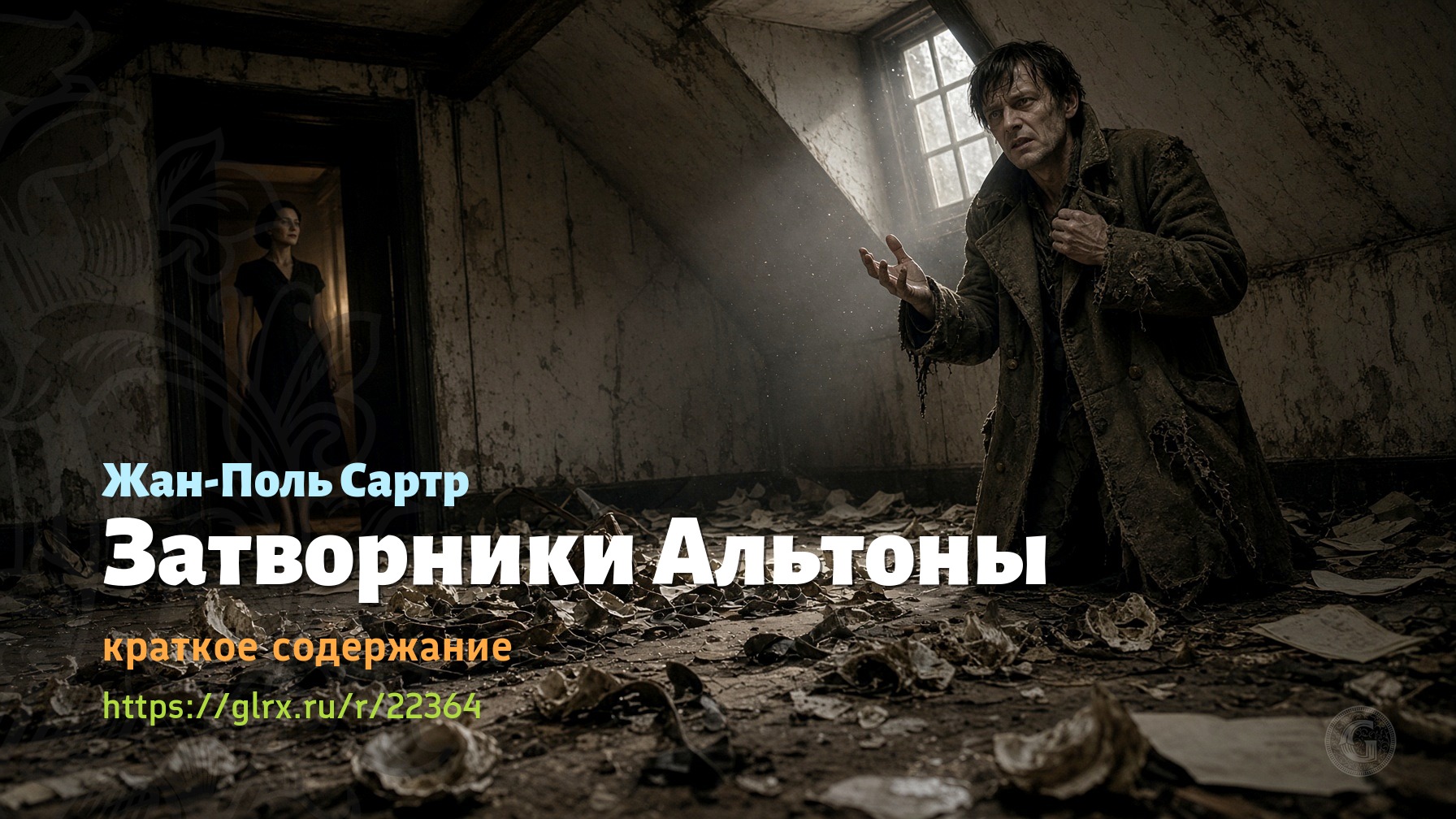
Upstairs, the dim light of a neglected army barracks reigns supreme. The floor is littered with broken oyster shells, fragments of an antique sideboard, and dirty tape reels beneath a faded portrait of the Führer. Dressed in a decaying officer’s uniform, Franz frantically shouts justifications to a tribunal from the distant thirtieth century, populated by giant crustacean judges incapable of comprehending the bestial nature of people in an era of massive, bloody mutual extermination. Sister Leni sweeps up the trash. For thirteen years, the devoted recluse has fed her brother raw shellfish, slept with him, and diligently fueled his insane delirium with images of Germany’s fictitious devastation. A wall poster strictly forbids fear.
At night, a sick mind painfully replays a long-ago episode of the capture of two Soviet partisans in a remote village near Smolensk. Sergeant Major Heinrich demands reprisals. A sharp tap on the oak door abruptly breaks this nightmarish frontline haze. Johann’s elegant daughter-in-law appears. The stunned owner of the room mistakes the beautiful guest for a pure vision, frantically swallowing white benzedrine to save his sanity. The drug temporarily clears his mind. A revolver pointed at his face does not frighten the calm woman who has come to save her husband from the fate of a prison guard.
The woman demands an end to her seclusion. Instead of sympathy, the guest tells the prisoner the truth about her father’s incurable throat cancer, which is killing the old man for the last six months of his life. The prisoner fiercely defends this fiction. With a wandering gaze, the madman shouts out a tale of the total annihilation of German cities by Allied troops, the nation’s agony of hunger, and the complete destruction of industry, forcing the frightened guest to confirm this nightmare for the sake of mutual trust. The officer arranges a new meeting with the guest. Kneeling, the grateful owner of the attic carefully puts on the guest’s discarded shoes and locks the heavy bolt behind her.
The Rebellion of the Younger Son
The old man returns from a short trip. In Werner’s office, his father unsuccessfully attempts to negotiate with his recalcitrant daughter-in-law, who has already secretly visited the recluse in his attic five times. The husband interrupts this dangerous dialogue. Intoxicated by champagne, Werner instantly suspects his wife’s infidelity and is tormented by a painful envy of his older brother. The lawyer smashes a crystal goblet.
Instead of escaping to a free Hamburg, the wounded youngest son demands complete submission, agreeing to become the cruel master of the shipyards he inherited. Jealousy consumes the last vestiges of reason. The rejected Johanna vainly pleads for salvation from the oppressive ceiling, promising her husband fidelity far from the cursed family mansion. The man responds with brutal violence. Breaking free from the embrace of the drunken tyrant, the insulted woman heads back up the stairs to Franz.
Newspaper page and recognition
The gift of a watch reverses the passage of time. The ticking of its hands on his wrist makes Franz painfully count the minutes of Johanna’s delay, shattering the familiar peace of his timeless delirium. His guest finally opens the door. Instead of loving speeches, the recluse feverishly recalls the Smolensk plain, when partisans cut off the remnants of his shattered company from rear supplies. Lieutenant Klag preached purity. Wanting to prove his absolute power over the fates of his subordinates, the senior officer personally took on the interrogation of captured peasants. Franz cold-bloodedly tortured the prisoners. The captured partisans’ refusal to reveal their positions in the face of certain death turned the torturer into an eternal hostage to his own cruelty. The peasants chose to die in silence.
An enraged Leni enters the room with a birthday cake and the latest issue of an influential newspaper. The press extols economic recovery. A huge newspaper spread details the 120 operating shipyards of the Gerlach concern, proving the unprecedented triumph of the defeated nation in the world market. The illusion of Germany’s demise dissipates. The jealous sister openly accuses her brother of the Smolensk atrocities, shattering the remnants of the romantic myth in the eyes of the shocked listener.
The daughter-in-law recoiled in horror. The realization of her beloved’s execution killed the suddenly ignited feeling, transforming the adored hero into a pitiful semblance of a repulsive crustacean. Refusal sounded like a final sentence. Disgusted, rejecting the pleas for mutual forgiveness, the guest forever wrenched her hand from the Smolensk executioner’s. The woman silently left the attic. Crushed by the complete disintegration of his thirteen-year deception, Franz scheduled an immediate confrontation with his father at precisely six o’clock in the evening in the family council hall.
Trip to the Devil’s Bridge
The old man waits for his son downstairs. Franz, descending the stairs, holds a portable tape recorder with recorded justifications for the court of future eras. The father admits to knowledge. Three years ago, blackmailers from among the surviving veterans revealed the crimes of his firstborn son in Smolensk to the manufacturer, receiving payment for complete silence. The old cynic explains the laws of the times. Industrial prosperity came precisely thanks to military defeat, which transformed the defeated nation into the main forge of the European continent. Both acknowledge their own insignificance.
Realizing the futility of further vegetative existence, father and son climb into a high-speed sports car for one last, deadly ride. The car hurtles toward the river. At 180 kilometers per hour, the Porsche crashes through the railing of the Devil’s Bridge and plunges into the cold waters of the Elbe. Leni locks herself in the attic. With heavy hearts, Werner and Johanna silently leave the deserted mansion, listening to the hoarse voice of a tape recorder blaring into the void about a man who has become a wild animal.
- A summary of "The Reprieve" by Jean-Paul Sartre
- Jean-Paul Sartre’s "Baudelaire," Summary
- A summary of "Maturity" by Jean-Paul Sartre
- "The Imaginary: A Phenomenological Psychology of the Imagination" by Jean-Paul Sartre, summary
- "Nausea" by Jean-Paul Sartre, summary
- A Time to Live and a Time to Die by Erich Maria Remarque, summary
You cannot comment Why?