A summary of Alexander Ostrovsky’s "Ardent Heart"
 Automatic translate
"Ardent Heart" is a comedy by Alexander Ostrovsky, written in 1868, published in 1869, and placed in the past because the note that the play took place "some 30 years ago" helped it pass censorship. In January 1869, the play was already staged at Moscow’s Maly Theater, and at its center is the story of Parasha, who struggles to defend love, honor, and personal freedom in a home where fear, money, and domestic tyranny rule.
The action takes place in the provincial town of Kalinov, in the courtyard of the wealthy merchant Pavlin Pavlinich Kuroslepov. The owner is lazy, sleepy, and suspicious: he sees visions of the end of the world and a falling sky, and he is terribly worried about the disappearance of two thousand rubles. Nearby live his wife, Matryona Kharitonovna, his daughter from his first wife, Parasha, and his clerks, Gavrilo and Narkis, while old Silan looks after the courtyard.
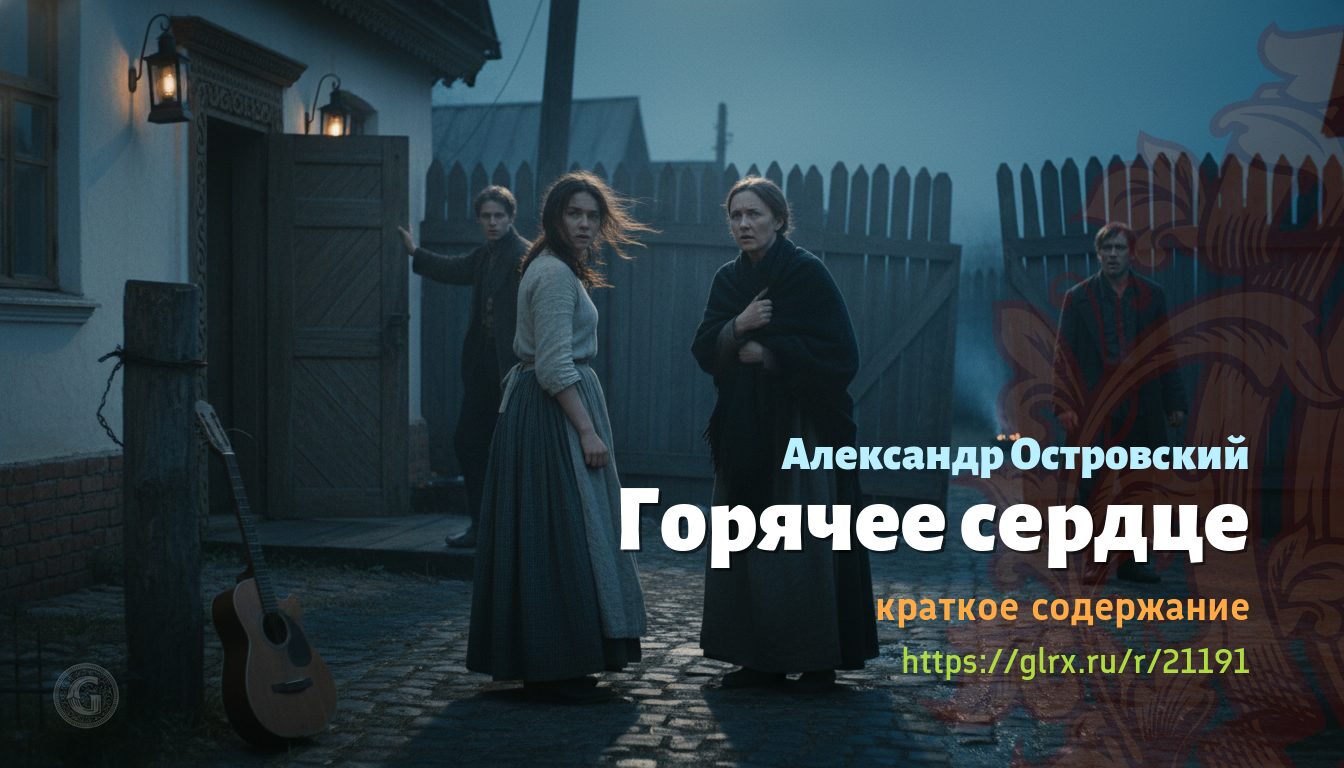
From the very first scenes, the structure of this house is clear. Kuroslepov is rude to people, breaks Gavrila’s guitars, demands the yard be locked, and is suspicious of everyone, while Silan snaps, grumbles, and guards the master’s property in his own way. That same evening, Vasya Shustry, the son of a ruined merchant, sneaks through the fence because he’s in love with Parasha and has become accustomed to seeing her furtively.
While Parasha is away, Vasya tells Gavrila about the contractor Khlynov, who has recently struck it rich and is now spending his money on absurd undertakings, music, boats, cannons, velvet suits, and elaborate parties. Khlynov’s companions are the Moscow Barin, who is essential to his status, and Aristarkh, a shrewd craftsman and inventor who arranges all sorts of amusements for his master and is not afraid to tell him the truth. This story introduces another world to the play — a world of merchant revelry, where wealth knows no bounds and seeks ever new spectacles.
Meanwhile, a dirty intrigue of its own is brewing in the Kuroslepov household. Narkis, the former coachman whom Matryona promoted to clerk, begins blackmailing her: first he demands a thousand rubles, then he demands that Parasha be married to him with a dowry. Matryona fears him because they share an old affair and a shared guilt, while Narkis himself says bluntly that he has no pity and will take everything he can from his mistress.
Parasha returns home irritated and exhausted by the constant surveillance. Her stepmother doesn’t allow her to go out, suspects her of dishonor, and tries to lock her away, but Parasha responds sharply and bluntly: she won’t give up her brief maiden freedom and would rather go to extremes than allow herself to be guarded like a thing. Even in front of her father, she insists that she can protect her honor herself, and that domestic guardianship only dishonors and breaks her.
In the second act, Parasha finally meets Vasya at night. The conversation is difficult: she loves him, but can no longer tolerate the uncertainty, asking him to act immediately and even saying that patience ends in water or in a noose. Vasya hesitates, citing debts, business, and a trip to Moscow. He wants to settle the situation first and then propose or take her away.
It was here that Parasha first clearly saw his weakness. For her, love had already become a lifelong pursuit, while for Vasya it was still a subject of conversation and excuses. After their date, Parasha left bitterly, and Gavrilo, who also loved her, talked about how a woman should be pitied, protected, and made a good life for her, though he himself, too timid, couldn’t say anything properly.
That same evening, the mayor, Serapion Mardaryich Gradoboev, arrives in the courtyard. He drinks with Kuroslepov, boasts of his military service, extorts a future "bristle" for the investigation, and discusses the missing money in the tone of a vulgar comedy, where power has long been mingled with drunkenness and petty greed. When he and Kuroslepov stumble upon Vasya and Gavrila in the bushes in the dark, Vasya is immediately arrested as a thief, and Gavrila is suspected of being his accomplice.
The interrogation proves nothing, but no one needs the truth. Kuroslepov, unwilling to investigate, orders Vasya sent to the holding cell, and then intends to conscript him as a dissolute man. He immediately fires Gavrila from the service, withholds his wages, and throws him out of the house in disgrace, as if the thief had already been found.
When Parasha learns that Vasya has been arrested and may join the army, her despair deepens. Soon she finds herself among Khlynov’s men, who are playing yet another "bandit" game. Master runs up to her as if she were prey, grabs her hand, and confesses that he went into the woods and gathered a gang out of love for her. When Gavrilo tries to defend Parasha with a stick, Master shoots him with his pistol and knocks him down.
Gavrilo, however, remains alive, and Parasha is overcome with terror. Aristarkh, recognizing the girl as his goddaughter, abruptly interrupts Khlynov and Master’s merrymaking, orders Parasha taken home, and angrily declares that it’s not enough for them to abuse defenseless people. It is from him that Parasha learns the extent to which the domestic persecutors have gone: her father, at Matryona’s instigation, was prepared to publicly disgrace her and lock her in a closet for a long time.
These words send Parasha into near delirium. She imagines herself marching into town with the bandits, taking revenge on those who have wronged her, and burning down her own house, just to avoid further humiliation. Aristarkh then relays further news: Khlynov has contributed four hundred silver rubles and redeemed Vasya from the military.
However, salvation turns out to be a new humiliation. Vasya comes to Parasha no longer as a free man, but as Khlynov’s dependent servant: he has taken him into his choristers, effectively enslaving him for a year. When Parasha asks why he took the money and whether he was afraid, Vasya remains silent, picks up the tambourine, and obeys his new master’s commands. For Parasha, this moment marks the end of their former love.
In Act Five, the domestic chaos reaches new heights. Kuroslepov, still half-asleep and awkward, hides the money no longer under his pillow but in a bag of nuts. Matryona continues to fuss, and Narkis once again pressures her, demanding rum, a thousand rubles, and a secret nighttime visit in men’s clothing. By the climax, it becomes clear that Narkis’s place in the house is lost, and Parasha now speaks like the mistress of the house and offers to take Aristarkh as his replacement.
Then comes Parasha’s major choice. In front of her father and witnesses, she first directly reminds Vasya that she once loved him so much that she was ready to become a soldier’s wife and follow him into poverty. But now, when she claims she will have money and a dowry, and when there are almost no external obstacles left, she rejects Vasya because he failed to take her when she was poor and too easily fell into bondage and dancing.
After this, Parasha chooses Gavrilo. She values his loyalty more than his position: she knows this ridiculous, timid, and downtrodden man will love her and not sell her out for convenience or fear. At first, Gavrilo can’t believe his good fortune, calling himself "an incomplete man," complaining that the beatings have knocked the courage out of him, but Parasha stands firm and says they’ll survive, even with the most modest labor, so long as they don’t fall into someone else’s servitude.
Kuroslepov, already broken by the entire chain of absurd and difficult events, unexpectedly relents to his daughter and allows her to marry the man she loves. Gradoboev congratulates the groom and bride, Gavrilo thanks him, and Parasha speaks to her father for the first time softly and kindly, although she reminds him that his daughter’s love must be cherished. The final scene concludes with a quiet scene: Parasha and Gavrilo sit under a tree and stay until dawn, talking heart to heart, as she had long dreamed of, now without guards, without secret fences, and without fear of tomorrow.
- The festival "The Future of Theater Russia" opened in Yaroslavl, bringing together theater graduates
- "Time of Results" by Sergei Voronin, summary
- "Catacombs" by Valentin Kataev, summary
- A summary of "Matryona’s House" by Alexander Solzhenitsyn
- "What you seek is what you find" by Alexander Ostrovsky, summary
You cannot comment Why?