A summary of "Matryona’s House" by Alexander Solzhenitsyn
 Automatic translate
This book is a largely autobiographical account of life in a Russian village. Written in 1959-1960, it draws on the author’s personal experiences, having returned from dusty Asian exile in search of work as a schoolteacher. The original title, "No Village Stands Without a Righteous Man," was changed due to strict censorship. The plot revolves around the everyday life of a lonely, elderly peasant woman, whose personal hardships are accompanied by a remarkable willingness to work selflessly for her neighbors and distant relatives.
Life in Talnovo
In the summer of 1956, the narrator, Ignatich, returns from exile at random, simply wanting to lose himself in the Russian hinterland. He longs to settle in a quiet spot in the forest. The human resources department sends the teacher to the village of Torfoprodukt in the Vladimir region. The name and appearance of the station immediately disappoint him: factory chimneys billow smoke everywhere, a narrow-gauge railway cuts through the dreary landscape, and workers drink and fight with knives in the evenings. His dream of a quiet corner is shattered. At the local market, he meets a woman who helps him find housing beyond the railroad tracks — in the old, patriarchal village of Talnovo, far from the peat fields.
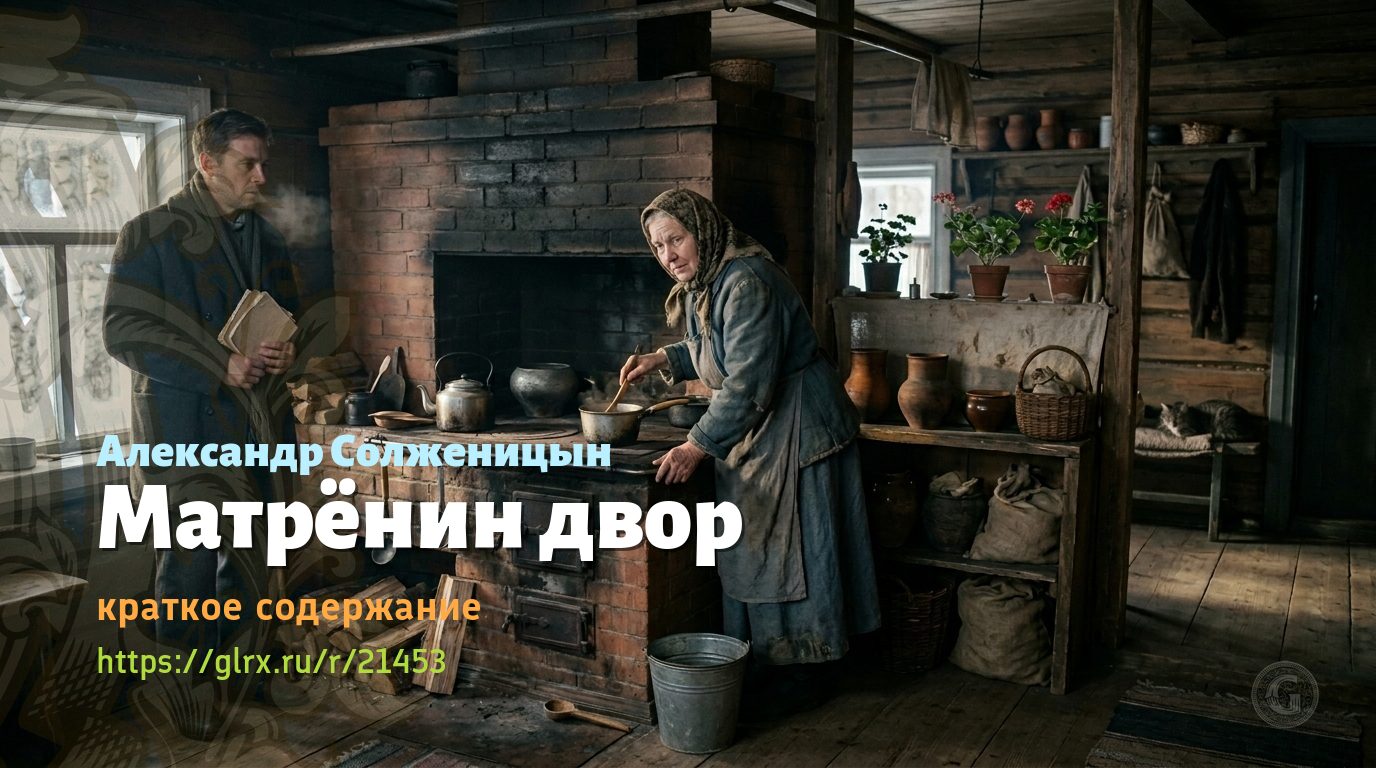
Matryona Vasilyevna takes in a lodger. She’s about sixty years old. She suffers from a serious case of yellow fever and lives in a dilapidated hut with darkened logs. The space is divided into a clean living area and a kitchen behind a wooden partition. The lonely landlady keeps company with fleet-footed mice rustling under the old wallpaper, a lame cat, and numerous cockroaches. Potted ficus plants take up most of the room. The narrator takes a place by the window, laying out his notebooks. The woman rises at four in the morning, greets everyone politely, quietly stokes the Russian stove, milks a crooked-horned goat, and cooks the lodger a meager meal: small potatoes or cardboard soup.
Daily work and hardships
Matryona worked for many years on a collective farm for fictitious currency — labordays’ worth of work in a grimy clerk’s book. No one has paid her in real money for a long time. Her relatives rarely remember the old woman. She has been unsuccessfully trying to apply for a state survivor’s pension. Local offices are located in different villages, ten to twenty kilometers apart. Officials spend months hounding the ailing applicant for certificates, forcing her to rewrite documents because of the slightest comma errors. Each bureaucratic obstacle takes up entire days, filling her everyday life with meaningless walking.
The woman finds solace solely in hard physical labor. She illegally mines peat in the trust’s swamps. Women go there in groups, filling sacks with over thirty kilograms of raw fuel. In winter, this secret stash serves as the only source of heat for the house. Matryona is regularly forced to work for free in the collective farm’s fields. Neighbors also take advantage of her helpful nature, inviting her to dig potatoes or plow their vegetable gardens, harnessing six of them to pull a heavy plow. Matryona never asks for money for her help. She speaks of others’ bountiful harvests with genuine joy, devoid of peasant envy.
As winter approaches, the soulless bureaucratic machine gives in. Matryona is granted a pension of eighty rubles. Together with the school fees for the lodger, she now has real money. She orders new felt boots, buys a padded jacket, and sews a good coat from a decommissioned railroad overcoat. She carefully hides two hundred rubles in the lining of this new coat for her funeral. Her illness temporarily recedes. Occasionally, Matryona listens to the radio with Ignatich, but rejects Chaliapin’s academic renditions of Russian songs. Only Glinka’s old romances suddenly bring quiet tears of tenderness to her.
Shadows of the Past
One evening, a tall old man with a thick black beard comes into the hut. He leans heavily on his staff and says, "Father! I don’t see you well. My son is studying with you." Faddey Mironovich asks Ignatich to improve his son Antoshka’s poor grades. The narrator is forced to refuse, as the ruddy teenager is frankly lazy and completely fails mathematical fractions. After the guest leaves, Matryona reveals the secret of her youth. Faddey is the older brother of her husband, Yefim. Before the war began in 1914, she was planning to marry Faddey. Her fiancé went to the front and soon went missing. The girl lay low and faithfully waited for three long years, while the world was turned upside down by wars and revolutions.
After the death of the brothers’ mother, Matryona succumbed to persistent persuasion and agreed to marry her younger brother, Yefim. The wedding took place in the summer, and in the winter, Thaddeus unexpectedly returned from his distant Hungarian captivity. In a rage, he nearly hacked the newlyweds to death with an axe, but restrained himself only for the sake of his brother. Thaddeus soon found another girl in the neighboring village of Lipovka, also named Matryona. He built a new hut and established a sturdy farm. They had six children, including the youngest, Antoshka. Thaddeus brutally beat his wife throughout his life and was known for his extreme stinginess.
Matryona’s marriage to Yefim was unhappy. She gave birth to six children, but all of them fell ill and died in infancy, before they even reached three months of age. Villagers whispered that Matryona was under a powerful curse. Yefim went missing in 1941. Having lost hope of motherhood and family happiness, the lonely Matryona took in Kira, the youngest daughter of Faddey and Matryona’s "second daughter." For ten years, the girl grew up in this hut as if she were her own. Later, she married a young engineer and moved to the village of Cherusti.
Destruction of the house
Sensing her imminent death, Matryona bequeathed a wooden log house to Kira — a room attached to the hut under a single roof. Thaddeus decides to claim his daughter’s inheritance while she is still alive. The young family urgently needs any structure to secure a lucrative plot of land in Cherusti. One February morning, the cruel old man, along with his sons and sons-in-law, arrives to tear down the house. They enthusiastically tear out the boards, roll out the logs, and number the log crowns. The hut is separated from the hut by a cold, temporary plank wall. Matryona mourns the destruction of the roof under which she has lived for forty years. At the same time, the lame cat disappears from the yard without a trace.
A severe snowstorm delays the removal of the dismantled structure for two whole weeks. Finally, crisp frosts arrive. The engineer’s son-in-law makes a deal with a fat-faced tractor driver to secretly transport the logs overnight. For the sake of greedy profit and saving on freight, they load the entire upper room onto two sleds at once. Faddey is reluctant to provide high-quality lumber to fasten the second homemade sled. Matryona fusses over the workers, helping roll the heavy logs in her old padded jacket. The men hastily drink hidden moonshine in the cramped kitchen and head off into the darkness. The woman, worried about the fate of the coupling, runs after the sled to the crossing.
Disaster at the crossing
Late at night, sullen railroad workers knock on Ignatich’s door. They search for signs of drinking among the scattered stools in the empty kitchen. Later, his best friend, Masha, brings terrible news. A heavy tractor is stuck at an unguarded crossing due to a snapped tow rope. The makeshift sled began to disintegrate right on the rails. Matryona rushed to help the men rescue the trapped logs. At that fateful moment, two coupled locomotives were traveling along the tracks without lights. Coal dust blinded the engineer, who was reversing. The locomotives crushed the machinery to pieces. Matryona, Faddey’s lame son, and the tractor driver died at the scene of the terrible collision.
In the morning, the woman’s mutilated remains are brought in on a regular sled. The village women engage in a traditional ritual lament, filled with hidden hypocrisy and the pragmatics of property division. Matryona’s three biological sisters quickly seize the chest and take the two hundred rubles hidden in her coat. They loudly lament, blaming her husband’s family for their sister’s death. Faddey’s family counter-accuses, defending their rights to housing. Only Kira, the adopted daughter, sobs sincerely, on the verge of losing her mind. Her husband faces imprisonment for illegal transportation. The railway authorities attempt to conceal their guilt in operating locomotives without signal lights.
The gloomy Faddey is completely unconcerned by the death of his own son or the tragic loss of the woman he once passionately loved. The tall old man spends his days knocking on the doors of stationmasters. He tries to save the logs of the ruined upper room from being burned by freezing track repairmen. Having obtained written permission, he gathers his surviving sons and sons-in-law. Taking circuitous routes through neighboring villages, they hastily transport the surviving remains of the log house to their yard, saving their personal belongings.
On Sunday, closed coffins are buried in the church cemetery. The wake takes place right in Matryona’s orphaned hut. Relatives drink honey sita, eat kissel with vodka, and loudly discuss unrelated everyday matters. A few days later, the empty house is officially awarded to a shoemaker married to the deceased’s sister. The insatiable Faddey takes the log shed and the entire interior fence. He transports the old boards to his place on a hand-pulled sled. Ignatich packs up and moves in with his other sister-in-law.
The new landlady remembers her deceased relative with frank, disgusted regret. She sincerely condemns Matryona for her reluctance to keep a greedy piglet, her disdain for fine clothes, and her foolish habit of working for strangers for free. Hearing these harsh, lifelong reproaches, Ignatich finally grasps the magnitude of the deceased peasant woman’s insignificant personality. She turned out to be that very righteous person from the old proverb, the one on whom the entire village, every city, and our entire land rests.
- "Time of Results" by Sergei Voronin, summary
- "What you seek is what you find" by Alexander Ostrovsky, summary
- A summary of "A Holiday Dream - Before Lunch" by Alexander Ostrovsky
- A summary of Alexander Ostrovsky’s "Ardent Heart"
- A summary of Alexander Ostrovsky’s "Family Picture"
- Exhibition "House. Sviyazhsky House"
You cannot comment Why?