A summary of Tatyana Korsakova’s "The Witch’s Circle"
 Automatic translate
Tatyana Korsakova’s "The Witch’s Circle" is a 2014 novel published by Eksmo. According to the author’s bibliography, it’s a standalone book, though it already draws on established imagery associated with witches, shadows, and the border between life and death. The book immediately establishes a tense, unsettling tone and maintains it until the very end, where the detective storyline is inseparable from Arina’s personal drama.
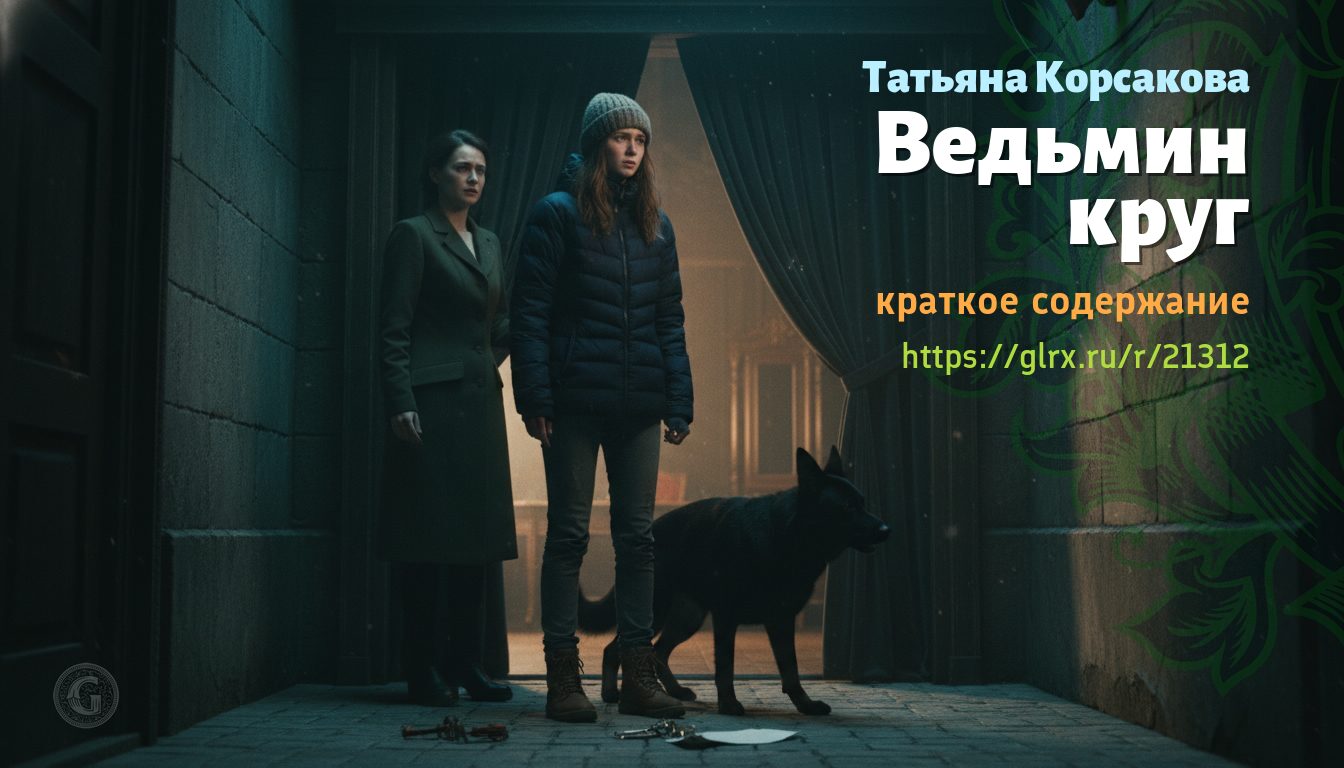
At the beginning of the story, Arina lives with the memory of past shocks and of Volkov, a man to whom she is drawn and whom she tries not to disturb unless absolutely necessary. His gift and phone number remain a sign of an unbroken bond, and so every new danger involuntarily brings her thoughts back to him. Already in these episodes, it is clear that Arina is tired of strange coincidences, omissions, and the feeling that someone else’s will continues to watch her.
Ordinary life finally recedes when Margot introduces Arina to the world of the Witches’ Circle — a closed community of women with supernatural powers. For Margot, this circle signifies privilege, high status, and support, but for Arina, it initially appears as a collection of beautiful words, alien rules, and poorly concealed ambitions. At the circle’s meetings, she sees women of diverse personalities and backgrounds, and it almost immediately becomes clear that behind the outward eccentricity lie fear, rivalry, and hard experience. Anouk, an old and very powerful witch, stands out in particular, and she will later become Arina’s main source of harsh truth.
The mystical environment quickly ceases to seem like a simple secret alliance. Arina and Margo find themselves in a place where even the smallest details reveal that the owner of this strange, closed world has been robbed and murdered, and she won’t be returning. Black, Arina’s dog, constantly appears around them, sensing danger and the underbelly of events before anyone can even name them. From this moment on, death ceases to be an abstract threat and enters the heroine’s everyday life as an almost tangible presence.
As tensions mount, Arina seeks out Anouk and tells her almost everything she knows. She comes to her not out of trust, but out of exhaustion: alone, she can no longer contain her fear, suspicions, and questions about who is hunting the witches and why the attacks are so precise. But talking to Anouk doesn’t yield a simple explanation, because each answer reveals a new layer of mystery, and it becomes increasingly clear that the enemy knows the inner workings of the circle.
At the same time, another thread emerges — an old, almost criminal story about a man his sister once tried to save, having him declared insane. This man shows no remorse and even willingly embraces the image of a murderer, so the past, seemingly left behind, returns to the real world in the form of crimes. Thus, Babai appears in the narrative — a figure on the border between madness, violence, and dark retribution, first as a terrifying trace, and then as a real force.
The cycle of attacks becomes more and more apparent. Flora disappears, and Arina sees her where the police later find no body, and then Sofia is discovered in almost the same place. These episodes demonstrate that the killer is acting consistently, knows how to hide his tracks, and seems to be one step ahead of the usual investigation. Therefore, Volkov, whom Arina had hesitated to approach for so long, once again becomes for her the person without whom it is impossible to connect the mystical part of the case with earthly reality.
Danger looms large when a man with blood on his hands and a knife comes to Arina one night. Afterward, Anouk begins to speak not of individual deaths, but of the very structure of the Witches’ Circle and how the women managed to close it. For her, the question is stark: the circle could have provided protection, but it could also have bound all the participants with a single, fatal thread, through which evil could reach each of them. Arina’s personal anxiety here becomes part of an older, more dangerous pattern, where magical connections are never harmless.
The book then increasingly shifts the action to the border between reality and the other side. Different rules apply there: shadows can speak without outright lying, a tree with carved names preserves the very possibility of existence, and a person can linger between life and death, not yet knowing whose side they’re on. For Arina, the other side ceases to be a foggy nightmare and becomes a place where she seeks answers, pays for her choices, and sees what no one notices in the ordinary world. It’s there that Black’s help is especially clear, as if he’s guiding her to a place where she can still make things right.
By the denouement, the main source of the trouble is finally revealed. Behind the string of deaths lies Salome, in whom the witch’s power is combined with cold lies, envy, and a thirst for superiority. She operates through illusions, conceals her true identity, and destroys the circle from within, using her knowledge of others’ weaknesses. Anouk sees her no longer simply as a fallen member of the circle, but as a creature who cannot be left among either the living or the dead.
The final clash unfolds on several planes simultaneously — human, magical, and posthumous. Volkov is willing to die in Arina’s place, and this choice changes the entire chain of events more profoundly than any ritual. Babai exacts his revenge, avenging his sister, and Anouk uses a special ancestral dagger to burn the witch’s essence out of Salome. After this, Salome disappears completely, and it is clearly stated that she will no longer exist in either the world of the living or the world of the dead.
After the denouement, the novel doesn’t ease the tension, but rather shifts it to a nearly motionless, terrifying scene on the brink of death. Arina sees Volkov wounded but alive: his chest is bandaged, the blood no longer flows, his heart beats steadily. Next to him, she notices her own body — alien, motionless, with a spindle in its crooked fingers — and realizes she is no longer where the living stand. Black lies beside his mistress, as if guarding the possibility of her return.
Anouk tells Arina that she’s not yet completely dead and can return if she truly wants to. The shadow, on the contrary, urges her to leave, promising fairy tales and peace, reminding her that almost no one ever wants to return. Arina chooses not emptiness, but the memory of Volkov, and so her final inner gesture is addressed specifically to him. But the book ends at the moment when the shadow still pulls her away and proclaims that her time in this world is up.
The ending remains open-ended, even though the main battle is already over. Evil is punished, Salomea is erased completely, Volkov is saved, and Arina is left with the most difficult question: which is stronger: the call of death or the connection with those who make it worth returning for. It is precisely this final scene that underpins the entire meaning of the book: the price of victory here is measured not by triumph, but by what remains of a person after an encounter with a shadow.
- Master class "Portrait in monotype"
- A new incarnation of the famous "Salome" was seen in Nizhny Novgorod
- Viktyuk brought to St. Petersburg not only famous performances but also premieres
- A summary of "The Witch’s Treasure" by Tatyana Korsakova
- A summary of "Witch’s Yar" by Alexey Pekhov
- "The Delightful Witch" by Anne Jane, summary
You cannot comment Why?