A summary of Tatyana Korsakova’s "Time of Fairy Tales"
 Automatic translate
This book is a dark psychological thriller from 2016, telling the story of a child abduction by a serial killer who hid his crimes under the veneer of old fairy tales. It is part of the author’s "Stories (Tatiana Korsakova)" series, number 3. This series also includes "All Happy Families," "The Witch and the Astrologer," "Let’s Try It!" and "Butterfly." The plot centers on an unexpected mystical twist: one of the Storyteller’s captives turns out to be the ghost of a long-dead girl who helps the survivors.
Psychological trauma and meeting Max
The main character, Alisa, has a life plagued by severe psychological problems. Visits to a therapist no longer bring relief. Medication was effective only for the first two months, and then the nightmares returned with renewed vigor. Alisa learned to sleep in short snatches and wake up at the first sign of anxiety. Raised in an orphanage, she learned from an early age to forge her own path in life by gritting her teeth and elbowing her way through rivals. Her assertive nature and talent helped her forge a successful career in journalism while still in college. Alisa writes influential articles for major publications.
After a long time, a girl buys her own one-bedroom apartment. On the first day, she brews expensive coffee. The aroma attracts her shaggy neighbor. The guy introduces himself as Max, an IT specialist. He offers a deal: Alice buys him coffee, and he gives her an old German sleeping bag. The girl agrees. A romantic relationship develops between them. Max begins to care for Alice. The guy earns enough to buy a place downtown, but stays in the suburbs for the girl’s sake. Max suggests that they make a nest with Alice. However, a panicky fear of change prevents her from making a decision. Terrible dreams continue to torment her.
Abduction and life in the dungeon
The story immerses the reader in Alisa’s painful childhood memories. Before she was 12, she was in a specialized boarding school for children with special needs. The institution was located in an old count’s house next to a pine forest and a fast-flowing river. The headmistress cared for the students only during scheduled television inspections. Alisa would often sneak off the grounds and sit on the riverbank, watching the grazing cows. One such day, an unknown man placed a spiky bag over her head, threw her in the trunk of a car, and drove away.
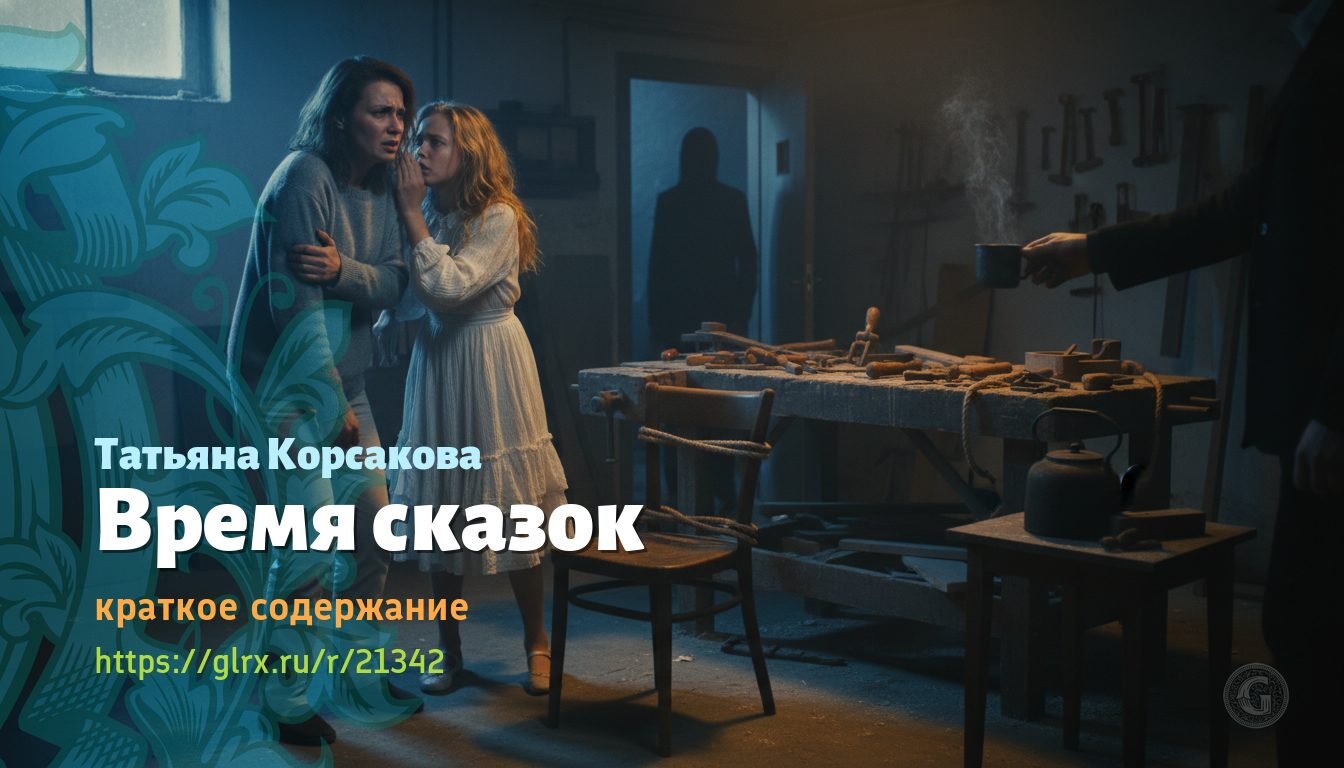
Alice comes to in a cold, dark cellar. A girl named Marusya sits nearby. Marusya is wearing a smart dress with ruffles and constantly combs her golden hair with a beautiful bone comb. Marusya explains the rules of survival: the kidnapper is called the Storyteller, he loves silence, and must not be angered. Soon, the Storyteller himself appears, his face completely hidden by an ugly mask. The maniac takes Alice to the carpenter’s workshop and tightly ties her to a chair. He gives the captives hot tea laced with a powerful sleeping pill. This drink makes Alice lose consciousness, causes severe weakness, and gives her a headache.
The Storyteller shows Alice an old edition of Brothers Grimm fairy tales in a foreign language. The book contains frightening illustrations. The maniac is preparing a new art project. A wooden bed, a carved nightstand, round glasses, and knitting appear in the corner of the carpentry workshop. One day, the Storyteller places a stuffed dead wolf wearing a funny lace cap on the bed. Marusya warns Alice of impending disaster. She explains the terrifying nature of what’s happening: the maniac creates postmortem photographic compositions. All the characters in his staged shots must be dead.
Escape and the consequences of trauma
The storyteller washes Alice’s hair with warm water and prepares her for the final photo shoot. The maniac sets up an antique camera on a tall tripod in front of the bed. He brings a woolen dress, striped stockings, a snow-white apron, and a scarlet satin cloak. Alice is to become the dead Little Red Riding Hood. Pointed shoes lie under the workbench. The maniac is about to give Alice a cup of tea laced with deadly poison.
While trying on the outfit, the Storyteller turns to his tools. Alice grabs a pair of heavy tailor’s scissors from the table with both hands and stabs the maniac in the side. The girl manages to grab an old fairy tale book, knocks down the heavy iron bolt on the door, and runs into the forest. As she runs, she tears off her fairy tale paraphernalia. Alice falls onto the dusty road, where she is nearly hit by a tractor driver. The man delivers the runaway to the people.
The heroine is returned to the boarding school. The headmistress refuses to believe the story about the maniac, the dead wolf, and the kidnapped Marusya. The administration declares Alisa a difficult teenager with delusional fantasies and a tendency toward vagrancy. The girl is injected with sedatives. Alisa undergoes lengthy treatment in clinics. The system forces her to forget the horror she experienced and Marusya’s face. The heroine is left with that same ancient book as her only proof.
Max’s investigation and the discovery of the criminal
In the present, Max finds the hidden book. He forces Alice to tell him the bitter truth. Alice flips through the worn pages and sees the very same illustration of the wolf. The nightmares take on real form. Alice recalls the term "postmortem." The heroes assume that the Storyteller is hunting children again.
Alice uses her professional skills to search for fresh information on missing children. A news report about the disappearance of a 10-year-old straight-A student appears on the news. The girl is the perfect candidate for the serial killer’s latest victim. Max taps into his IT connections. He hacks into networks and finds a photograph of a golden-haired girl in a fancy dress, holding a bone comb. It’s a postmortem photo of Marusya. The image mimics the fairy tale of Rapunzel. Max uses the photo as a digital trail and follows the breadcrumbs to find the serial killer’s lair.
The perpetrator turns out to be a talented photographer from an intellectual family. He recently exhibited his legal work in Berlin. The photographer visited Alisa’s boarding school and took portraits of the children. His grandfather worked as a caretaker on an estate belonging to the German commandant during World War II. The maniac left behind an antique camera and an original book of fairy tales. A terrifying detail emerges: the photographer commissioned a shoemaker to create custom-made red shoes for a new installation. A new, terrifying fairy tale has already begun.
Rescuing the captive and saying goodbye to the ghost
Alice and Max drive a jeep into the forest to an abandoned hunting lodge. Max demands that Alice stay in the shelter. A man enters the workshop disguised as a lost tourist. Max subdues the Storyteller with physical force and ties him up with crude knots. Near the workbench, Alice sees ready-made red boots and a sharp saw for dismembering bodies.
The heroine descends a wooden staircase into a dark basement. A kidnapped girl sits in the corner. The Storyteller’s victim is alive and well. The girl throws herself into Alice’s arms and says she was expecting rescue. She explains that another bright girl named Marusya promised help would soon arrive.
Marusya’s figure emerges from the darkness. The girl is still combing her hair. Alisa realizes the monstrous truth. Of the two, only Alisa has matured and grown up. The real Marusya disappeared 15 years ago while attending her school photography club. Marusya was already dead during Alisa’s first capture. The spirit of the murdered girl constantly guarded Alisa in the basement. Now the maniac is finally neutralized. Marusya thanks her friend, steps into the shaft of falling light, waves, and vanishes forever without a trace.
Time for good stories
The final scene of the novel takes place in early December. Winter brings heavy, frequent snowfalls. Alice is in her new shared apartment. The woman suffers from severe morning sickness. Alice feels nauseous, wants to cry, and craves pickles and chocolate cake. Max is scheduled to be away on a long business trip to an important symposium in Toronto. Alice is preparing to spend several days in utter loneliness and sadness.
The doorbell rings insistently. Max stands there, clutching a large chocolate cake and a three-liter jar of pickles to his stomach. Max explains his sudden return. He fell asleep on the way to the airport. In his dream, Max saw Marusya. The ghost called him a stupid man, completely ignorant of women. Marusya informed Max that now was the time for good fairy tales, so he should urgently buy a certain grocery set and return home. Alice laughed and cried with happiness. She pressed her cold cheek to her husband’s and spoke frankly: "By the way, darling, we’re having a baby."
- Who received the award to them. O. Permyakova this year
- The myth of the mechanical apple (12+)
- "Jacob’s Ladder" by Lyudmila Ulitskaya, summary
- "House in Mansurovsky" by Maria Metlitskaya, summary
- Vladimir Korolenko’s "Marusya’s Farmstead," a summary
- A summary of Alexander Volkov’s "The Wizard of the Emerald City"
You cannot comment Why?