"Dead Island" by Nikolai Svechin, summary
 Automatic translate
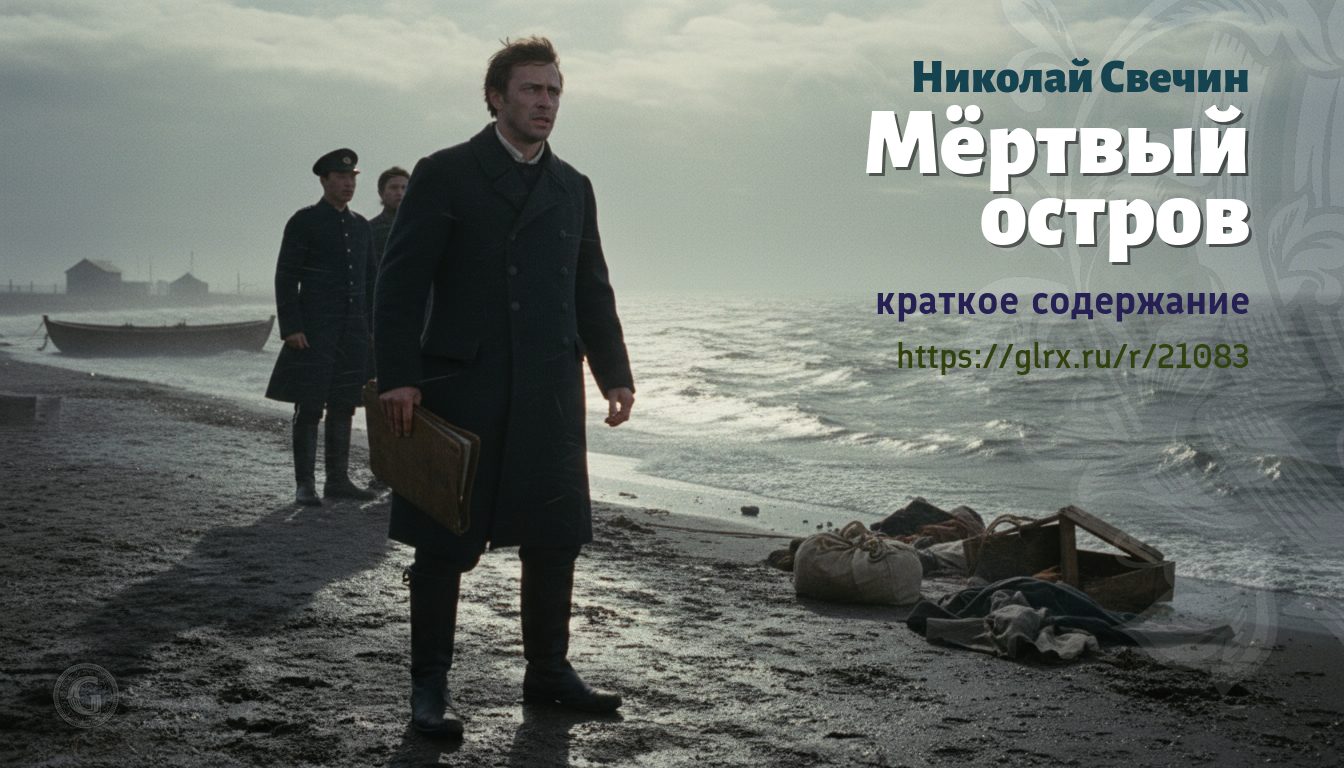
"Dead Island" is a historical detective novel by Nikolai Svechin, published in 2014. Set in the spring of 1889, its main force is not a single mystery, but the entire system of Sakhalin’s penal servitude, where disappearances, forgery, and violence have long been commonplace.
The plot
At the very beginning, Police Department Director Durnovo summons Collegiate Assessor Alexei Lykov, who is grieving the death of his mentor, Pavel Afanasyevich Blagovo, and has almost lost his composure. Instead of a vacation, he is given a difficult assignment to the edge of the empire: in Japan, near Nagasaki, the bodies of three Russian convicts have been found, although according to Sakhalin documents, they are still listed as prisoners. Already in this first conversation, it becomes clear that this is not just a single escape, but a major breakdown in the entire punitive apparatus.
The story of the corpses seems particularly strange because the Japanese servant managed to identify the Russians by their belongings, Consul Kostylev managed to photograph the faces of the dead, and by the time he returned with the police, the bodies had already disappeared from the shore. Technically, the crime was committed outside the Empire, but Durnovo sees a different meaning in the incident: if lifelong convicts end up on the Japanese coast, it means someone on Sakhalin has organized escapes and is covering them up with paperwork. Lykov accepts the assignment and heads to the island, realizing that he will be dealing not with individual criminals, but with an organization in which the law serves as a cover for lawlessness.
Sakhalin penal servitude
The journey to the Far East proves long and arduous, and the arrival on Sakhalin itself immediately dispels Lykov’s last illusions that this is just a routine official trip. The island operates by its own rules: Sakhalin’s governor, Major General Kononovich, reports to the Amur Governor-General, but wields virtually unlimited power locally, meaning every aspect of local life depends less on the law than on the will of the administration. This environment, from the very first days, suggests to the detective that the investigation will have to be conducted not only against the criminals but also against the milieu that feeds them.
Lykov inspects prisons, transit facilities, and settlements, peering into the faces of convicts and officials, and gradually becomes convinced that the penal servitude on Sakhalin has long operated by its own internal rules. He is particularly impressed by the prison’s riot-control devices: Birington points out pipes connected to a steam boiler, through which hot steam can be pumped into the cells, instantly crushing any resistance. This system explains a lot: everything here is built on fear, but it is precisely fear that facilitates secret deals, mutual responsibility, and the authorities’ habit of not seeing what’s right in front of them.
During his official travels and rounds, Lykov encounters a wide variety of people — from officials and guards to exiles who, despite their penal status, prove more useful than many free employees. Among his assistants, Golunov, a penal clerk who speaks to the prison world in a language he understands, is prominent. Through such figures, the novel demonstrates that on Sakhalin, the boundaries between "service," "penal servitude," and "industry" are blurred: a former criminal can be an indispensable assistant, and an official guard can be a participant in a criminal deal.
Progress of the investigation
The further the investigation progresses, the more clearly Lykov sees the mechanism by which criminals subjugate the prison administration. Wardens can be bribed, intimidated, or first driven to the point of collapse by artificially orchestrated unrest, and then offered peace in exchange for obedience to those skilled in "pacifying" the prisoners. This leads to the main idea of the investigation: escapes are not random; they are impossible without people in uniform, without false records, without a cleared path.
Lykov doesn’t sit in his office, but constantly travels around the island, verifying testimony, checking documents, inspecting crime scenes, and risking his life many times. In one scene, he examines the body of a murdered man, notices a bullet lodged in the occipital bone, and removes it himself with a knife, because for him, every little detail could become a clue to a whole chain of crimes. Another time, his anxiety is so intense that he orders the Cossacks to keep their weapons at the ready, and his premonition is confirmed — the investigation follows the trail of people who are accustomed to answering questions with ambush and gunfire.
A crucial part of the case involves paperwork, and it is here that Lykov encounters the most dangerous aspect of the Sakhalin system. He discovers that the convicts he needs seem to be nonexistent: their names have disappeared from the records, they are listed neither among the living, nor among the dead, nor among those transferred, as if someone had erased them from the official map of the island. This gap between reality and the records speaks louder than any denunciation, because the detective is no longer confronted with three successful escapees, but with a well-established system of concealing their tracks.
Escape traces
Lykov gradually comes to believe that the Sakhalin penal servitude is much more closely connected to the Japanese coast than is usually admitted. The suspicion of yakuza involvement, voiced at the beginning of the case, gains more and more weight: the fugitives are being received, escorted across the sea, and used as merchandise, force, or expendable material. In this arrangement, the criminals themselves become pawns, and therefore the deaths of the three men found off Nagasaki appear not to be random cruelty, but the usual consequence of an internal struggle for money, security, and silence.
The detective acts harshly, at times almost to the limit, because the local criminal underworld recognizes no other language. In one poignant episode, he encounters a murderer who, hiding behind a door, demands a doctor, citing illness and attempting to speak to the police as a man already confident of impunity. Lykov’s response is immediate and merciless — he kicks down the door and dispatches his adversary without further ado. This scene isn’t just for show: it demonstrates the intensity of the case and how far the novel departs from armchair detective work.
The last moves
By the end of the investigation, Lykov’s individual observations begin to coalesce into a coherent picture. There are people operating on Sakhalin who are skilled at hiding prisoners from the register, removing them from surveillance, sending them to sea, and then covering their tracks so that everything appears to be in order on paper. This is precisely why the investigation is moving forward on two fronts: it is necessary to understand who smuggled the fugitives out, and, equally important, who within the island administration made them "invisible."
The novel brings this matter to a quiet conclusion, but it concludes not with an official report, but with a human gesture that remains etched in Lykov’s memory. At the end, he receives a letter from "Buffalyonok," who explains that he hesitated to seek permission for his plan because he would have been refused, and the mission required him to disappear from the island spectacularly and without a trace. In a second letter, addressed personally to Alexei Nikolaevich, "Buffalyonok" bids farewell, thanks him and his family for all their kindness, and asks for his memory and prayers — with this note of personal affection and irreparable separation, the novel ends.
- Seaside painter Yuri Volkov presented his anniversary exhibition in Vladivostok
- Melikhovsky Theater went on tour in the cities of Sakhalin Island
- Sakhalin invites comedians throughout the country
- In memory of Anton Chekhov, the exhibition "The heritage of Chekhov artists" is dedicated
- An exhibition dedicated to the Olympics was opened at the Museum of Yuzhno-Sakhalinsk
- Exhibition "View from the twentieth century. Old Russian temple painting in copies of Soviet artists"
You cannot comment Why?