Mikhail Sholokhov’s "Alien Blood," a summary
 Automatic translate
This book is a powerful Cossack drama about parental pain and compassion, written in 1926. A stern old man treats a gravely wounded Red Army commander after losing his own White Guard son in the war, and attempts to replace the dead man with a stranger. Based on the story, director Vladimir Monakhov made the feature film "Uninvited Love" in 1964. The film was a huge success, attracting millions of viewers to theaters.
This book is part of the famous "Don Tales" series. In the complete editions of the series, it is number 24. The series also includes other well-known books: "The Birthmark," "Shibalkovo Seed," and "Aleshka’s Heart."
The Life of an Old Cossack
The story takes place in the village of Filippovka. One winter, a local grandfather, Gavrila, is kept awake at night by the howling of a wolf. The old man coughs heavily. His thoughts wander to his only son, Pyotr. Pyotr went missing at the front. His father personally prepared his son for battle against the Reds. Gavrila sold his oxen and bought a fine horse. He retrieved his grandfather’s saddle. The Cossack ordered his son to serve honorably and not bring shame on the Don.
After Peter’s departure, the Bolsheviks arrived in the village. The old way of life collapsed. Gavrila developed a strong hatred for the new regime. The old man wore wide trousers with stripes and a chekmen with crosses, in defiance of the local Soviets. The chairman of the local executive committee once asked Gavrila to remove his medals. The old man lost his temper and flatly refused. Soon, Gavrila’s resentment grew into deep-seated anger.
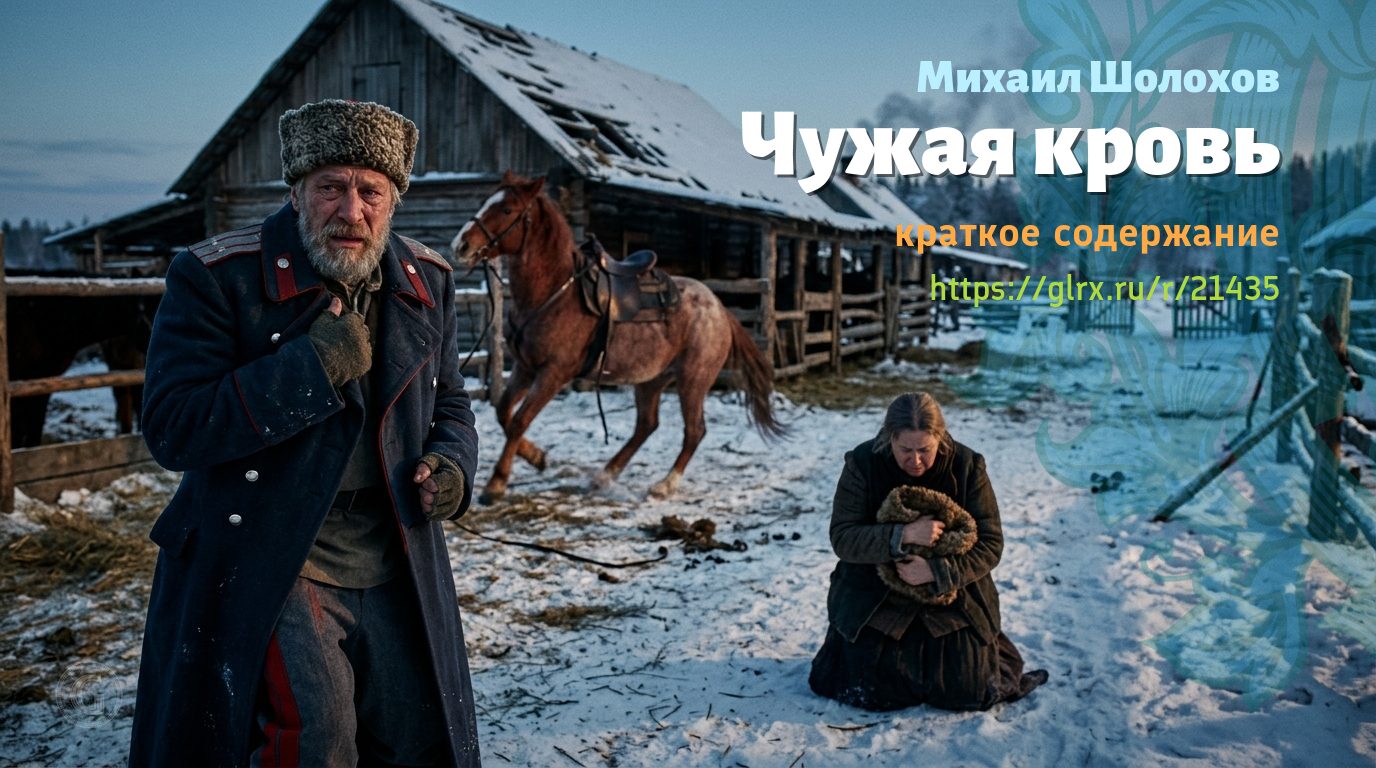
Gavrila’s farm is in severe decline. The barn roofs are rotting, the cattle are breaking the bases, and mice are living in the empty stables. The old man’s last horse was taken by passing Makhnovists. They only paid a couple of puttees for it. The old couple stubbornly wait for Peter. Gavrila sewed his son a new sheepskin coat and a warm papakha (fur hat). One day, he saw his wife kneeling. The old woman was clutching Peter’s fur hat to her chest and cradling it like a child. Gavrila became furious, took the thing away, and put a lock on the chest.
In the fall, Prokhor Likhovidov arrived in the village. He had served in the same regiment as Pyotr. Gavrila hurries to see Prokhor, but only finds him in the morning. The aging guest wears someone else’s clothes and hobnailed boots. Gavrila bluntly demands the truth about his son. Prokhor nervously twists the tablecloth and reluctantly recalls the January near Novorossiysk.
Prokhor tells the old men terrible news. The company was stationed by the sea, and the commander sent Peter on patrol. While they were resting near the forest, the Reds suddenly attacked the Cossacks. Peter’s saddle girth loosened, and the horse jerked to the side. The Cossack fell to the ground. The Reds hacked Peter to death with their sabers. Gavrila refuses to believe the guest. The old man flies into a rage, tears his shirt open, and drives Prokhor away. That night, the mad father goes to the haystack and calls his son into the darkness: "Son!" Then he falls face down in the snow.
Bloody massacre
Soon, three soldiers arrived in the village. They were commanded by a young, blond man. They were carrying out a grain tax collection — demanding that the surplus grain be given to the state. Gavrila tried to be insolent. The blond commander, wearing a yellow sheepskin coat, assessed the supplies in the barn. He ordered the grain to be taken to the grain dump and threatened the old man with a revolver for rebellion. Gavrila, terrified by this clear voice, relented and quietly walked to the porch.
Suddenly, mounted bandits burst into the yard. Sharp shots rang out. The village chairman runs across the yard toward the threshing floor. The food requisitioners fire back with carbines. The mounted bandits brutally hack down the soldiers with their sabers. Gavrila sees a chestnut stallion fly over the fence and trample the people near the haystack. The raiders take the oats for the horses, take the sheepskin coat from the dead commander, and ride away.
In the evening, Gavrila boldly goes out to the threshing floor. Silence has fallen over the village. The old man finds the murdered commander on the fence. Three naked soldiers lie in the snow near the straw. Gavrila approaches the blond young man. The commander’s face seems childish, the fluff of his mustache covered with frost. The old man touches the young man’s bare chest. He suddenly feels a faint, living warmth through the cold.
Gavrila carries the boy’s bloody body into the house on his back. The old man washes the wounded man with cold water, vigorously rubbing his arms and legs with a woolen stocking. A dull, slow heartbeat beats in the boy’s chest. For four days, the wounded man lies unconscious in the room. A terrible scar reddens his face, and his severed chest gasps for air. The old men take turns sitting by the bed. They feed the boy warm milk through a thin tube.
Soon the boy begins to thrash about in a frenzy. He babbles in a foreign language, hurls curses, and shouts commands. Gavrila listens to his delirium and feels pity. The old man watches his wife wither from long sleepless nights. All the mother’s love for her murdered son is wasted on this wounded, strange boy.
New son
On the sixteenth day, the boy opened his eyes. He hoarsely asked Gavrila about the fate of his comrades. The old man replied that the dead had long since been buried on the parade ground, and then learned the boy’s name — Nikolai. Gavrila firmly decided to call him Pyotr, in honor of his son. He spoke softly of this to the young man. The boy understood and fell asleep peacefully.
The boy recovers slowly. Gavrila feels a terrifying attachment to his new son. The face of his beloved Peter fades in the old man’s memory. Gavrila even feels jealous of his wife’s care for the wounded guest. The old woman feeds Nikolai lard and spring herbs. His wounds heal quickly, his cheeks turn pink. Only the broken bone in his right arm is healing poorly.
In the second week of Lent, the boy sat up on his own for the first time. Gavrila asked his wife to get his son’s clothes from the chest. The old man reminded him about his papakha, but his wife had long since prepared everything. In the warm spring, Nikolai walked out onto the porch for the first time. Gavrila carefully held him from behind. The young man drank deeply of the fresh air. He tenderly thanked his father for the grain he had donated.
The relationship between the old man and the new Peter became warm. Gavrila listened for a long time to the young man’s stories about his past. It turned out the boy was originally from the Urals. He was an orphan and grew up near a large factory. Nikolai honestly admitted he was a communist. Gavrila no longer feared that word. The old man fervently begged the boy to stay with them. He invited him to manage the farm and promised to find him a good bride.
Nikolai thought about it and decided to stay with them until summer. He admitted his right arm was crippled, but promised to work honestly. Spring gave way to hot days. Gavrila and Nikolai spent a whole week in the steppe. They plowed the land, sowed wheat, and slept under an oxcart. The white boy completely obscured the image of his murdered son. The old man thought of his beloved Peter less and less often.
Call of Duty
One evening, Nikolai skillfully repairs a lawn mower and leaves for the Council. An old woman brings a dirty, old envelope addressed to Nikolai from the post office. The letter has arrived from the Urals, from old friends at the factory. Gavrila anxiously hands the letter to his son. The workers write that they want to restart the old cast iron factory. They loudly call Nikolai back to his homeland.
The boy is losing weight and suffering from melancholy. At night, Gavrila clearly hears his heavy sighs. While haying, Nikolai tells the old man that he can no longer live in the village. His soul longs to return to his native factory. His friends are starving, but they stubbornly build their factory. Nikolai feels a debt to them. Gavrila realizes he can’t keep the boy on the Don land. The old man asks him to deceive the old woman and tell her he’s leaving for a short time.
On the day of departure, an old cart creaks. The oxen slowly move along the dusty road. The route runs along the banks of the Don. Near a chalk mountain, Gavrila brakes the team. From there, they have to walk about a kilometer. Gavrila hands his son a heavy bag of delicious food. The food was baked by an old woman. The old man sobs loudly. He reaches out with trembling hands, embraces Nikolai, and asks him not to forget their home.
Nikolai limps quickly down the narrow road. Gavrila holds onto the watermelon and shouts loudly after him, begging the boy to come back. The wind swirls dust where his son just stood. A white head flashes around the bend for the last time. Nikolai waves. The bitter thought beats in the old man’s chest: this boy will never come back again.
- Ivanovsky artist Alexander Yachkov presented a personal exhibition
- "An Old Friend is Better Than Two New Ones" by Alexander Ostrovsky, summary
- A summary of "The Jokers" by Alexander Ostrovsky
- Aivazovsky exhibition in the Kiev art gallery
- "Under the blue sky of the East … Collection of Islamic art of the princes Vyazemsky"
- Mikhail Sholokhov’s "Wormhole," a summary
You cannot comment Why?