A summary of "The Path" by Mikhail Sholokhov
 Automatic translate
Created in 1925, this book is a grimly realistic portrait of the Civil War era, depicting profound social divisions through the lens of a young protagonist’s difficult coming-of-age on the Don. The text is part of the "Don Stories" cycle. Sholokhov’s early works from this collection are united by a shared geography and the harsh historical truth of the fratricidal war.
Conflict in the village
The sandy Hetman’s Way stretches along the Don River all the way to the sea. Seventeen-year-old Pyotr Kremnev and his father, Foma, work as laborers, making felt boots from sheep’s wool. The hard labor in the stuffy dugout wears out fifty-seven-year-old Foma. During breaks, father and son eat hot cabbage soup with vegetable oil. The old man sympathizes with the Bolsheviks, awaiting the arrival of the Red Army. A neighbor, the blacksmith Sidor, brings encouraging news of the retreat of the White Cossacks. He was forced to urgently shoe an officer’s horse. Foma firmly believes that a workers’ government will bring long-awaited liberation from poverty.
Soon, a puffy Cossack ensign and Shustrov, the village council’s inmate, arrive at the dugout. The visitors brazenly demand the supply of finished felt boots for the front. Foma refuses to hand over the fruits of his backbreaking labor. The inmate punches the old man in the face, ripping the collar of his shirt. Pyotr, who intervenes, is stunned with a powerful blow to the temple from the butt of a revolver. The ensign brutally beats the old man on the back with a whip until he falls to the dirt floor, bleeding.
A beaten Foma is thrown into prison. Pyotr visits his father in his damp cell. While the guard eats a watermelon and makes a phone call, the exhausted old man talks to his son. The investigator kicked him, but Foma refuses to betray his convictions. Through the pain, he insists, "No, Petyakha, you can’t beat a word out of Kremnev Foma with a fool!" Soon, the boy tells Pyotr terrible news. The young man runs to the office and learns that the Cossacks have publicly lynched his father. The village clerk, Ivan Arsenyevich, dandily adjusting his wide breeches, boasts to the priest’s wife, Anna Sergeyevna, that he personally kicked the prostrate Foma. The priest’s wife lazily scratches her thick calf and listens to the horrific story. In the square, Pyotr finds a shapeless, bloody lump. A few days later, the blacksmith Sidor is also led away to execution.
Warehouse explosion
The front line is inexorably approaching. The dull rumble of gunfire shakes the frozen ground. Pyotr is grinding corn kernels between bricks when his neighbor, Grandfather Alexander the Fourth, approaches him. The old man once publicly declared disrespect for the Tsar, for which he received fifty lashes at the village square. Alexander and his son Yakov plan to secretly leave the village to meet the Red Army soldiers. To weaken the enemy, they decide to destroy the artillery depots of the Second Don Corps. The dangerous depots are located right in the village’s wooden stables.
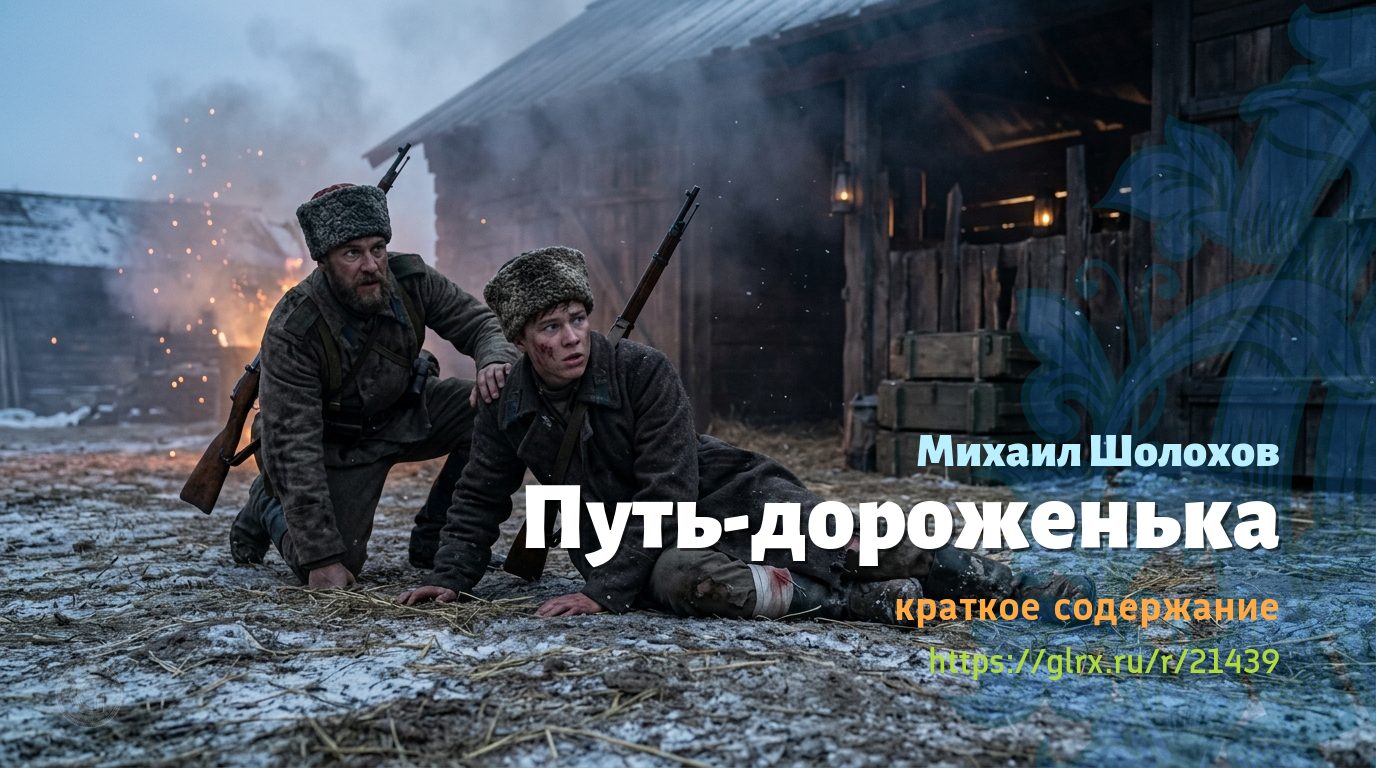
At night, Pyotr crawls across the frozen ground toward the building. The young man tightly grips a flint, tinder, and kerosene-soaked hemp. He manages to strike a spark and ignite the boxes of ammunition. The guards notice the saboteur and immediately open fire. A bullet pierces Pyotr’s leg below the knee. Grandfather Alexander and Yakov grab the wounded boy and help him escape. Powerful explosions rock the village. Warehouses explode into a huge crimson column of flame. The alarm bells wake the sleeping residents.
Three saboteurs take secure cover in a pit under dry dung. After waiting a day, they head along a deep ravine toward the State Forest. The frozen travelers knock on the door of forester Danila Lukich. Inside, a prearranged ambush of three Cossacks awaits them. Bound with hemp rope, the captives are mercilessly led back. Near the outer courtyards, Yakov breaks the rope and dashes into the paddocks. Pyotr and Alexander quickly follow. The Cossacks shoot them in the back. Grandfather Alexander falls, his wounded head buried in a snowdrift.
Yakov and Pyotr miraculously manage to hide in abandoned quarries. For two days, they wander in the damp darkness of old caves. Upon emerging, the blinded fugitives see Red Army soldiers on the road. Yakov bursts into tears and rushes to kiss the horsemen’s stirrups. The rescued Pyotr is carefully laid in a sleigh on hay. A Red Army soldier carefully warms the boy and feeds him chewed crackers.
Clash with bandits
It’s September 1920. Pyotr Kremnev serves faithfully as the secretary of the Komsomol cell. Together with Grigory Raskov, a member of the bureau, Pyotr sets out on foot to the Krutenkiy site. They are tasked with conducting a demonstration land survey. The next morning, the local chairman anxiously warns the surveyors of danger. The neighboring village of Vezhinsky, located approximately thirty kilometers away, is unexpectedly captured by Nestor Makhno’s cavalry.
Pyotr and Grigory try to escape unnoticed. Seeing a detachment under a black banner, they hide at the bottom of a washed-out ravine. The fugitives forcibly take horses from a local Taurian farmer. Grigory’s foaled mare quickly runs out of breath and falls heavily to the ground. Pyotr shoots accurately at the nearest pursuer, but the enemy quickly catches up with them. A slanted Kalmyk hacks the weeping Grigory to death with a sharp saber. Pyotr is brutally knocked down, a hair lasso is thrown around his neck, and he is dragged swiftly across the dusty ground. The young man smells the bitter scent of wormwood and thyme as he loses consciousness from the intense pain.
Meanwhile, Komsomol member Antoshka Grachev gallops off from the village executive committee on reconnaissance. Seeing Makhnovist cavalry, he dismounts and takes safe cover in the church bell tower, inhaling the scent of incense and pigeon droppings. Antoshka calmly shoots enemy machine gunners in the square, spreading panic among the enemy ranks. A Makhnovist sailor attempts to open fire but falls dead from a well-aimed bullet from a young man. In response, the enraged artillerymen roll out a sprawling three-inch gun. With a direct hit from a heavy shell, they shatter the church dome over the head of the brave defender.
In the ranks of the enemy
The battered Pyotr struggles to come to his senses. From the terrible blows, one eye has completely oozed out. The prisoner is brought to the second group’s headquarters, housed in a luxurious priest’s house. The priest’s wife complains about Soviet rule and generously treats the commanders to six-year-old cherry liqueur. A black banner of Ukrainian anarchists hangs defiantly on the wall. A white-mustached commander in a silver papakha sternly interrogates the mutilated prisoner. Pyotr holds his ground, flatly refusing to beg for mercy. The commander praises the young man’s strong character. He authoritatively cancels the execution and enlists Pyotr in his army under the watchful eye of the drooping-mustached Gulyai-Polet soldier, Dolbyshev.
The second group heads for the Millerovo railway station. Pyotr rides in a shaky cart, cautiously testing the soldiers’ morale. Nestor Makhno himself rushes toward them in a cart pulled by four foam-soaked black horses. During a nighttime halt, machine gunner Manzhulo boldly declares that Makhno will soon abandon his troops at the Romanian border. Dolbyshev zealously defends his commanders and obediently goes to inform Captain Kiryukha. The enraged soldiers knock the informer to the ground and brutally beat him with rifle butts.
Soon, headquarters orders the company to storm the brick factory of the nearest state farm. The soldiers reluctantly disperse into a loose line. Near a deep marmot den, Dolbyshev dies ingloriously, shot in the face by his own enraged subordinates. After three unsuccessful attacks, Captain Kiryukha furiously draws his curved Caucasian saber. He tries to rouse the weary men for a fourth attack, but Manzhulo flatly refuses to advance.
Pyotr loudly calls on the soldiers to immediately lay down their arms and stop the fratricidal bloodshed. Kiryukha angrily snatches up his Mauser to deal with the insolent agitator. The young man manages to fire his regiment-loaded rifle first. The centurion falls dead to the darkened ground. Manzhulo stops the soldiers just in time, ready to tear Pyotr apart. The Komsomol member confidently delivers a persuasive speech. He passionately explains that the Red Army will defeat the bandits and preserve the freedom of those who surrender voluntarily.
The soldiers split into two noisy groups, but quickly agree to cease resistance. Pyotr attaches a piece of his torn white shirt to his bayonet. Together with Manzhulo, he boldly heads for the stone fence of the state farm. The soldiers unanimously throw down their rifles and calmly pass through the wide-open gates.
Some of the surrendered Makhnovists seamlessly integrate into the regular cavalry regiment. Petro remains peacefully on the state farm. At a club meeting, the local branch unanimously adopts a resolution. The comrades propose sending the hero to the district hospital and then offering him a good position. The young man rises heavily from the bench. Swallowing tears with his one good eye, he sincerely thanks those gathered. Petro decisively rejects the comfortable life and chooses to return to his native village. He must reorganize the Komsomol. In the dead of night, the young man strides alone and firmly along the frozen Hetman’s Way toward the pale green light of the pentagonal star.
You cannot comment Why?